Suggested Reading
Interview
Event
Robbie Fitzpatrick on Basel Social Club and Welcoming the Barbarians
Peter Bauman
•
September 14, 2026
View


.png)
Peter Bauman (Monk Antony) previews the autumn 2026 art and technology season, from Armory week in New York to ISEA Dubai. As the platforms close and the museums assess, Bauman lays out the highlights month by month, a full event calendar and picks from leaders in the field, including Corinna Gardner, Michael Spalter, Leyla Fakhr, Erick Calderon (Snowfro), Sofia Garcia, Lowbie and quasimatt.
The first half of the year saw the further shuttering of the art and technology space’s digital infrastructure. But this process dates back years. As I discussed with Kayvon Tehranian and Sebastian Sanchez, we are in a digital art post-boom era.
Two autumns ago in September 2024, Sotheby's dissolved its digital art team. One autumn later, Christie's followed suit. The last two years have seen a hailstorm of falling platforms, including Nifty Gateway, KnownOrigin, MakersPlace, Rodeo and Foundation. Earlier in 2026, fx(hash) quietly went dark before announcing its closing in the middle of August.
This Great Platform Shuttering surely has economic factors but it also speaks to something I wrote about in December 2025: how the work that stood out to the panel was more physical and experiential. That trend seems to have only intensified into 2026 and could even signify a generational shift.
In are grassroots and experimental DIY spaces, accession registers and mid-career retrospectives. If the AI doom wave has taught us anything, it’s that the digital condition will consume all, rare books included. Creative expression today must address it almost unavoidably; even by shunning, it comments.
I’m most excited by the weirder, more experimental, grassroots and community-driven projects that require presence and IRL connection. They typically treat technology in a third way, rejecting doom and boom for a sort of room: space and time to shape. They are the community-spaces like AIPS, NODE, Basel Social Club, Glitch France and tiat.
As worrying talk of pace and incidents accelerates, we all get the palpable sense that no one’s at the wheel and we’re careening off the road.
We collectively feel helpless about the future despite incredibly powerful frontier models at our fingertips in the present. It’s a cognitive dissonance at a global and temporal scale.
It’s a cognitive dissonance begging art and artists to navigate it. Roy Ascott argued artists must lead the way with technology. Today, leading the way doesn’t mean blind adoration or equally blind fear. It’s that third way, walking the line between impotence and immortality (and immorality).
We certainly don’t trust tech leaders and politicians to lead the way. Artists must.
It’s about awareness of issues, of systems, of power. Are these technologies being used to make autonomous weapons? We understand they are extractive but so are all legacy industries in our capitalist world. Art is about making these considerations less abstract and more tangible, making them visible, discernible.
Art takes the messiness of the world and makes it more digestible, nudging us to confront these questions ourselves with nuance and openness. In a way that more manipulative actors certainly do with less delicacy and care, or honesty.
Maybe energy extraction, meat eating and AI are related; it’s people like Kate Crawford and Vladan Joler who lead us there. It’s exhibitions like MoMA’s Full Disclosure: The Edge of Information Design, where the public encounters the work and ideas.
So not all is history. The most recent wave of technology in art with blockchains and deep learning is acquiring a proper past, its own history. This past is starting to be canonized and recognized. We are seeing new histories written.
Digital art’s recent past is being institutionalized before our eyes and this is what it looks like.
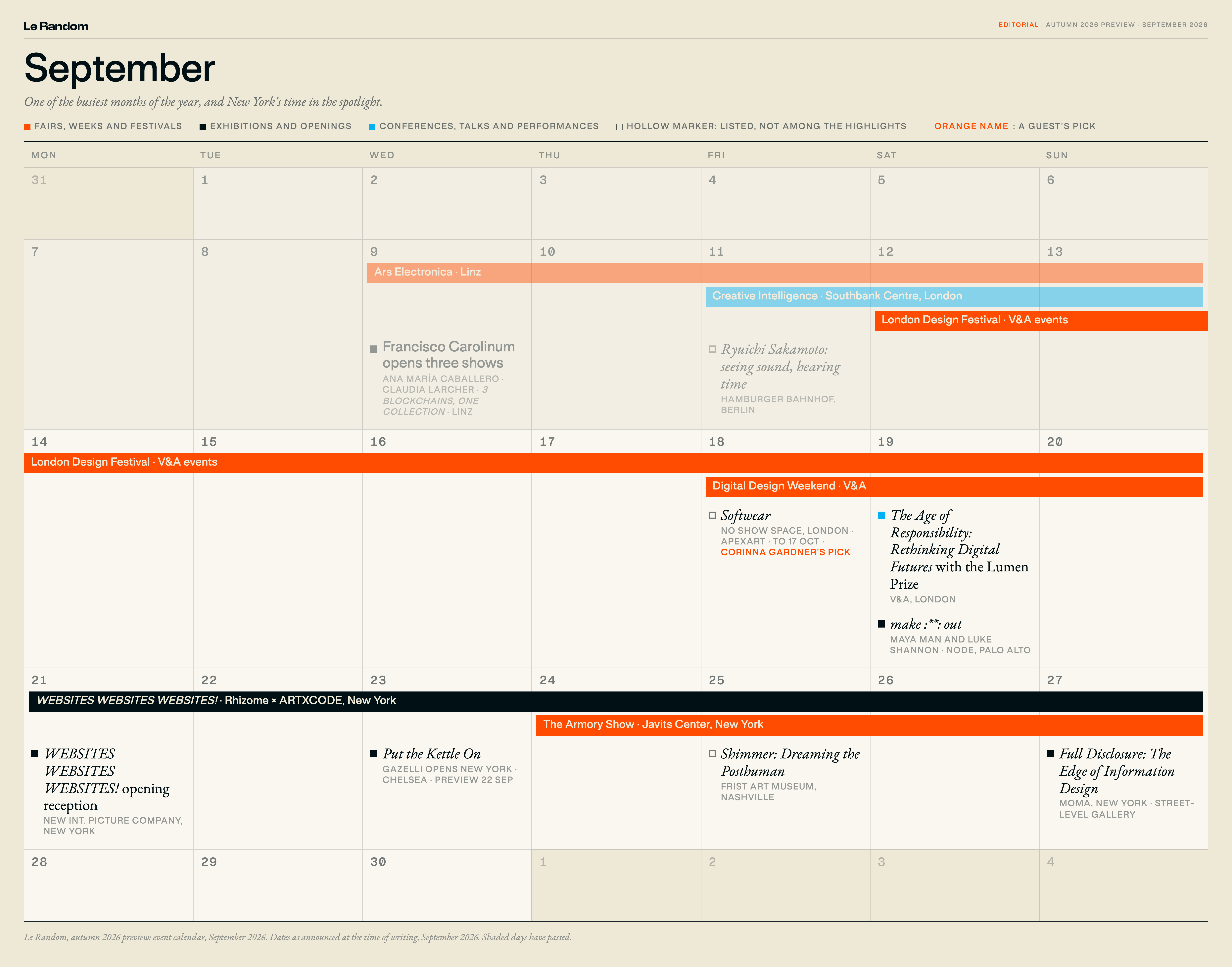
Note these calendars are snapshots. See our Upcoming section for a live, month-by-month planner.
September
Hopefully you stored energy over the summer because September is one of the busiest months of the art year. The first half of the month saw Ars Electronica and openings at the Francisco Carolinum Linz with Ana Maria Caballero, Claudia Larcher and 3 Blockchains, one Collection. It also saw NFT.NYC in its new post-summer slot.
September also sees the V&A kick off its second Digital Art Season, On Agency. Events take place through December 3 and intersect with London’s art calendar. During the London Design Festival, V&A will have its own Digital Design Weekend (18–20 September), hosting The Age of Responsibility: Rethinking Digital Futures with The Lumen Prize on the 19th.
Meanwhile, in the Bay Area on September 19, NODE opens Make Out, a two-person exhibition by Maya Man and Luke Shannon. NODE Palo Alto’s latest show will showcase the duo’s Fortnite video collaboration, Battle Royale Pas de Deux (2026), as well as their individual work.
Across the country, September is New York’s time in the spotlight, anchored by its annual week around The Armory Show (September 24–27) with events and openings from the weekend prior. First to mention is the opening reception of Rhizome’s WEBSITES WEBSITES WEBSITES! (WWW!) with ARTXCODE and LAN Party. ARTXCODE’s Sofia Garcia told me about the show:
“WWW! (Websites Websites Websites!) runs September 20–27 at 39 Great Jones Street during Armory Week, curated by myself with Vienna Kim and Benoît Palop of LAN Party, marking Rhizome's 30th anniversary.
“Twenty artists span three decades of practice on the web, from the playful interventions of 1990s net.art pioneers to the poetic web experiments of artists navigating today's algorithmically saturated internet. Presented as live websites installed physically across the gallery and online, WWW! bridges generations of artists to show how the website remains a radical artistic space: one that belongs to no platform and answers to no algorithm.”
Also during Armory, the London- and Baku-based Gazelli is opening a Chelsea (Manhattan) location with Put the Kettle On, a group show featuring artists like Memo Akten. Finally, at the end of this very busy week is the opening of MoMA’s Full Disclosure: The Edge of Information Design. The Paola Antonelli curated show is on view in the museum’s free street-level gallery from September 27 and features thirty works of digital and analog information design.
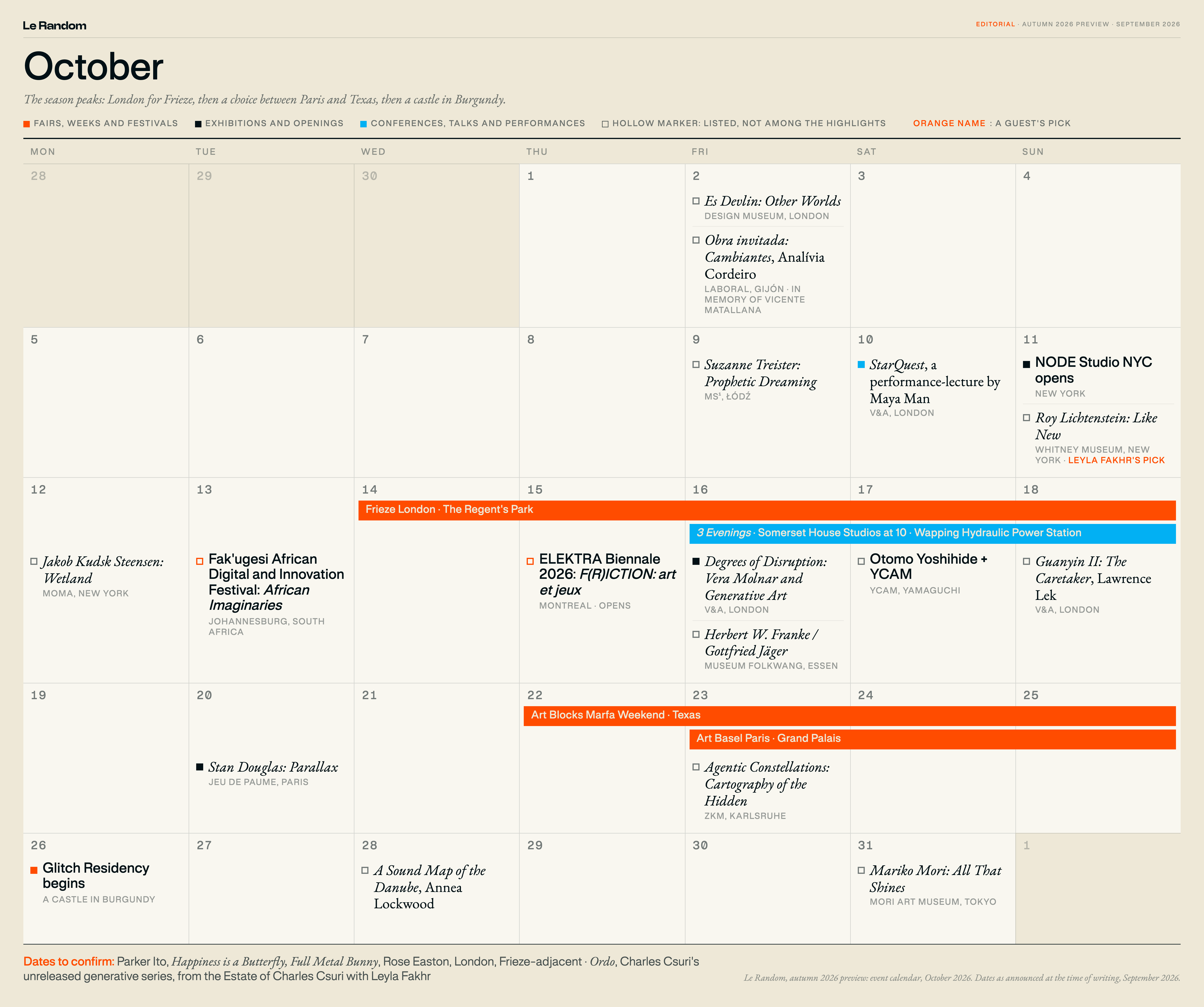
October
Hopefully you’re not too worn out because the season is still peaking in October. If September traditionally belongs to New York, then October’s attention shifts back to London for Frieze week and the continent for events like Art Basel Paris.
Concurrently, the V&A’s Digital Art Season ramps up in October with Maya Man performing StarQuest on Saturday, October 10. The museum’s core event for the season, however, is undoubtedly its Degrees of Disruption: Vera Molnár and Generative Art, opening Friday, October 16. The show juxtaposes contemporary practitioners, like Casey Reas and Licia He, with Molnár.
Sandwiched between those dates and zagging across the globe again is a major stateside opening with NODE Studio NYC. The Palo Alto-based space’s expansion into New York is a step toward fulfilling its name-suggested promise of venues around the world, as its founders shared with me.
But the following week, you must choose: Paris or West Texas desert. Hm, tough choice. Yet both events are world-class: Art Basel Paris and Art Blocks Marfa unfortunately coincide this year over the weekend of October 22 to 25. If it makes any difference, Paris will not feature a new edition of 0 10.
“We're beyond thrilled to welcome folks back to the West Texas desert,” Art Blocks founder Erick Calderon (Snowfro) told me. The annual, days-long art festival in the middle-of-nowhere art pilgrimage town of Marfa draws in the truly committed to code-based art forms.
Super-massive events like Armory, Frieze, Basel Paris and Marfa have gravity that attracts their own galaxies of sub-events to look out for, like Stan Douglas: Parallax at Jeu de Paume, opening the week of Art Basel Paris on October 20.
Finally, the month concludes with what is one of the premier annual art and tech events of any season: Glitch Residency at a Burgundian castle south of Paris. The two-week-long residency organized by Primavera De Filippi brings together a rapturous group of art and technology practitioners in an intimate, esoteric and highly productive setting.
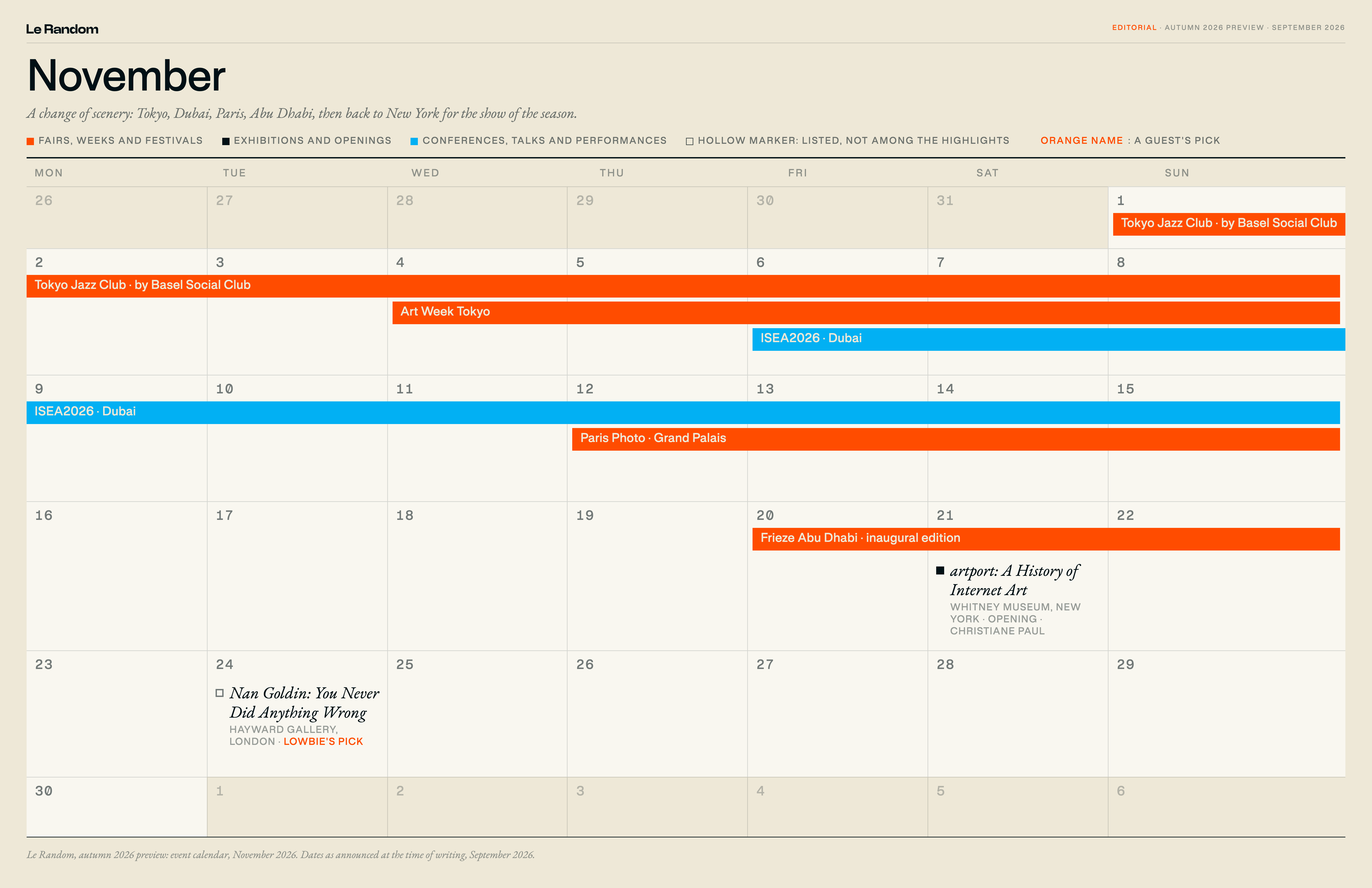
November
November represents a refreshing change of scenery for many of the main events and the intrepid global art traveler. The month’s highlights kick off with Art Week Tokyo November 4 to 8 that will feature the first iteration of Tokyo Jazz Club (November 1 to 8) from Basel Social Club and potentially other exciting sibling sub-events. Next, for the more tech minded is ISEA in Dubai where “electronic / emerging art” meets the energetic region. Fresh off ISEA is the inaugural Frieze Abu Dhabi. Sandwiched between the two is Paris Photo in the month’s middle.
Finally, head back over to New York for the can’t-miss show of the season, Christiane Paul’s artport: A History of Internet Art, celebrating the 25th anniversary of artport, the Whitney's online gallery space for net art commissions known as “gate pages.”
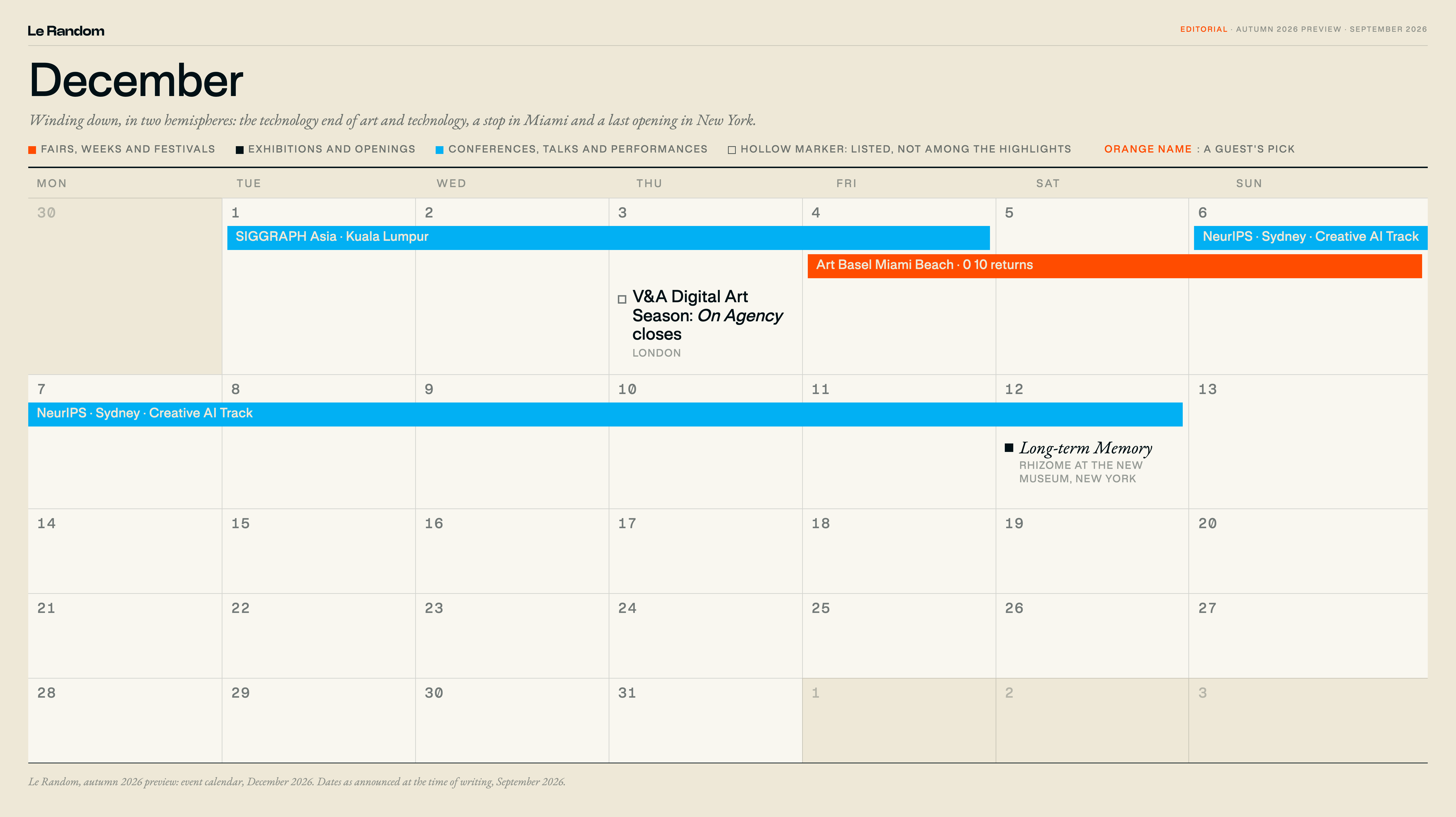
December
By December the “autumn” season is certainly winding down but two major technology events anchor the month's beginning: SIGGRAPH Asia (1–4) and NeurIPS Sydney (6–12). These are two events firmly occupying the technology end of art and technology. But friend of Le Random, Luba Elliott, has been curating and organizing the NeurIPS Creative AI Track for nearly a decade.
But in between the nerd events, perhaps make a stop in stimulating Miami for Art Basel Miami Beach (4–6), which will also see the return of 0 10. Close watchers are keen to see how the section develops a year from its Robot Dog beginnings.
Closing out our highlights of the year, we return to New York as Rhizome’s anniversary programme concludes at the New Museum on 12th December for Long-term Memory: A Short History of the Internet According to rhizome.org.
There are plenty of wonderful events listed with comprehensiveness more in mind in our event calendars above.
Finally, we asked five voices from around art and tech one question: what are you most excited about until the end of 2026?
Corinna Gardner’s choice: Softwear
A great little show curated by Kira Wainstein looking at the interplay between textiles, code and gender through the work of Crystal Bennes, daniela brill estrada & Monica C. LoCascio, Charlotte Johannesson, Steph Linn and Shannon Swinburn.
Michael Spalter’s choice: Vera Molnár: Variations (Radius Books)
This upcoming monograph explores the life and computer-generated, algorithmic art of pioneer abstract artist Vera Molnár, highlighting her use of pen plotters, chance operations and geometric variations from the 1960s onward from her first retrospective based upon the exhaustive holdings of the Anne and Michael Spalter Digital Art Collection.
Snowfro’s choice: Dmitri Cherniak: Ringers in Motion
It's beautiful to see Dmitri's work being exhibited at the Tel Aviv Museum of Art right after Ronen Tanchum's In Bloom, both Art Blocks artists and brilliant generative artists. I'm always excited for any opportunity to bring exposure to the generative medium and the artists working within it.
Leyla Fakhr’s choice: Roy Lichtenstein: Like New
While I've seen a lot of Lichtenstein's work over the years, I'm really looking forward to the Whitney retrospective. He was so ahead of his time, turning to popular culture at a moment when Abstract Expressionism had dominated American painting. Lichtenstein went in a completely different direction: comics, advertising, bold outlines, flat color and images that looked mechanically reproduced. The paintings are just iconic: beautiful and bold. Their simplicity feels particularly appealing now, when we're surrounded by so much visual noise and maximalism. They're so of their time, yet still feel completely fresh. I'm looking forward to simply letting my eyes relish their beauty.
I’m also working with the Estate of Charles Csuri, an artist who started using computers to make art back in 1964. As it happens, he was a contemporary and close friend of Lichtenstein. What I find interesting is that both artists were questioning what art could be, but in completely different ways. While Lichtenstein was turning towards comics and popular culture, Csuri felt that painting and sculpture weren’t enough for what he wanted to explore, so he turned to the computer and began building his own tools for making art. This October, we’re releasing Ordo, an artist-curated generative series whose files were found on Csuri’s computer and had never been released during his lifetime.
Lowbie’s choice: Nan Goldin: You Never Did Anything Wrong
The first time I saw a Nan Goldin film, Memory Lost (2019–2021), I was completely floored. The second time I saw that film, I was floored again. I am assuming that the third, fourth, fifth and sixth times I see her films, at the upcoming Hayward Gallery retrospective where they are showing four of her recent films, will also floor me.
I'm also super excited for Parker Ito's show at Rose Easton in October, for which I have already seen previews. It's all the best of Parker's recent ideas put into a blockbuster Frieze-adjacent show. LOG may have some involvement with zines there.
------
Peter Bauman (Monk Antony) is Le Random's editor in chief.
Special thanks to Corinna Gardner, Michael Spalter, Leyla Fakhr, Erick Calderon (Snowfro), Sofia Garcia, Lowbie and quasimatt.