About us
Stay in touch
Peter Bauman: Hello, everyone, and welcome to this Le Random podcast. I'm your host, Peter Bauman, the Editor-in-Chief at Le Random. And today we are continuing our Friday podcast and YouTube episodes as companion pieces to our Monday editorials. And this week, our Monday editorial was with the wonderful Claudia Hart and her incredible story called Claudia Hart on Land of the Dead. So I definitely recommend you checking out that piece.
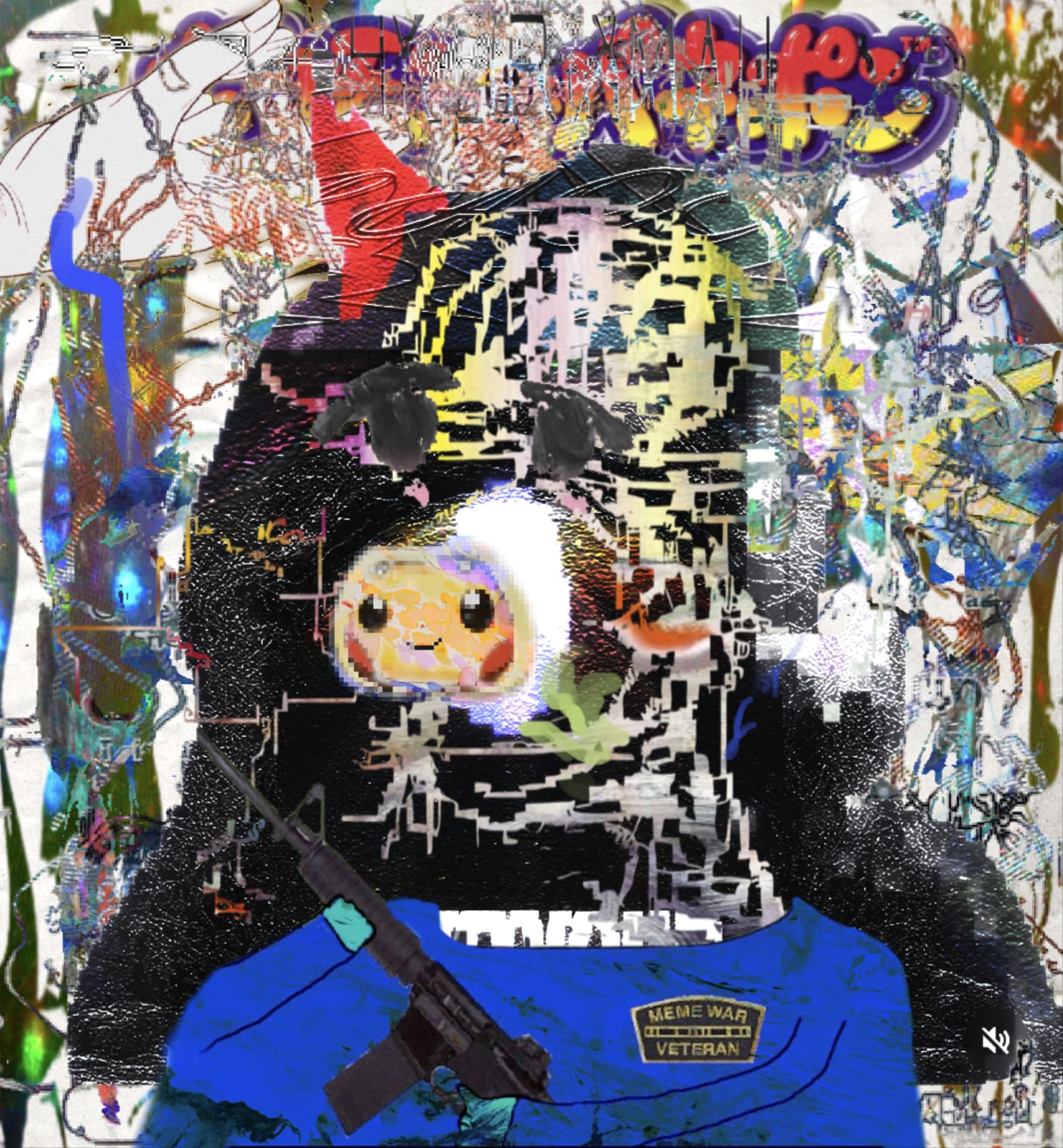
And then in addition to that Monday editorial, we also have a sneaky Friday piece this week with our guests today, Parker Ito and Evil Biscuit. This is about a collaboration that the two of them did that is also connected to the Monday editorial. And it's coming out today, which is Halloween, Friday, October 31st, when this is getting published. So I'm very excited about that collaboration and that piece. So check that out today as well.
But today for this conversation, our guest is Parker Ito. He is this multidisciplinary artist who's associated with coming up in the later stages of net art, but also post-internet, and what was called back around ten years ago, zombie formalism. But now, in addition to this illustrious art world career, he's becoming associated with the Solana avant-garde scene. And that's a lot of what we're going to unpack today. How his image-first, now more generative-leaning practice found this natural home on Solana's artist-led avant-garde scene, where memes and large trait collections along with more subtle, post-AI uses of AI have in some ways rekindled the artist's belief in the idea of an avant-garde.
So I'm really excited to talk to Parker about his work with the Solana avant scene and how it relates to the wider art world and his ten to fifteen year career before this. So I can't wait. We have lots to talk about. Let's begin.
I appreciate you taking the time to chat, and I'm really interested in learning more about your practice, but also how it connects to this Solana avant scene. But one thing that you just said while we were chatting before we started recording, you mentioned San Francisco and LA and the different art scenes. And yeah, I wonder, there's this new venture called Node that's opening up in Silicon Valley that's wanting to maybe make inroads with Silicon Valley investors and try to get them more interested in art. What do you think about the Silicon Valley art scene, and why is it such a challenge for artists and collectors to seem to be on the same page there?
Parker Ito: Yeah, I mean, I guess it's sort of like, entering just from the purely contemporary art side, or the trad art world side, it can take a lot of education to get into stuff and kind of know what to collect. And a lot of that money is kind of nouveau riche money that maybe doesn't have, in traditional collecting, in traditional old money, there's a kind of lineage of collecting. Often the parents collect and the children collect, and maybe some idea of patronage, or taking on involvement in the arts as a duty. And I just don't think that really translates with the Silicon Valley people.
Also, on a taste level, the stuff that they are interested in is really, a lot of it's quite bad. The first thing that comes to mind is that sculpture that Mark Zuckerberg had made of his wife. It's made by a kind of well-known artist, I guess you could say, but someone that, really the quality of the art is not very good. And it feels like, yeah, it's kind of, I mean, this takes place of course in the art world with even serious collectors, that it is like a name associated with it, but it's not necessarily a [unclear] thing.
But I think also there is just the larger infrastructure available, or the larger kind of art ecosystem in the Bay Area. It's a very provincial mindset, and I think that that probably also has an impact on how people learn about art, or what they're exposed to in the Bay as well.
Peter Bauman: I wonder, what do you think would help the infrastructure? So maybe not talking specifically about Node, but if there were to be a way to do that.
Parker Ito: That was trying to just theoretically get at that Silicon Valley money. There was a big push in 2017, 2018, maybe. Commercial galleries. Yeah, when SFMOMA reopened, right? And SFMOMA sort of took on the Fisher Collection and they redid the museum. And I was here for the opening of that, even though, so I went to school here. So I have ties to the area's art scene. I had not spent really much time after graduating coming back here, maybe once or twice. But one of those trips was coming back for, my friend had an opening at the Wattis, which is an institution attached to California College of the Arts, which is the school I went to.
I mean, even the Wattis for a long time has felt really at odds. The kinds of projects that the Wattis was showing was really unique. And it was the only place in the Bay Area that you were kind of being exposed to that. And I feel like they've had a lot of resistance from the school, CCA, for a long time.
But so there was kind of this big promise that, yeah, with the reopening of the museum, it was going to, I guess, change the conversation around the museum. Maybe that's kind of a world-class museum. And then that would mean that these new galleries should open here. Gagosian, Pace, like, literally opened in Silicon Valley. The majority of the galleries were in the city. Pace opened an outpost. But yeah, they closed it down and all those galleries have left. It's hard to say what went wrong there, but it's just not the interest.
Peter Bauman: Yeah, I mean, it'll be interesting to see if, I guess, about a decade later, and now if a different approach, it's not a commercial gallery, it's more of a space and a foundation, that would be any different. But I guess I ask because I feel like your work could be part of some kind of long-term solution, because it really speaks the language of the internet, like a lot of the Valley does, and it knows the culture and can reference it. And yeah, it seems fluid in a language that a lot of maybe other contemporary art may not be. So that might explain also why they're not as interested, because maybe just work in general, it's maybe difficult for them to find work that does speak to them, but maybe isn't just like coded math work or something.
Parker Ito: Yeah, I mean, so much of what they are is just a kind of rehashing of the Mission School aesthetic, which is kind of this naive, clumsy style of art, and very handmade. And yeah, I don't think that that art is appealing to Silicon Valley types at all. But the kind of art I make has really not been embraced in the Bay Area at all. And when I was in school here, I always felt at odds. And even now, when I first started dating my girlfriend a couple of years ago, I was like, all right, I'm going to get back into the Bay Area art scene after being here for a little while. I was like, no, that's not happening. It's just a different mindset. And I don't really care that much about participating in it.
Peter Bauman: Is it a painter versus mixed media divide, that sort of thing? Or is...
Parker Ito: It's just so much as people like Barry McGee, Margaret Kilgallen, stuff that kind of came out in the 90s, I guess, early 2000s, kind of in tandem with graffiti culture and stuff like that. So it's a very, it's kind of folky and naive. And it doesn't really care about the internet, I guess, or technology. Not that that's even important. But it's even the way that it's a looking-back kind of approach to art, I guess.
And the Bay Area, so there's a current, they do a show at the Yerba Buena Center for the Arts every couple of years called Bay Area Now, and this year I think it's actually called Bay Area Then. And it's just kind of a recap of the Mission School. I mean, I haven't seen a ton of reviews on it, but I know there was one review by kind of one of the main critics in San Francisco that just kind of ripped it apart and was like, essentially, this show is a microcosm for why the Bay Area art scene is sort of backwards thinking, I guess.
Peter Bauman: Yeah, I can certainly understand why something with a neo-folk aesthetic wouldn't appeal to Silicon Valley workers, or even especially a younger crowd in the Bay Area. And I think it's interesting to contrast that to how you feel about the Solana art scene, or yeah, whatever this avant scene is. Do you see the energy of this space in contrast to the traditional art world, especially from the Bay Area, that's a little more focused on the past and past styles and kind of recreating past styles? And then the Solana avant scene, it seems like actually something maybe new that's happening.
Parker Ito: I mean, my whole thing is that what's happening right now, the Solana scene, is totally the new vanguard. When I came up and was a part of the sort of net art scene, I really believed in an avant-garde. And then I would say as I transitioned into the mainstream art world, I really stopped believing in that. And this has really reignited something in me that kind of believes that this is in line with that tradition, and what we're seeing now in Solana is a new kind of art that's not been made before. I think aesthetically, I think the tools that are being used, I also think the way that the art just functions in the world.
I mean, I've said this in past interviews, but this is the first truly memetic art, I believe. That to me feels like a kind of continuation of the whole post-internet project, or that's the next evolution of that, right? It's art that sort of mimics the internet, and now it's art that just is the internet.
So yeah, and then obviously this all happened organically too. This is not a group of people that has been sort of lumped together in a market sense. There's no kind of curatorial support. No one in the art world even knows about this. People in NFTs don't even know about it to some degree. It's only been really recently. I've been in this scene for a year and a half, but it's been going on a lot longer. Not a lot longer relative to other things, but in, I guess, internet time, it's probably a three-year-old-plus scene. And yeah, there's a lot of new people from the Ethereum space that have really taken notice. I think it's offered something really new and unique, and it has a kind of energy that I think a lot of art is just missing right now, especially in the mainstream art world.
Peter Bauman: Yeah, it does seem, at least from maybe the Ethereum collector's perspective, there seems to be those couple of years of a lot of abstract generative art that was made with a random number generator of some kind, and there was a lot of interest in that. And then there's been a lot of interest in AI, and I don't think that's going to go away, and I don't think the code-based work is going to go away. But it at least seems like now what's happening on Solana is mostly figurative, and it isn't AI-based work. So it doesn't have that kind of baggage of AI.
“It's art that sort of mimics the internet, and now it's art that just is the internet.” — Parker Ito 11:04
Parker Ito: I think I would sort of counter with that. I think the applications of AI are just much more creative and maybe subtler sometimes. I mean, Little Spy World was made with AI, and there's a whole long thread. I think maybe Matter wrote the thread. Somebody wrote a thread about the way that the AI technology was used, and it was a really creative use of AI.
I mean, I use AI in my work. Burger Fund, I don't know if you know that project? That's all AI. Live with Juni Coin, that's all AI. I just think the applications are different, and it's not about it being AI. It's just another tool that people recognize to kind of make new things. But it's not indulgent in the way that other stuff can be, with any kind of tool, really.
Peter Bauman: I guess it's work that is already seeming to be post-AI in the sense that it doesn't, yeah, it's not really drawing attention to the fact that it uses AI in any way.
Parker Ito: Yeah. I think work like American Artist is really interesting. He does a lot of that with his installation work. It would just be installation, but there's an element of AI. It's not necessarily what they're drawing attention to, but it's baked into the work in an almost indistinguishable way.
Peter Bauman: And yeah, I think that that does seem to be like a post-internet or a post-AI approach to thinking about those technologies. And I also brought up the differences between the Solana and ETH community. So that's something that I never really thought about very much, but then the more that I've talked to people in this Solana community, the more that I've gotten a sense that that distinction, and how a lot of people in Solana see themselves as different from the ETH community, is important. And yeah, I just wonder how you see those differences between the communities. Or have you experienced firsthand any other differences between them?
Parker Ito: Well, I mean, the Solana scene is primarily artists. There is people who are, I guess, collectors in a kind of traditional sense, but primarily it's like you're making art for other artists. And the ETH space, I feel like it's much more collector-heavy. Of course there is artists that supported my projects, and that's how I met a lot of the Solana people. But yeah, it's really like a for-us-by-us mentality, I guess. I mean, the people also are a lot younger in the Solana scene, I would say.
I don't know. Let me think. I mean, I do feel like there's a lot of differences in how the projects are constructed and how they're kind of meant to be understood. Because when I was doing the Verse project, there was a kind of back and forth discussion about supply and size of the collection. And originally we were going to do a collection of a thousand. That was kind of a big collection for Verse, you know? And that for me, based on kind of just the Solana stuff, that's like a medium-smallish collection. Like now, it's not as [unclear]. It's like, oh, I'm going to do a really large collection. But a lot of the really important collections in Solana, they're all like 10K size, or like 3K, or a lot of them are over a thousand.
And I remember when I was doing my project with Zine, even though that was on Ethereum, it was the first time I was experiencing all of this Solana stuff and discovering it. It was the first time I had used HashLips before. I was talking to a friend who had been following a lot of the work in the Solana scene. He was kind of talking about how I should make a larger collection, I should embrace things kind of being more unrefined and ugly, and I should not try and have everything kind of lined up perfectly. And that's kind of the point in a way, you know?
And so it's like you're making a project where, especially with the Zine project, because it was so large, maybe one out of every 25 images, 50 images is a success, right? And then the rest of it is kind of exposing the process, has experimentation built into it, is maybe not a kind of complete artwork in a traditional sense. And I think that's a huge thing that now just feels like it's kind of second nature to me.
And that also has to do with the price points, because in Solana this stuff is a lot cheaper. There's stuff I bought on the secondary market where I couldn't buy as much of it because I got in late, or it was a collection that came out a couple of years ago. But most of the stuff that I've minted since I've been in this space that was like on the launch day or whatever, I've bought probably 10 at a time or something, right? And so also most of the mints are blind. And so it is kind of this thing of, there's kind of a gambling element also. The Solana, the trenches, the shitcoin stuff, it's all adjacent. Like there's something there.
Peter Bauman: Less than 5,000, right?
Parker Ito: 2,500, yeah.
Peter Bauman: Yeah, those collections seem to be able to, Punks, I mean, even Punks is 10,000 too, but the number of traits that something like Drilady has dwarfs Punks. And I think that that really explains some of the difference between the two projects. But I also wonder if there was something to the fact that a lot of the artists on Solana seem to have a painterly background, or an interest in painting, or an interest in art history. Have you noticed that in your experience with the space? And of course, your own career supports that.
Parker Ito: I mean, yes and no. I think one of the differences is that there's kind of this idea in art school that you need to make things, to then refine those things, to then finally be able to exhibit those things. And I've always been very against that idea. I think that showing is kind of the most important in a way.
And I mean, I don't think it should override making always, but I think in those early stages of developing a kind of artistic voice, you should just be showing as much as possible. And I definitely had friends in school who really did. They felt always like they weren't ready to show, or they didn't think the thing was refined enough. And I kind of always just thought that was a bad way to approach art making.
But if you're in art school and you make some stuff and you have a show, not that many people are going to see it. It's kind of a local community, maybe online. But when you make a collection, there's potential for a lot of people to see it and to collect it and to kind of think of it and pay money for it also. That's a huge difference, right?
And I've heard some people talk about this before. This kind of like, a lot of these Solana people didn't consider what they were doing art maybe when they initially got into it. And then kind of when they realized, oh, someone will pay money for this, I think it changes how they kind of think about what they're doing.
So I would say that I think it's kind of been for a lot of people that kind of read the manual as you're going along. So I don't know if they got into it with specific art historical knowledge, but maybe kind of discovered it through the process of making. And then said, oh, here's something I've made, but here's the kind of historical artist that is doing something similar, or something that relates to what I'm doing. And so, yeah, I think it's like a different kind of flow of information. I don't think it's, some of these people do have arts degrees, and I think a lot of them are sort of burnt out by what contemporary art has become. It's not a linear historical knowledge, I think, in the way a classic art school education is. I think that impacts the way it looks also.
Peter Bauman: Yeah, certainly. Maybe not an art historical, or not necessarily an encyclopedic art historical knowledge, although there are references in a lot of the work. But it seems more just an interest in composition and some of the more classical ideas of aesthetics and a painterly style. I guess even those [unclear], people like Evil Biscuit, with Trafella 2 and Trafella 3, and Drilady, I mean, these are very painterly collections, I think, or at least they offer moments of a lot of painterliness. And I think that was intentional. So that's always something that I've thought kind of separated this scene a bit from, yeah, I mean, I think that's the more coder-engineer side, I guess, of the art movement, of the fine art movement that's developing here.
Parker Ito: I mean, yeah, there's not really been a Solana NFT project that's been a coded kind of thing. I mean, that I think also, from what I understand, has to do with the complexity of Rust, which it's a lot harder to program in Rust, I guess. But yeah, I was actually talking to Biscuit about this the other day, because yeah, that's the thing.
But these like psychotic images that I've never seen before, that's like a world that I can enter, where the point of entry is much more straightforward. And I think that was a big, it's really dumb and simple to say that, but at the height, when the NFT bull run kind of happened, I just didn't give a shit about NFTs at all. I think because a lot of that, because I have like PTSD from market speculative shit from the art world, with paintings being flipped at auction. But also just, yeah, because there was specific aesthetics associated with it, but also a kind of reverence for the tech that I think came along with that. And the Solana thing, it's like primal and gets back to kind of just raw emotion. And I think that really spoke to me.
Peter Bauman: Yeah, I really like that it allows for this more personal point of entry, because yeah, you can offer what you do know. I mean, you don't have to learn coding to participate. That isn't a step you have to take. You can already participate with just what you do know and the abundance of, I guess, cultural references and just the knowledge that you've accrued. You've looked over a decade in the art world and at art school.
And there's a couple of things that I want to talk about. One is you've mentioned a couple of times the sort of disillusionment you've had with the contemporary art world, and it seems to be related to auctions and markets. And now you find yourself in the Solana scene that is built on meme coins, and it's hyper market financialized and it's based on the market. So do you kind of think sometimes, here we go again? Or why is this market element of the work kind of interesting this time?
Parker Ito: Well, the Solana scene does feel different, and does feel, I mean, until recently, it's changing now, right? Because it did feel kind of like its own little thing that only the people in the scene were paying attention to. And so there wasn't a ton of trader or speculative stuff happening. And yeah, I mean, Drilady was on Forbes the other day and I was like, oh, fuck, here we go again. It was kind of just on a personal, emotional level. I feel like I'm much more prepared, like equipped now, to kind of handle that ride again.
But I mean, I do feel like, just because there is so many artists supporting my work in the Solana ecosystem, I really do feel like when I'm making something, that's the audience. And it feels very different in the ETH ecosystem. And I've kind of wanted to have, now I'm trying to have a foot in kind of both of those spaces. But obviously the Solana space is where my heart and soul is. That's my people. That's who I make the art for in a way, and when I'm making something I'm communicating with those people.
I mean, Drilady is literally that. I would never release that collection on ETH, because it's so specific to that ecosystem. Yeah, so the ETH stuff feels a lot more parallel to kind of some of the trad art world mechanics and the speculative stuff and hyperfinancialization. But in the Solana scene, I just feel like it's just people who love the shit. And now that could change a lot, because there's so much exposure.
And yeah, I'm seeing a new thread on Twitter every day about trying to onboard people, by someone who's just discovered this, and it's like blowing their mind how much is happening. And there's so much that has happened. There's so much that happened before me. A lot of it, there's nowhere you can really look and be like, oh, here's a record of this. It's not easy to kind of follow the trajectory. You really have to be invested.
Peter Bauman: Yeah, even finding dates and which artists have made which work is kind of, it's not immediately obvious. You need to do a little bit of digging, whereas on maybe some of the more sophisticated markets like ETH, that's a lot more available. And maybe that's what you mean by that ETH culture is more interested in the markets and who the artist is and what the prestige of the artist is, whereas this is much, much, much more anonymous. And that puts the focus on the work on the screen and not who the artist is and how much it's selling for. And yeah, I think that comes through in the work.
Parker Ito: I would say now we're getting, there's been a lot of good traction. There's been a lot of attention to floor prices. With certain collections, the Trafella 3 floor price is high right now. The Trafella 2 floor price is high. Little Spy World floor price is high. I mean, Horses was doing really well. Horses 2 was doing really well for a second.
So yeah, I'm kind of excited to see what the next phase of this is, because no one in the mainstream art world knows anything about this scene at all. And every time I would try to talk to people, it was so confusing to them. And I do think what these people are doing is really important. I don't know if it's ever going to translate into the art world, just because, well, currently in the state of the art world, no. It's going to be kind of tough, I think, unless there's some important curators that really get on board. I think there's like a technology barrier just with how to even interface with a wallet.
The contemporary art world is just alienating so many people. I don't know, there's something about being a part of this scene that is kind of also part of it. Like, of course the art is first, and there's a lot of good art, but there's something just about the excitement in the scene that I think is missing from a lot of culture right now. And a lot of subcultures or counterculture or whatever. I actually don't believe in counterculture, but even subcultures, because everything is so accessible now.
And everyone is kind of like, I mean, for example, vintage fashion, seven years ago, whatever, when it kind of, specifically men's vintage fashion, because there was not that group of people who had really intense knowledge about specific collections and were searching out these pieces. And now it's a completely oversaturated market, right? And it'll be interesting to see what happens.
Peter Bauman: One thing you said earlier was that you suggested that artists show as much as possible. And it reminds me of something that you said too. You gave this really interesting interview at Emergent Mag, and you said, "It's very hard for me to make one iteration of something because I can usually imagine it in several different ways." So I think that's really interesting. I mean, I think it's such a succinct explanation for why generative tools are important for you and matter for you. But yeah, I just want, without me necessarily saying it yet, can you talk about how this difficulty that you've had throughout your career of entirely 100% completing an idea, and then also seeing your work in several different ways even when it is complete, how did that all lead you to explore these concepts of generativity?
Parker Ito: I mean, it's just more been like, here's the thing that I've been doing my whole career, and wow, here are the tools that enabled me to do this in a way that I never imagined, and make it much more sophisticated. So it's really just coincidental. I really just feel like what I've stumbled into tool-wise is just so suited for how my brain works and the kinds of things that I'm making.
And I mean, I've said this a lot in interviews in regards to NFTs, but I do feel like for me it is the kind of rawest form of expression, because there's no mediation with assistance. Because for so much of my career I would make an image, and then I would have an assistant translate that into an art object. And now I'm just making images.
It's just really my brain. When I think of my art, I think of it, even pre-art NFT, I thought of it as images. That's why there's this quote by me, the Picasso quote, this quote about making 250,000 JPEGs in five minutes or whatever.
Peter Bauman: Oh yeah. Yeah, yeah, yeah.
Parker Ito: So that's kind of like, that quote's from 2013, but even that quote is sort of, it's about images. It's about making images and understanding the world through images. And so I feel like really my art is just image making. And sometimes that is like a sculpture that is then photographed and put on my website or whatever. Sometimes that's an NFT, or sometimes that's a slide of an NFT that's projected in a gallery or whatever. But it's really like image heavy. It's just the perfect meeting of tools and medium and ideas.
“It's about making images and understanding the world through images. And so I feel like really my art is just image making.” — Parker Ito 33:06
Peter Bauman: Yeah, and I guess this ability to create these raw images, part of the rawness I feel comes from the fact that they're quite densely packed, usually with references, and references to art and culture and memes and the internet and yeah, just any number of things. What is the sort of process of thinking about what you reveal of yourself in that way? And how do you think about revealing yourself through memes and culture? And why is that? How does that actually fit?
Parker Ito: I mean, one of the big things that I've kind of been on for years is, I don't necessarily think of there being references in my work. There's sort of, I guess, Easter eggs. There are sort of continuing, there is a reference, actually, to previous things I've made.
But the way that I always frame what I do, the analogy I use is like when you get a tattoo. If you're someone like a Westerner who gets a Chinese character tattoo that says love or peace or whatever, you could just get the word written literally on your body, right? A lot of times those things are actually mistranslated, right? The person who has the tattoo doesn't even know what it is, that it says the wrong thing, right? But there's something about the style that is more frontal than the kind of content itself. And so I think of style as content as a way to kind of think through my work.
And so it's actually interesting because I use this Deleuze book in my collection.
Peter Bauman: A Thousand Plateaus.
Parker Ito: Yeah. My knowledge of Deleuze and Guattari, although my friend recently told me that's not how you pronounce it. It's pronounced some other way. I don't know, maybe you know the proper pronunciation.
Peter Bauman: Well, yeah. Some have some different way of saying it.
Parker Ito: But the whole idea with Drilady is like, it's like a bimbo fight bunny, right? And so I asked, what's a kind of super dense theory that had been written that, you know, it would be good for this to kind of have this bimbo reading? And it just so happened that A Thousand Plateaus, there's a version that has a horse on the cover, right? And horse art and horses is kind of a reoccurring thing in the Solana art scene. And so it was like the perfect trait, right?
I've never read any Deleuze before, but I know about, obviously I know about Deleuze and Guattari. It's the rhizome, right? Literally from rhizome. I'm not, you know, but somehow started reading, started asking ChatGPT questions about philosophers or something, and it brought up Deleuze and Guattari. And I read through some bullet points that it made, where it was kind of making connections with stuff happening in Solana and NFTs and stuff, to my work specifically. And basically everything they wrote about in the seventies is how I describe my work.
But I was really, you know, not informed. I didn't realize that the schizo collage term that's kind of thrown around in this space, I don't know if people are aware, but that is a direct, there's a direct connection to Deleuze and Guattari, because in Anti-Oedipus they come up with schizoanalysis, I think is what it is. They talk about kind of like images being ripped from context. There's no source anymore, right? It's become deterritorialization, I think is the concept that's applied through the schizoanalysis or whatever. And I feel like all of this applies to what is happening in the scene.
And yeah, they talk about images no longer kind of having reference, like they're completely ripped from sources, and they form these sort of fractured identities and can be kind of multiple things at once. And so that's like a way I've always thought about my work. And then kind of reading this, I was like, oh shit, yeah, these guys kind of nailed it in the seventies.
Peter Bauman: Yeah. You talked about connections to your other work. Like, I know you had a lot of chains in your previous...
Parker Ito: Yeah. I mean, that was sort of a long answer, but to kind of continue on that, I would just say that I think of my work as a collection of things and styles, and kind of with those styles sort of associated feelings, right? There's sort of like certain aesthetics that, I think this is also something they wrote about, because they're responding to Freud and Lacan. So they're responding to things from a kind of...
Peter Bauman: Psychoanalysis.
Parker Ito: And so, yeah, I don't know. It's not, there's not a kind of logic that I can, I mean, sometimes I can kind of map it out, but it's more just about the kind of specific aesthetics that I'm using to try and invoke the kind of associated feeling. And that's why I really am drawn to religious art, even though I'm not religious, because I feel like it's really explicitly communicated in religious art.
Peter Bauman: It's interesting. I mean, what you're talking about, post-structuralism and the rhizome, it does remind me of how you've described your practice before, of how you've kind of been making for more than a decade of continuous work. And that common thread in your career over the last, especially maybe 12 years, although it could go back longer, because I looked at your paintings from 2010, and they look, you can see the aesthetic similarities to Drilady already, even back in 2010. So what do you think are some of those connections, those threads? If you have been making this one continuous work since 2013, then what's been holding it together since then?
Parker Ito: The answer is really just me. But I think that's like a hard to maybe enter. Sometimes I feel like my work is hard to enter if you haven't been kind of following all of the things that I've done before. And it's hard for me to know what people think of even as my work, because I have made a lot of different things. And obviously, when the zombie formalism stuff was happening, I was sort of associated with that. But I also came up with the post-internet people, and that was happening at the same time, and had less association with that. And the things in my art are just kind of like what's around me. It's a very kind of simple practice to some degree.
I mean, it's really, really about my kind of viewpoint. It's not art that is like objective. I'm totally like in it, and it's all about me and how I see the world.
Peter Bauman: Yeah, I mean, I guess that explains why it's, yeah, you consider it never finished, and why it does have these motifs. If they're not references, maybe motifs might be a better word. But yeah, I mean, there's characters that repeat a lot.
Parker Ito: A lot of those characters are me, or things that kind of existed in the world, but then I reformatted them and kind of absorbed them into my canon or whatever. So like the Park Domingo girl would be part of that. The Western Exterminator character. I don't know if you saw any of those sculptures I made with this. It's like Hammer Guy. That's like a figure that's on the freeway in LA. That's part of this exterminator company. And all of the headquarters for the exterminator companies are on major freeways. So you always see this figure when you're driving on the freeway. They have some sort of painting or sculpture of it.
So I remade that figure, and that's also something that's been in my work a bunch, but kind of as a different, pretty different at points from what their figure is. But that's kind of a good example of how something kind of is taken in and then it becomes a different thing. And then it kind of just references the way I've used it before and becomes separate from the original source.
Peter Bauman: Yeah, it's really exciting that this post-internet era does seem to be becoming reimagined again in 2025, using similar logic as post-internet, but just what's happening in 2025 and the tools of 2025, like you were saying, AI and then newer blockchains like Solana.
It reminds me of something that Artforum recently had, an article with Yuk Hui, a Hong Kong philosopher. And he said, "More and more, I'm getting bored by works that convert data into visual or sonic elements by using a random number generator." Again, I don't necessarily fully agree with that. I think that's a very broad statement. But then he goes on to say, "If we agree that these technologies have the function of augmenting our senses, it is necessary to ask what kind of senses are augmented and what it really means. Maybe we should return to what Nietzsche calls a greater spiritualization and multiplication of senses."
I guess I take that to mean that work that's only visually appealing, that activates certain senses, is maybe not as rich as work that activates a multiplication of the senses and maybe in a more spiritual way. And I just wonder, do you think that your work supports or challenges the view that generative art is becoming too reliant on sensory overload rather than more of a sensory enlightenment?
Parker Ito: So basically my only qualification for art is that someone says it's art. I don't necessarily think that makes the art inherently good, right? You still have to kind of judge it. But I don't think that art should be any one thing. I don't think it should be any one experience.
And I think one of the jobs of artists is to imagine new worlds, sometimes reinvent old ones. This is one of the reasons I really like NFTs right now. And I don't know if you know Wretched Worm. He's part of the [unclear]. He made this tweet that is from several years ago, but it's kind of popped up lately. He's basically talking about, I can't paraphrase it 100%, but he's basically saying how, yeah, he goes to a party and he tells someone he's working with NFTs, and they say, isn't it over? And then he says, yeah. And they say, isn't it cringe? He says, yeah. And they say, isn't it completely irrelevant or something? He's like, yeah, but all of this stuff is super inspiring to me.
And I feel like that is like the most important attitude for an artist to have, right? It's like, yeah, we should always be kind of challenging preconceived ideas, or our own ideas about what we sort of think art is.
So yeah, to this guy's quote. I think that art can be both of those things. I think that imagining a world where art is only one of those things is unproductive. And so, like, yeah, I would always try, like now it makes me want to make something that's random number generated that's really good, just to be like, no, this can be done.
Peter Bauman: Yeah, you could do it. I think many people have shown that it can be done, which is why I don't think what he first says resonates with me a lot, because it's a little too general. But I do think it's interesting that some of especially the abstract work can rely on visual senses, or any of the senses, auditory senses as well, to be applied to important abstract painting, post-war painting as well. Like to me, the gap is not that large between those two things. So I think that could be applied to a lot of art, even stuff that is sort of celebrated for being critical, right?
I guess for me, what I find interesting about the purely visual and then what I'm seeing on, I won't only say it's the Solana scene, but yeah, the avant scene, is, I guess, the richness and the depth of, I guess, the cultural references. And even if it is something that you just ChatGPT'd, I mean, that's even better. That's even more part of the joke, that yeah, no, it's not there because it's this meaningful philosophy book. It's only there because there's a horse.
Parker Ito: So many people have responded to that specific trait and asked me about it, or been like, will you trade me one with this trait in it? And I'm kind of just like, sure, yeah, but I barely know anything about this.
Peter Bauman: Well, yeah, I think it's part of what your work celebrates. And there's a tension in a lot of this work between just what's happening on the internet and a lot of the internet's ideals and being idealistic in certain ways, like being willing to share and not being overly concerned about authorship. Those are quite idealistic. You have to, in a way, really fight human nature to get to those levels where, oh, I don't care as much about authorship. I mean, people tried that in the sixties in Paris and it didn't, well, it didn't work very well for a huge amount of time.
There's this tension between these internet ideals, and then there's also, I think, deep cynicism that also I think is present in the work. And I guess cynicism in the fact that everything could be, there could be a wink attached to everything. Poe's law. You don't know what's serious and you don't know what's sincere and you don't know what, what is it? And do you think about that when you're making these works? I mean, is that ambiguity with you also as an artist? Are you also playing with those ambiguous ideas?
Parker Ito: I think it's like not intentional to want to be ambiguous, but I think that a lot of these scenarios or whatever, I don't think things are often mutually exclusive. So it's like they can be both, or they can be many. And I think that's probably more where I'm sitting.
Yeah, I mean, these things are not meant to just have one layer of meaning and understanding. But I mean, also, it is kind of like sometimes the things do take on personas, or I'm aware. Drilady I think is a good example of this, because Drilady is kind of disgusting and kind of crass, and has sort of some things in it that are maybe not, like, just at pure face value. I would maybe be like, oh, that's not good or productive. But there's a part of me that is really attracted to that and understands this in a different way. And yeah, I think Drilady is like the most important collection I've made so far. Even though I think it could have been better, I think it's the most personal. It's the one that I feel the kind of closest connection to, and it represents me as a person.
Peter Bauman: Yeah, I get it. I mean, it is really personal work, and that's something I'm interested in, that kind of Poe's law of it all, and with those references that are almost like thoughts. I mean, not all of them are pleasant all the time. How do you kind of compartmentalize when that might go overboard in the community, or when certain words are used in the community, or when more negative things are used? How do you think about it, or how should the audience think about it, again sort of maybe keeping in mind that Poe's law element, that you don't really ever know what's sincere or what's actually a radical belief? But yeah, how do you compartmentalize certain things that maybe you disagree with, while also still fully supporting and being active?
Parker Ito: Well, I mean, this is like something I've kind of had to adjust to, I would say. Seeing certain things in the space and being like, oh, I'm not actually sure if this person is making fun of this, if they think this is something they should fully believe, if this is a persona, if this is just part of the lineage of a kind of character. And I think for everyone it's like totally different. I don't think there's one...
The group chats have illuminated a lot for me, because you're kind of seeing people outside of the collection. But yeah, I don't even really know how to answer this question, because it's something I also am like, shit, does this thing that I'm making, does it read this particular way? But I think it's like just a risk also you're willing to take if you kind of believe in what you're doing.
And I mean, there's also like a spectrum of what is acceptable, right? Certain things are more acceptable than other things. But yeah, it's words I guess I wouldn't myself use, even in a private group chat. But yeah, I mean, I'm kind of starting to deal with it as a kind of...
It's just being photographed wearing like a shirt with a swastika on it, right? And my kind of understanding of the kind of optics of that were always like, they were basically just trying to piss off their parents as much as possible, right? Because post-World War II, wearing a swastika was like the worst thing you could do, right?
And I feel like with the co-option of kind of woke politics into corporations, and basically being woke is now associated with your boss, right? And so restricting that kind of language, that's like the man, you know what I mean? It's like, whereas before, to be gay was counterculture, right? And so it feels, I think for a lot of people of that generation, I'm realizing, yeah, so there's a problem in kind of conflating the sort of premise of woke ideology and then the way that it's been co-opted into the kind of institutions, right? And so yeah, using those kinds of words, it's like punk, do you know what I mean? Because it's anti-man or anti-institution, right? And I think that's also something that is different for us.
Peter Bauman: Yeah, same. Well, it's the same thing with using, I think today's version of the swastika, although that's still quite a compelling symbol, is 9/11 and the Twin Towers burning. It's an intentional, yeah, it's intentionally meant to twist. And yeah, even when I tell people, that's one of the things I feel like I tell people about the space first, is that it has this kind of punk attitude, and that's one of the examples. And yeah, that's definitely part of it.
Parker Ito: Yeah.
Peter Bauman: And that's part of that, the kind of anarcho-crypto sort of thread of it all. But yeah, there's definitely a generational part of it too. It's really interesting.
Maybe the very last question could just be, where do you see the Solana avant scene headed? And if you think Drilady is your most important work, I would assume that maybe, yeah, that means you're probably only just getting started. Or how are you thinking about that?
Parker Ito: Yeah, I have a lot of ideas for collections. I mean, I've been really surprised by all the ETH people that have come into the space recently, and that is something I wasn't expecting to happen as soon. That's, I think, that's brought a lot of new eyes, and people are just so excited. Everything's just Solana NFTs, Solana NFTs, my timeline now. I just want to continue to make collections and hang out with my friends, is kind of how I think of it. Because yeah, it just is so much more fun for me than a lot of the traditional art world stuff.
I mean, there's already like kind of a schism in the scene to some degree about what it should even be, and how much of it should be open to outsiders, and who needs to be acknowledged, and all these kinds of things. So I don't really know. There is just a lot of infighting. It seems like, I don't know, from the outside, if you have experienced that at all, but...
Peter Bauman: Maybe I've gotten a sense of it in the scene. I mean, I know that there has been a history of drama. I think maybe that's just when, yeah, when people really care about something.
Parker Ito: No, it's really, it's exactly how the net art stuff was too. It's like a small scene where people care about things, and so of course there's going to be beefs and stuff like that.
Yeah, I don't know. I think a lot of these people want to show in gallery spaces. I mean, some of them have, but a lot of them seem like they want to make objects. And VVV just offered a like a physical redemption thing, and I think a lot of people are going to start kind of integrating that more into collections.
I don't know, I'm kind of in a unique position because I'm somewhat established in the traditional art world. And so I don't look to that world for validation as much as I used to. And I do think there are certain people in the scene who still do look to the mainstream art world for validation, want to be validated by that, and don't feel like they can truly be an artist unless they're sort of within that scene.
But I also think one of the most powerful things about the whole thing is that it doesn't need that validation at all. It's already super radical. It's already super pro-artist. It's already like the financial mechanics of it are already a better deal for artists than traditional gallery kind of agreements. And so there's a lot of things where I'm kind of like, why do you guys even want to show in galleries? It's just kind of, you have so much more, there's so much more experimentation. There's so much more kind of just rawness. The gallery system is just, that world is dying. And it does feel like this is the new frontier and nobody even cares or knows about it yet.
I'm still so really like, yeah, even, I mean, a lot of this ETH exposure stuff has really surprised me. I didn't really think it would be like this. I'm just being a part of this thing, and I'm really lucky that people have supported my work in the scene and kind of taken me in. So I'll just continue to do it anyways.
Peter Bauman: Yeah, I mean, I guess that's interesting. I mean, it speaks to your position, that you have had that experience in the traditional art world, that you can come from that perspective, that you understand and know what's happening now, especially when we don't necessarily need to be going down the path of the traditional art world.
“But I also think one of the most powerful things about the whole thing is that it doesn't need that validation at all. It's already super radical. It's already super pro-artist.” — Parker Ito 58:37
How did they respond when you tell somebody from a gallery or a commercial gallery, or in that traditional art world, that Drilady is your most important work, your best work? What did they...
Parker Ito: Oh, sorry, I should reframe that. Drilady is not the most important work I've made of all time. It's the most important NFT collection I've made. The most important work I've made is the Cheeto exhibition, that crazy one in the warehouse. That is like my most important work. But Drilady, yeah, is the most, I don't even know if "most important" is the right word. It's the most personal or representative of me as a collection, you know?
And I think like, yeah, that's in the kind of formal, like in the formal capacity, but also in the tone, because it's kind of the most playful. Like the first collection is so, so serious. It's so, so like art, you know? And I like that Drilady is just like silly and dumb and doesn't care what you think about it. It's just kind of like just crass and sort of hyper-sexualized and just kind of horny and disgusting and all this shit.
So I don't think it's for everyone, but I think there is just a lot of artists that could benefit from being like exposed to these tools and this space. It's like if the work, if it didn't make sense for the work, then yeah. But I have a lot of friends who have like completely left the art world just because it's hard to maintain, or maybe had a good run, but now are kind of like, it's the first kind of bump in the road or whatever.
And I've really tried to get people into the space, because I think beyond just the financialization part of it, or the fact that there's people in this scene who are 23 who are just making collections and, you know, they're not living super well, but they're able to live off it. And that's great, you know? But it's just, I don't know. People just don't want to take it seriously, I think. I think their ideas of what NFTs are are just so fucked up from all the speculative stuff and Punks and NFTs. And there's so much of that stuff that is not even technically art, it's like collectibles, right? And so I think it's really hard to separate that in people's mind.
But yeah, nobody, I mean, I don't think I've ever spoken with anyone in the art world that knew a single Solana NFT collection. Maybe sometimes people know Milady, or have heard of it. I mean, that was pretty big and controversial. But nobody's ever heard of Jafela or Mafela or any of this shit, you know? And I would really like to one day meet someone who actually just does know what the shit is. But except for Dean Kissick. Dean knows what the stuff is.
Peter Bauman: Regina, Regina Harsanyi at MoMI, she, I think she knows.
Parker Ito: She knows what Jafela is?
Peter Bauman: I think she does.
Parker Ito: Yeah, I think so.
Peter Bauman: Yeah, I think so. But yeah, she's, she's a young digital curator.
Yeah, again, thank you so much. I really enjoyed the talk, and yeah, really interesting. I mean, I'm just trying to kind of learn more, and yeah, I appreciate your patience and chatting about some of this stuff.
Parker Ito: Cool. All right. Well, talk soon.
Peter Bauman: Yeah, sounds good.
Parker Ito: All right.
Peter Bauman: We'll see you. Take care.