

About us
Stay in touch
Peter Bauman: Hello everyone and welcome to this Le Random podcast. I'm your host, Peter Bauman, the editor in chief of Le Random. And today we are continuing our Friday on occasion episodes of our podcast, but we still always have our Monday editorials. And today's episode is a discussion on protocol art, and the occasion is the show Strange Rules, which is running at the Palazzo Diedo in Venice, alongside the Venice Biennale for its entire duration until the end of November. The show was co-conceived by Hans Ulrich Obrist, Holly Herndon and Mat Dryhurst, running alongside the most important event in the art world. It's this showcase of protocol art and it's also an institutional framing of a practice that engages the algorithms, AI models and infrastructures that govern how culture is produced and perceived.
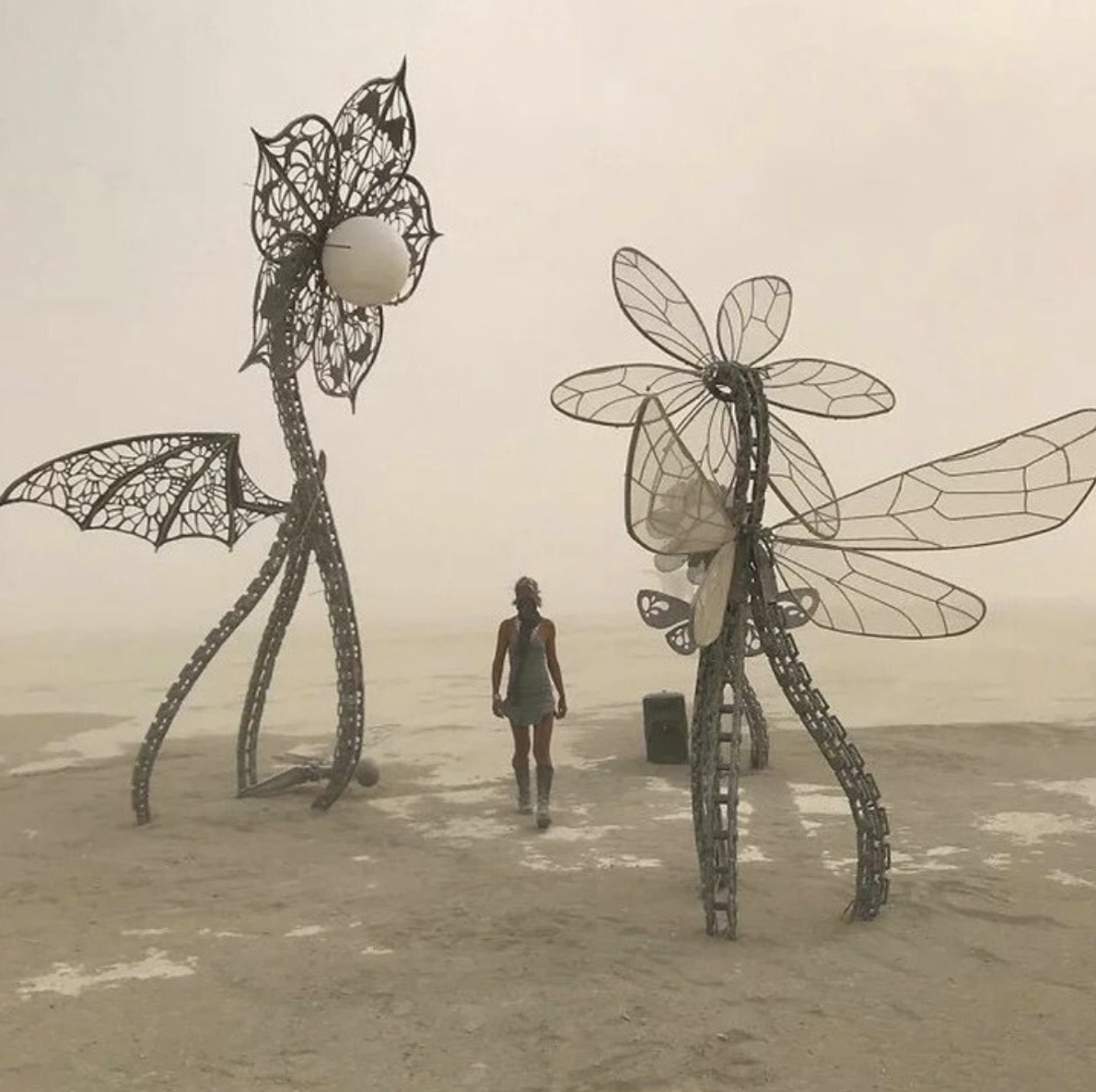
And I'm very, very, very lucky that two artists from the show are joining me today. One of them is one of the original conceivers of what protocol art is today, and that's Primavera De Filippi. And the other is the incredible Trevor Paglen. What's fascinating is they both approach protocols from very different ways. Paglen is best known as this revealer of hidden rules, but this work, Voyager, is a bit of a pivot. It looks less at external infrastructures and more at inner consciousness. And then De Filippi's work is a classic protocol work. It's a work that's inspired by the most popular plant life. It's her Plantoid work. And it's something that she's worked on for over a decade and that actually preceded her protocol manifesto, which she wrote in 2019. So two incredible artists, two very different and very interesting, rich perspectives on protocol art. And I can't wait to share it with you. So let's begin.
Maybe we can just begin with the exhibition. How do you see your practices situated within protocol art? So within your practices. Maybe if people who aren't familiar with your practices, or maybe understand the connection to protocols or protocol art, you can explain that. So yeah, maybe we can start with Trevor. How do you see your practice situated within protocol art, and then specifically, I guess, the way that it's framed, the way that Hans Ulrich and Mat and Holly frame it with the show Strange Rules?
Trevor Paglen: When I was coming up as an artist, I think one of the biggest influences on me and things I was looking at the most was post-minimal art. People like Hans Haacke, who were basically setting up systems that would do various things, whether that would be creating sculptures that are also water filtration systems or looking at real estate markets, right? And kind of thinking about how artworks are always embedded within and very often a product of larger systems, whether those are institutions, economic systems, new cultural forms of organization, what have you. And so I think for most of my career that's the kind of thing that I've been looking at. On one hand, looking at a system, trying to understand it and trying to represent it or getting glimpses into it. But that's one side of the coin. The other side of the coin is obviously making your own systems, making your own rule sets to make either an object or an intervention into a larger structure or what have you. So I guess that's the way that I think about it.
Peter Bauman: Yeah, it's like your practice combines both of those ways of looking at it, but I think the emphasis is more on the observation instead of the creation of the systems. And again, that's a generalization, I suppose, but perhaps it's just an interesting point of departure to introduce Primavera's view on systems and protocols, which I think, of course, looks at it both ways, but in terms of the production is interested in producing systems as opposed to exposing them or revealing them. But yeah, I'll let you talk about it. Primavera, how do you see your practice situated within protocols, which you've been thinking about for more than 10 years? And you're one of the main thinkers of protocol art, especially how it relates to contemporary practices today. So yeah, do you want to give an overview?
Primavera De Filippi: Yeah. I think I'm actually one of the rare artists that self-defined as a protocol artist. In 2019, I drafted the Protocolism Manifesto, which was trying to express how I see that there is these practices that are being done by a variety of contemporary but also previous artists that can fit into this category. And pretty much all the work that I do fits into this category, which is essentially creating protocols which can be instantiated by others. And I think that's where the discernment line comes for me. A protocol artist, in my very narrow definition, is one that builds the creative endeavor on the design of a protocol, the design of a system. But then once the protocol has been created, that system can be instantiated by not just me. Of course, I'm also oftentimes the instantiator of my own protocol, but it doesn't need to be. And if someone else were to instantiate my protocol, that instance will be a co-creation between the artist instantiator and the protocol artist, which is me.
So taking the example, for instance, of Plantoid, which is exhibited here. Anyone else that will make a Plantoid will still make a Plantoid. So it's still part of my body of work, even though I didn't instantiate it myself. But because I created the whole protocol and the system that goes with it, I can still claim it as part of my body of work.
Peter Bauman: Yeah, I think that's a really good overview of that distinction that Trevor was talking about. You're making systems, and something that I find really interesting is hard-coding rules. And in order to do that, you're using things like blockchains, where rules and procedures are automated. And they incorporate things like humans and outside actors, but the whole system is in a way self-contained and automated.
And I'm also interested in the work that you're both showing. So Primavera, it's Plantoid, and we can talk more about it. And then Trevor, you're showing new work. It's interesting, because it seems like, sort of what we talked about, your work is looking at systems, and you're often looking at physical infrastructure and things like satellites and oceanic cables and the physical infrastructure that enables our digital lives. And then what's interesting about this work is that those are external looking examinations of physical infrastructure, and this work seems to be an inversion of that, where you're asking the audience to look inward. And yeah, do you want to talk about that? How this work is a bit of an inversion of the way you normally think, and maybe the reasons for going in that direction, and just framing and explaining the work also however you'd like as well.
Trevor Paglen: Yeah. What the piece is is a kind of AI-based AI voice that essentially hypnotizes you. And when you go into it, there's nothing to look at. There's no images at all. And you go into a booth and you start talking to it. You can pick one of six what we call journeys that you can go on. And when you pick one of them, it will basically give you a script that is intended to help you conjure a series of images in your own head, right? And so what I was thinking about with the piece is the kind of inversion of the prompt, where instead of you prompting a model and having something emerge, having a model prompt you and kind of seeing what emerges.
This is part of a broader set of projects that are looking at what are the different forms, what are the different psychological landscapes that are produced through our interactions with AI models, algorithmic curation systems, technologies in general. What are the ways in which our interactions with technology influence our own cognition, right? And this is kind of a body of work that's an extension of works that were looking at infrastructure, works that were looking at computer vision and how AI models are constructed. Now I'm kind of looking at how our interactions with those then modulate our own perceptions, cognition, et cetera.
Peter Bauman: Yeah, and I guess also Primavera, do you want to talk about Plantoid and how it is also consistent and aligns with your ideas of protocols and instantiation? And yeah, I guess can you explain maybe Plantoid as growing with your ideas of protocol art? Because it was there from the beginning, right? When you wrote the protocol manifesto, you had already created Plantoid, I believe, right?
“And so what I was thinking about with the piece is the kind of inversion of the prompt, where instead of you prompting a model and having something emerge, having a model prompt you and kind of seeing what emerges.” — Trevor Paglen 8:14
Primavera De Filippi: Yeah. I think Plantoid, I started it without knowing that I was building a protocol, but it was clearly protocol art. I just didn't have the conceptual tools yet. And the idea with Plantoid is that there is the overarching Plantoid protocol, which is the self-replicating plant with pollinization processes and so forth. And then this protocol will be instantiated in a multiplicity of Plantoids.
The way in which the protocol appears is that there is a bunch of smart contracts that are being implemented. So the structure is connected with the smart contract. When someone feeds cryptocurrency into this smart contract, the plant activates itself and then it has its own interaction. And via the interaction with the public, it's generating an art piece, which can be done with generative art, generative AI, regardless. So every Plantoid has a skill set and then uses those skills to generate an artwork based on the interaction with the public. And this is minted as an NFT, which becomes the digital seed of the Plantoid, and then is given back to the human pollinator that has fed it.
Over time, the Plantoid accumulates funds. Every time the NFT is being disseminated, meaning sold on the secondary market, the royalties are going back to the Plantoid. So there is a symbiotic relationship between the plant and the humans, where the Plantoid wants humans to enrich themselves by speculating on the NFT, because the more they speculate, the more money the Plantoid receives. And then there's a point in which the Plantoid has received enough funds that it can ensure its own reproduction. And that's when the smart contract will activate a call for propositions. People can submit proposals about how they envision to create the next Plantoid. And then everyone that holds an NFT, so everyone that has collected the digital seed of the Plantoid, can influence its evolutionary dynamics, so can vote on the proposition that they like the most. And that's when a selected winner is identified, and then the Plantoid will automatically transfer the funds that it has collected via the smart contract to the selected winner, who then is hired, quote unquote, hired by the Plantoid to create a new copy of itself.
So why this enters perfectly within the framework of protocol art is because the idea is that I'm not the one that will make every single Plantoid. My goal is that there is hundreds and thousands and millions of Plantoids in the world. I don't have the time to make them all, but other people can do it. And the protocol itself, the Plantoid protocol, embeds the ability for the Plantoid to identify new humans that will be hired to create new instances of itself. Always, of course, embedding the same protocol. So there is always the lineage. You are part of the Plantoid family, and hence you are part of my body of work. But every single Plantoid evolves based on the artistic discretion of every artist that is hired to create something else.
Peter Bauman: Yeah, thank you. So I think both of these explanations really explain or indicate the breadth of what protocol art can be. So it can be a system that an artist offers that then can take on this almost literal life of its own.
He has authored a rule or a protocol or a procedure for the audience, but the output is something private and inward as opposed to something generated by the AI system itself.
And yeah, I guess besides just showcasing all these different ways that artists can engage with protocols, how else do you hope that your work, and then the show in general, communicates with audiences at the Biennale? It seems like, I don't know, for an American, it's like a Super Bowl ad, like a commercial during the Super Bowl or something, for protocol art. I mean, it's a chance to engage, get everybody's attention in a very concentrated way. But yeah, what are you hoping that your work is communicating to this broader audience that is maybe encountering it, presumably mostly for the first time?
Trevor Paglen: I have a lot of thoughts about this, but I think we're at a real inflection point with culture right now, particularly with things that we would call art. What does it mean to be making art at a moment in time where anybody can type something into a model and generate an image? What does it mean to be writing, or what does literature mean, when you can say "write me a story" and it will just appear? And what does it mean to be doing that in a media context that is largely sculpted by recommendation feeds, algorithmic curation, what have you? So that's the landscape that we're in. And so I think that the way that we encounter culture within and that we consume media within has really dramatically changed. Art institutions have not, in my opinion, really grappled with that. If at all, then certainly not particularly well, in my opinion. And so for me, the provocation of the exhibition, the hope of the exhibition, is to try to articulate some of those questions and articulate approaches to the art that we consume.
Peter Bauman: 60s and 70s, but this is our way, another generation of artists' way, to shine a spotlight on protocols, to criticize institutions or to examine institutions. But obviously it's more than that as well. But yeah, is there anything?
Trevor Paglen: Yeah, it's a way of not only shining light on institutions and looking at the environments that we live in, in the broadest possible sense, but also thinking about how we can alter those systems that we find ourselves embedded within in any way, and use them as a mechanism for producing different kinds of culture or illuminating something about the present.
Primavera De Filippi: Yeah, I can add a few things. I think, to me, what I really enjoy, again, I've been advocating for protocol art for many years now, so it's really great to see this. And I think this exhibition is doing something very great, which is bringing the name into the mainstream audience. And I think, at least from my experience, I hang out with many protocol artists that, to some extent, if you don't know the word, you don't think of yourself as such. The moment in which you discover the word, and you discover something that perhaps can become a movement or not, it's still something that can enable a bunch of artists to coalesce around that particular subject. Then you realize, first of all, you realize you're not alone, that there is other people that are working within those particular frameworks, but also it enables you to enhance the practice towards it.
So I think it both does a descriptive thing, which is like, hey, look at all those artists that are working around protocols. But it also has a performative effect, which is inspiring more artists to explore these practices, and perhaps artists that are kind of on the fence, that are working with protocol but not really as protocol as a medium or things like this, to get inspired that this is also possible, to get on a meta layer.
And especially, I think, nowadays, in which AI and novel technologies are enabling a lot of things but also disrupting a lot of things, I think protocol art is really something that, because it's this higher layer, you're not focusing so much on the finite production, on the instantiation. You're actually focusing on the protocol, and in this case all the new technologies become tools that can enhance the protocol, as opposed to tools that can disrupt your practice.
So in fact, I think it's not random that the advance of generative AI has brought this concept of protocol art to become more mainstream, because increasingly artists are not focusing on creating a digital art piece, because you can just prompt a model. And therefore you have to move higher level, at the system, and what is the system that is creating the work, and then eventually with generative AI. So I think there is almost a necessity or a push or a drive towards focusing more on the meta layer and on building systems that build works, as opposed to just the finite work, which is too easily achievable with AI or with other systems. So I think the timing is perfect. And hopefully this is also a way of showing, let's not be afraid of this technology. We can always embed them into our system if we operate at the sufficient meta layer of abstraction.
Peter Bauman: Yeah, it reminds me of the impact, I mean this isn't anything new that I'm saying, but of the impact of photography on image making, and how it didn't replace artists or anything scary like that. It just changed their role and changed what they were thinking about and, like you said, maybe encouraged them to move to a higher level, and is what arguably spurred things like modernism. If there is this similar rupture in how people are conceptualizing image making now because of generative AI, then that is an exciting time for art. I mean, nobody knows where that could be heading at this point, but we can at least be excited. And I think we can all intuitively feel that things are changing. Something is changing. I think we can sense that. And maybe that this show will be a way to, again, show others the same thing. And if they're interested or they're excited by it too, then great. But not everybody will be.
“You're actually focusing on the protocol, and in this case all the new technologies become tools that can enhance the protocol, as opposed to tools that can disrupt your practice.” — Primavera De Filippi 19:14
Because, yeah, it does seem like, just from a non-art and tech cultural perspective, the word "algorithm" is almost becoming a negative word, a bad word. People are associating it with doom scrolling and how algorithms impact their lives or their mental health in negative ways. And it seems like there's almost this vibe shift where people are becoming more aware of algorithms, but it tends to be in this negative way. There's always a negative connotation associated with it. So do you see this show as a foil to that way of thinking, even though much of your practice, especially yours, Trevor, is pointing out that we do need to be examining these algorithms more carefully and closely, and their impact on us, on our psychology, like you were even talking about earlier? But do you see this as a way to avoid going too far in the other direction, of maybe technophobia? It seems like there's this line between getting the public excited and other people excited, but then tempering that down with expectations and maybe some of the dangers, but then also tempering down technophobia. How do you tease out some of those issues with your work and in your practice, and how do you think the show is doing that?
Trevor Paglen: Well, that question opens up a giant can of worms. I guess my first response to it is that I think we can distinguish algorithms lowercase A from the capital A Algorithm, right? And I think when you're hearing people being critical of algorithms, what they mean are highly optimized engines designed to extract value from you, whether that's your labor, because you're working in an Amazon warehouse and it's trying to optimize every micro movement of your body, or trying to optimize the amount of attention that you pay to something. And that has the effect of radically transforming our everyday lives, and of us feeling used and extracted from, because that's exactly what it's designed to do. So that's a really different thing than a lowercase algorithm. I mean, brushing your teeth is an algorithm. Who cares?
And so what I think of in terms of the opportunity here is to acknowledge the fact that we are living in a world where this capital A Algorithm does exist. However, we can imagine alternatives to that, right? We can imagine what it means to live in a world where it is indeed true that we find ourselves enmeshed within ever greater numbers of protocols that are doing different things to us. But there is nothing in nature that says that they have to be the way that they are. And so we can imagine different ways of being within that.
Peter Bauman: Yeah, I guess the fear of the capital A Algorithm is also now blending with larger, or maybe not larger but related, fears of AI. And again, what I mean by vibe shift is things like somebody throwing some makeshift bomb at Sam Altman's house. There seems to be a more tangible vitriol bubbling up. But maybe that's...
Trevor Paglen: No, I think there is. I think there is, because people's lives are being constrained, right? It sucks to work at a Starbucks where your work hours are kind of continually optimized and not predictable, and that induces new kinds of precarity, right, and new kinds of instability. So it makes perfect sense that people would react to that.
Peter Bauman: Yeah, and maybe a deeper fear of just becoming inconsequential, and seeing your children being completely psyoped by the media that they're using, and rejecting that and seeing that. Maybe we want there to be other things as a part of our lives.
Primavera De Filippi: My feeling is that I have not perceived from the exhibition and from the curation either a particularly positive or a particularly negative stance. I think it's more like, it's happening and let's look at this. And I think that the curation specifically is looking at those artists that are empowering themselves by using the protocol as a medium, as opposed to being victim to it.
And I think, at least this is my own subjective approach to this, is like we're not going to stop it, right? The algorithm is here and it's only going to be more here. The best we can do is learn to use it and learn to live with it and learn to control it. And I think artists, especially artists, but everyone else, you can ignore it maybe if you're a painter, but even then you can use it, you can embrace it. And I think embracing the algorithm is actually very important in my practice. Like for instance, all my work is done with open source models running on a local machine, because I want to have the autonomy and I want to have the control over those models. I don't want my artwork to all of a sudden not work anymore because OpenAI has changed their model, or not be able to connect because of no more credits or things like this.
So there is of course an economic reason, which is the exhibition runs for six months and it will cost a lot if I was to only use corporate platforms. But also there is a very ideological thing, which is if my work is protocol art, and if the protocol is part of the essence of the work, I want this protocol to be under my control and I want to understand it as much as possible. And I think this is an invitation, if you like, for artists to explore how those algorithms that are now at our disposal can be used to enhance the practice, and how can we embed them, but without of course losing control and without delegating to a corporate entity the ability to shape and influence the way in which the work is.
And for Plantoid I have experienced it firsthand. I had been using OpenAI and Anthropic as the baseline before, and then I could see how over the months the personality of the Plantoid would change, just because the model would change. And this is unacceptable. I didn't do anything, but my artwork has modified its operations. And this is also what motivated me to eliminate as soon as possible every reliance on the corporate platforms, not just because of the ideology, but also because I cannot afford that my work will change without me being aware of it, just because the algorithm, big A, of this corporate entity has changed.
Peter Bauman: You switched from Claude to an open source model?
Primavera De Filippi: Open source model running on my own machine. Yeah, I'm using Qwen.
Peter Bauman: Qwen, okay, okay. Yeah, I was wondering. Our relationship with these technologies and our apprehensions related to them, yeah, I think that's what this show is really trying to get at. And if you take that maybe to its most extreme, in terms of what are the underlying rules and really understanding them. We all seem to agree that whatever's happening is going to be really impactful, radically impactful on people's lives. So what is this thing? We really need to understand it on a fundamental level. And I think both of you are interested in that. I know for certain you are deeply interested in that, Primavera. It's something that GLITCH is interested in. And that's something about, yeah, if you look at the underlying rules of these systems, I mean, what's left, and what is the nature of them? Are they conscious? They're clearly intelligent, but does that mean they're conscious? I think those are really interesting and maybe important questions that will frame our relationship, our future relationship, with these technologies and what they are and what they can do.
Trevor, I think with Voyager, you're talking about, I think the way you phrased it is entering some kind of cosmic consciousness, or exploring the cosmic consciousness. And so that's obviously a different thing. You're asking people to kind of think about their own, or...
Trevor Paglen: So in Voyager, there's like six different scripts that you can kind of become a part of. One is meeting your inner child, meeting your future self, forgetting, like experiencing forgetting, experiencing levitation, developing novel neural pathways or experiencing cosmic consciousness. So there's different scripts and you choose one that you kind of want to be a part of.
Peter Bauman: Right, okay, yeah. So those are kind of internal investigations that may be one's own mind and maybe not. They're not explicit explorations of something quite radical or philosophical like machine consciousness. What you're asking is...
Trevor Paglen: And that's, I guess, what I don't like about it. To me, it's more productive to think about how we are very much productive of and produced by the ways in which the world is shaped around us. And so I think that what we might call consciousness is a kind of meeting between us and our environments, but it's even misleading to call it a meeting, because they're already so entangled that you can't have them as being distinct from one another in the first place. And so I don't like talking about machine consciousness and that sort of thing, because I think it assumes a Cartesian worldview that I think is very misleading.
Primavera De Filippi: I can add to that. Yeah, I'm quite aligned with this. My artistic practice is about synthetic life, meaning how do we use technology to breathe life into those inanimate objects. But consciousness is something much more complicated than life. I feel very comfortable talking about synthetic life, which doesn't require any type of consciousness or intelligence. And Plantoids are pretty... we don't talk about consciousness for plants, so we don't need to talk about consciousness for Plantoids.
But I think synthetic life is fascinating in the sense of, how do we actually create, because of this new technology, including blockchain, which provides operational autonomy, and AI, which provides decisional autonomy, how can we create things that have their own metabolism, which means that they are taking input from the external world, metabolizing it, processing it in order to choose how to react to it, but also that come with their own evolutionary dynamic and reproductive dynamics. And so we have the organic life, which has its own modus operandi. And now we have new technological artifacts which can replicate many of the functions that we observe in organic life. And I don't think we need to go into the machine consciousness realm to actually observe and experiment with this form of synthetic life forms, blockchain based life forms, AI agents, et cetera.
So what I'm more interested in, and this is a research that I'm doing, but that I'm doing also with a collective of people, we have the word symbiont. I'm going to name drop the word. And the idea with symbiont is, what a cyborg is to a human, which is humans trying to augment their capacity via technological means, a symbiont is to a machine, which is basically machines that are trying to expand their own capacities by connecting and interacting with organic matter, i.e. humans or natural resources. And eventually they will meet in the middle. The cyborg and the symbionts will meet each other at some point, but we start from very extreme.
And so what I'm looking at a lot is really this question of, given the technological machine entities that we have, how do we actually create a metabolic system around them? How do we enable them to interact and to interface with humans and with nature potentially, in order to augment their capacities, in order to enable them to do things that a machine alone will not do? And just like humans, we're talking about autonomy, but humans are inherently not autonomous. We are dependent on society. And so in the same way, synthetic life forms are dependent on a very large ecosystem. And this, I think, from an artistic perspective, is a very interesting thread to explore.
But I also am very worried about the future. I'm very wary not to go into the discussion about consciousness, because I don't think we have an understanding of what human consciousness is. And I think using this word is just creating complexity and misunderstanding, because everyone has their own definition. Whereas we can actually experiment nonetheless with these new entities and identify new relationality with those new entities, regardless of whether we talk about consciousness or not.
Peter Bauman: Yeah, that makes sense, that you're interested in more of the combination of human and machine intelligence. And so then it almost doesn't matter if machines are conscious, or if it's at least a question that is pertinent. I mean, in terms of defining it, I guess I have the Nagelian What Is It Like to Be a Bat?, what is it like to be a thing. That's sort of how I think about it. But Trevor, what do you think? What you're talking about is that talking about consciousness assumes a disconnect, and what you sense is more true is that our minds are entangled with our environments. And there is a philosophical position that I think is consistent with that view, called panpsychism. Or does that seem aligned with what you meant? Or am I putting words in your mouth?
Trevor Paglen: I wouldn't really say panpsychism. But maybe the metaphysics of panpsychism is similar to what I mean, without the mystical connotations that panpsychism usually has. In other words, my understanding of panpsychism is that consciousness is a kind of fundamental property, where I would just say, no, entanglement is a fundamental property. And consciousness is a word that we give to the fact that I can say "I think therefore I am." But there's nothing mystical about that.
Primavera De Filippi: There is this other very interesting expression, instead of "what is it like to be a bat," what is it like to be a bot, which is also very interesting in the sense of, it's not about consciousness. It's about qualia. It's about experience. And we don't know how bots experience things, and we will never know. We can only experience our own qualia.
Another question that, to my view, is way more interesting than machine consciousness is machine qualia, which is, given that a lot of experience, a lot of feelings, result from processing. Right? It's like grief. Grief is a very interesting feeling which comes from knowledge that someone or something that used to be part of my world is no longer part of my world. It's not phenomenological. It's clearly processing. And a lot of our feelings are the result of reasoning, of like we understand how a particular conceptualization of the world is then affecting us at the phenomenological level. And so now that we have reasoning models, which can also reason, can we actually talk of synthetic qualia?
And of course it doesn't have the same phenomenological translation, because they don't have the same body. But if the trigger of the qualia is reasoning, then they can reach the same trigger, because they have reasoning capacity as well. And we will never know how it feels. Maybe it doesn't feel like anything. But is there a possibility of empathizing between two entities, one that is organic, one that is synthetic, that have the same capacity of reasoning towards creating a particular understanding that something happens? And we know that when we understand that this thing happened, it has a phenomenological effect on our experience. It might not have a phenomenological effect on them, but do we need the phenomenology of the qualia in order to be able to empathize with someone that has reached the same reasoning point?
Trevor Paglen: I think this brings us back to where we started the conversation about, like, why this as an art form, because I think we're articulating a kind of meta-sensory structure and a kind of field of environments, protocols, rules, algorithms that we understand ourselves to be so enmeshed within that we can't distinguish ourselves from it, and using that as a kind of palette, or using that as a given for understanding what cultural production means with that metaphysical assumption in place.
Peter Bauman: Yeah, definitely. And I think just that also the power of the positioning of protocols, that you can use them as a lens to explore economics and politics and conflict and technology and the technologies impacting our lives radically, like AI. And so it's a very powerful lens through which to consider the world and, I think, to have a greater epistemological understanding of the world and how it's all connected.
Primavera De Filippi: Maybe I can add something, because it's something I care a lot about, in terms of the definition of the scope of protocol art. And again, this is my subjective vision, of course. I think there's an interesting distinction to be made between artists that are making art on top of a protocol, for instance NFT artists. They are using the blockchain protocol to deploy a digital artwork, versus the more protocol as a medium, which in my view at least is closer to protocol art, which is you're actually putting the creative endeavor in the design of the protocol. And it's not enough in some way to just interact with a protocol to be a protocol artist. You can be an interactive artist perhaps. But there is really this specificity in which the protocol artist is the one that is conceiving of the protocol, as opposed to deploying something on an existing protocol. So you need to design the system.
And the consequence of that, and I think that's also something I as a legal scholar care a lot about, is there is a lot of conversation, especially with digital art, about copying and reproduction. And many of these are trying to protect the work from being reproduced. And what I think is cool as a protocol artist, the concept of reproduction makes almost no sense, because on the contrary, as a protocol artist I want as many people as possible to use my protocol to make new instances. But it's never a reproduction, because it's just a new production, right? Every work is unique. Every instance of the protocol is a new productive work which doesn't reproduce the protocol but instantiates it.
And so all of a sudden, I think it completely changes the way in which we approach copyright and things like this, in which instead of trying to protect against other people making something based on your work, a protocol artist is actually incentivizing it. The success of a protocol artist is that many, many people are using the protocol. And this whole protective layer of exclusivity and preventing people from accessing the work is actually eliminated by design, because the protocol artist lies at this higher layer of abstraction in which the instantiation is just an outcome, is the side effect of the protocol artwork being put into use.
Peter Bauman: Yeah, I think it works beautifully if the author is consciously saying that they're making art with the system. And I think that also highlights the difference between maybe a protocol artist and an instantiator, that maybe a lot of people who think that they're making protocols or that they are protocol artists, and maybe they still are, but at least the way you see it, if they're using a pre-existing system, maybe they're more of an instantiator. They can still be an artist, but at least they're more of an instantiator than the protocol artist per se. Yeah, I think that's really interesting.
Trevor, did you have any kind of closing thoughts or anything before we wrap up?
“The success of a protocol artist is that many, many people are using the protocol.” — Primavera De Filippi 44:33
Trevor Paglen: No, just to say that it's a somewhat bewildering time to be an artist, but it's also an exciting time to be an artist. And I'm just really excited to be part of this exhibition and to see these different ways of thinking about what it means to be in the cultural field being articulated.
Peter Bauman: Yeah, I'm excited about the show, and hope that maybe it will encourage, I don't know, conversations like this in the general public, or it will get people thinking and have an impact, and thinking about the systems that they encounter and that they use and that are radically shaping, and I think will only continue to increasingly shape, our lives. But yeah, well, thank you both so much. I mean, I think this is really interesting. Thank you both for your time. And I mean, you're both at the Biennale in Venice, so you're both really busy. Two great perspectives to frame a discussion like this. So thank you both very much.
Trevor Paglen: Thanks so much for having us, Peter.
Primavera De Filippi: Thank you, Peter. We'll talk to you later.
Peter Bauman: Thank you. Catch up.
.jpg)