.jpg)

Suggested Reading
Interview
Evergreen
Keiken on the Worldbuilding Lens
Peter Bauman
•
August 24, 2026
View


Protocol artist and theorist Primavera De Filippi and Peter Bauman (Monk Antony) trace art's route to life through its grammar. They map how artists make work as, with and about protocols and worlds, which arise when rules shift from the first person to the third.
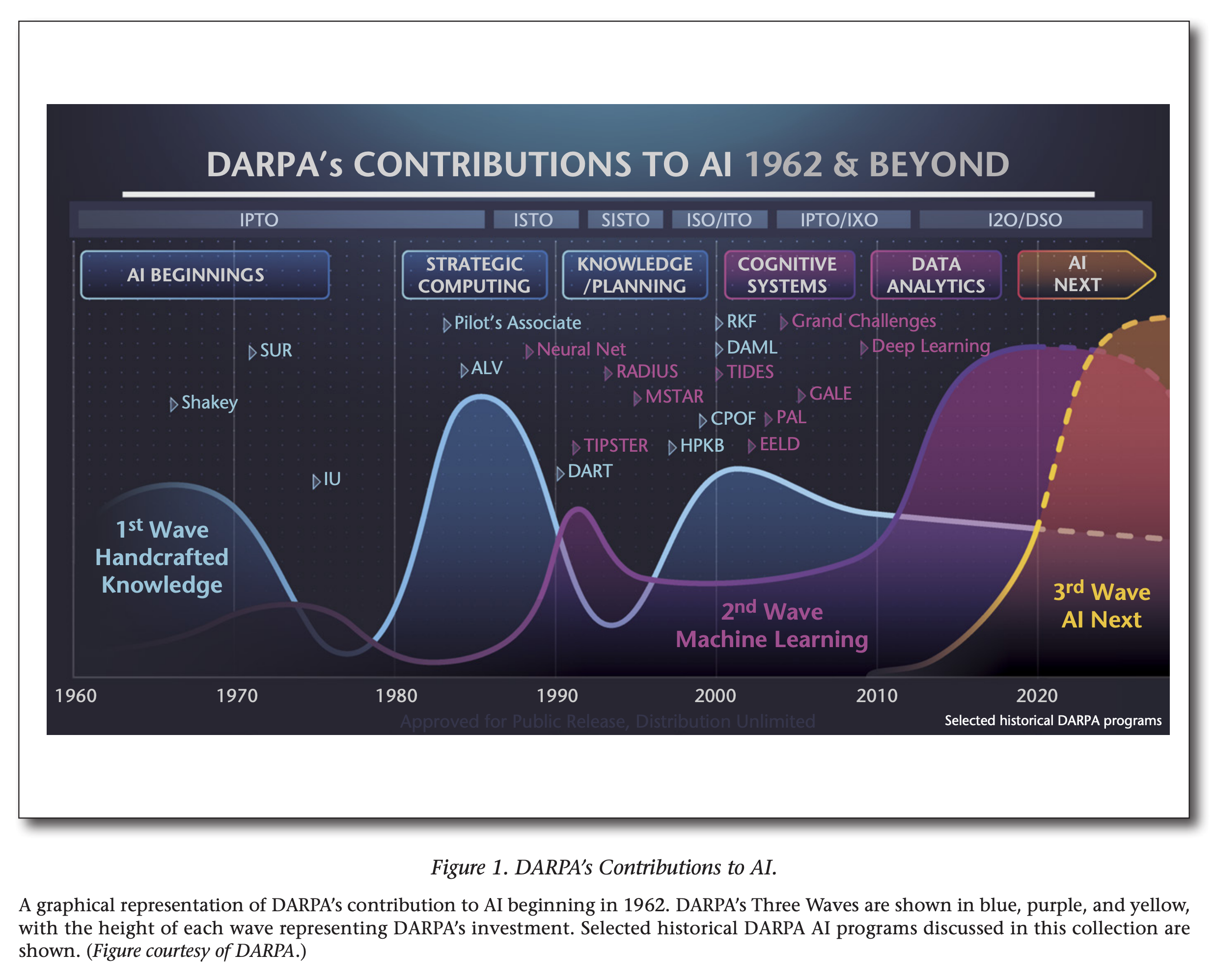
Since cybernetics, weapons—er, I mean machines—have been consciously designed to be more lifelike: more adaptable and intelligent. For seventy years, researchers, partly funded by DARPA, have sought to build machines that match, even surpass, the capabilities of humans.
Beyond weapon-making, cybernetics has profoundly impacted art and computer science as well. Through their overlap, art has absorbed tainted-but-vital technologies like computers, networks, blockchains and deep neural nets to shape cultural production. Along the way, artists have engaged with and subverted these technologies, redirecting their life-like powers to their own ends. This essay traces and examines this lineage and two central components: protocol art and worldbuilding.
Protocols and Worlds
Tracing art’s route to life means examining two dominant strands of contemporary making, protocols and worlds. We define protocols loosely as a set of rules that produce an artifact. So what does that make a world?
There are different theories relating protocols to worlds. But the way we see it, a protocol becomes a world when its rules begin describing entire environments rather than singular entities.
That said, all protocols have loose worlds, the halos surrounding them, all the activity they gather, much beyond the artist's control. Still, worlds proper are different; they are intentional and traditionally written into protocols.
Loose worlds
In the loose sense, protocols and worlds are two sides of the same coin. More three-dimensionally, the protocol is the nucleus with instructions; the world is the surrounding electron cloud. A great painting creates a consciousness “world” inside the viewer’s head, Roy Ascott’s “consciousness as medium.” Instruction-based pieces like Yoko Ono’s Grapefruit create firmer “worlds” of sibling pieces, performances and recreators. Automated protocols, like Mifella, create worlds of community and buzz. More intimately, evolutionary systems like Botto create adaptive, agentic worlds beyond their authors, shaped by relations between human and non-human intelligences.
Proper worlds
But what’s meant by worlds proper is more specific. It’s when protocols, often in complex, collaborative stacks or systemic nodes, move from the first-person physiology of evolutionary systems (sometimes referred to as symbients), like Botto, Plantoid or Holly+ into the third-person laws of interlocking ecosystems. Basel Abbas & Ruanne Abou-Rahme build worlds as complex ecosystems, with projects consisting of installations, real-time visuals, performances, albums, publications, archives, websites and more. These worlds are often multidisciplinary and collaborative by default. Producing films takes a village; producing worlds, like Abbas & Abou-Rahme’s, Keiken’s or Jakob Kudsk Steensen’s, usually does as well.
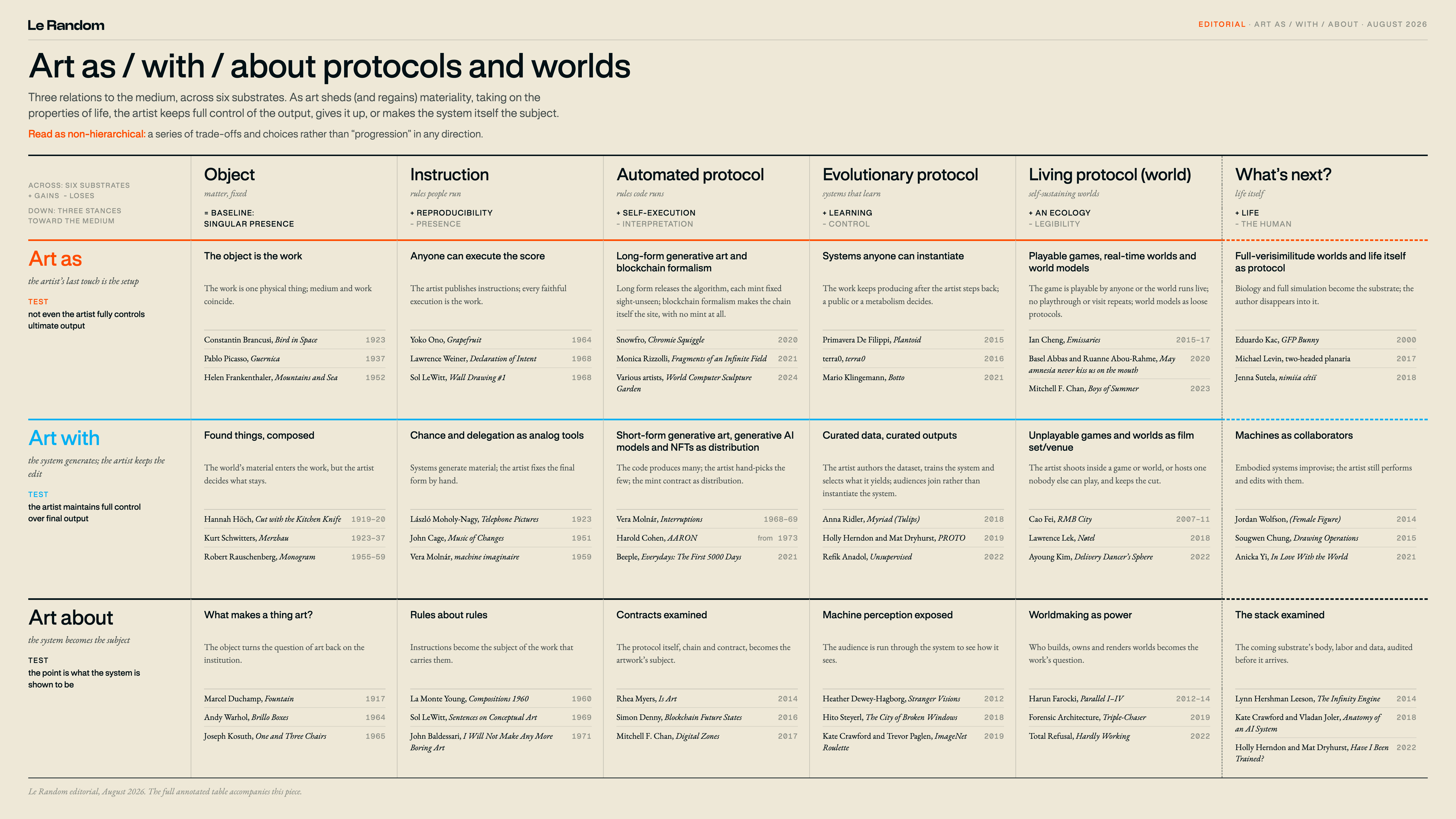
With a broader view of how today’s systems relate to objects and manual instructions, we arrive at the above diagram of “Art as / with / about protocols and worlds.”
The above diagram, this essay’s heart, can be read in two broad ways. First is across, tracking art’s loss and reacquisition of materiality, art’s acquiring the qualities of life and probing ideas of automation. Looking across is the process of artists giving life to art itself over time through technology.
Second is moving down, raising questions about medium relationality. Does the artist maintain control throughout the entire process? Are they keeping the final edit for themselves (art with), sharing it with others (art as) or is their aim to expose, critically examining socio-geopolitical dimensions?
Neither movement across nor down implies progress or a final destination. Instructions gave art legitimate reproducibility of an original but lost the presence, tradition and historical testimony of a singular Guernica, a physical reproduction of which would be labeled a forgery and valued accordingly. Meanwhile, a known reproduction of a LeWitt wall drawing is an “authorized instantiation,” just as legitimate and valuable as any other. Protocols abolish the original’s privilege and fetishization. But are we left with only “copies”?
Rather than progression, moving across represents new aesthetic terrain, surfaces made possible by new ways of thinking or new technologies. Accessing that terrain isn’t easy or necessarily wanted; it requires trade-offs, choices, differing interests, aesthetics and questions. Despite what most galleries and art fairs may have you believe, painting and sculpture objects are not inherently more valuable or legitimate; neither are they old-fashioned or declining.
Thankfully, some artists engage with these new capacities but, equally thankfully, many do not, especially at first. Now we’ll look across the diagram and define key terms.

As art itself gets more lifelike, consciously mimicking human intelligence as far back as the perceptron, it loses reliance on genuine human intelligence to perform certain, automatable tasks. Human intelligence is better served higher up the value chain on non-automatable, higher-level tasks.
We begin on the left with objects of inert matter like paintings and sculpture, maximally material and minimally alive. They cannot copy themselves, respond, or sustain. They persist, like all matter in a battle with entropy. Not to be too unkind but it’s a tree’s lifeless husk, its “body,” disconnected from any roots or branches.
Before we feel too bad for the object and its position in art today, walk into any commercial gallery or see the 2026 UBS Art Market Report to realize that objects account for around 94% of fine art dealer sales. “Digital art” accounts for 0.4%. Outside of NFTs, if you’re buying art today or ever have, it is overwhelmingly likely that it was an object.
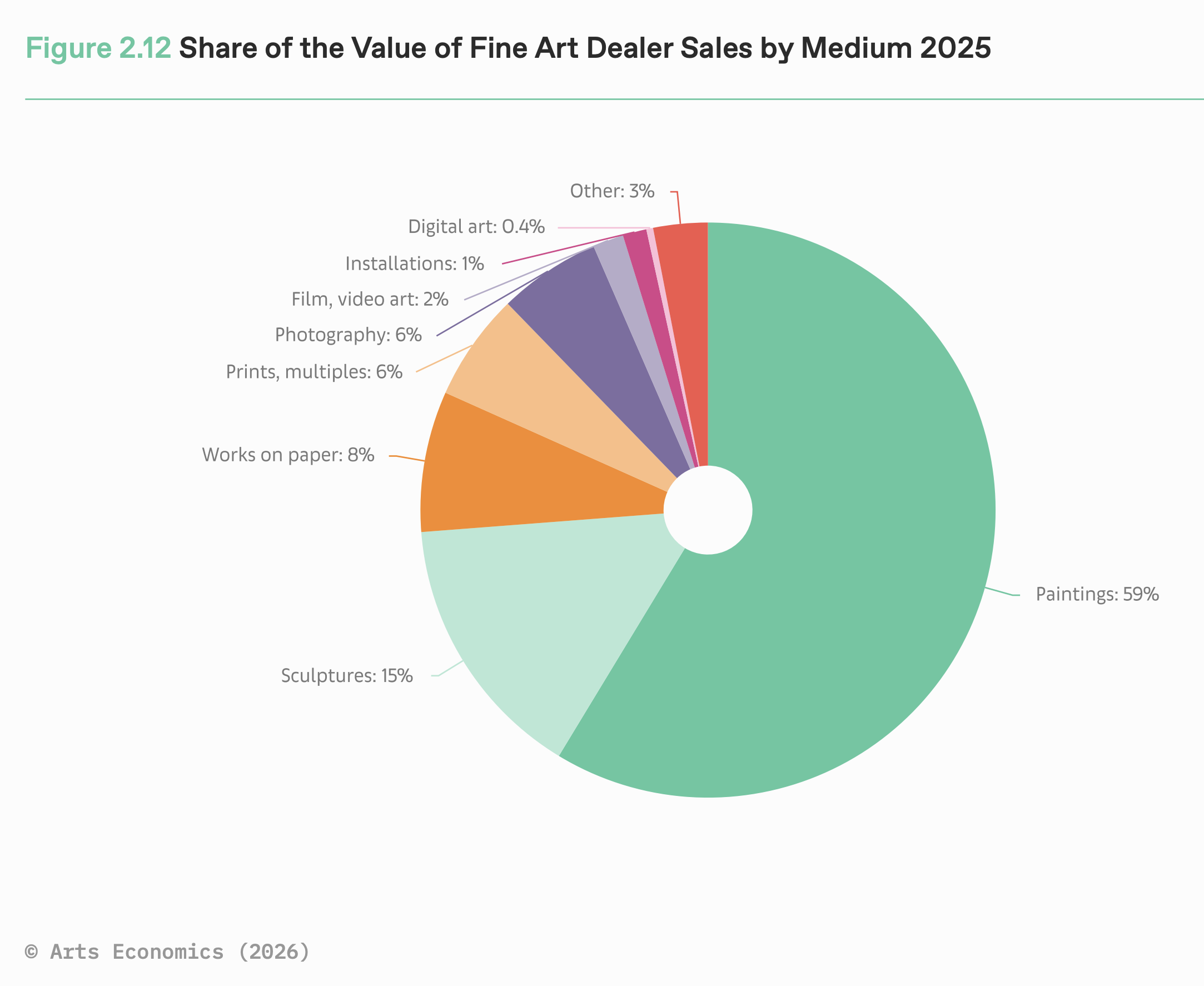
If you're thinking, "I bet that share of 'digital, film and video' is growing exponentially." The 3% 2025 number is a decline from a 2022 peak of 5%. Objects aren't going away any time soon.
The object stubbornly persists despite Lucy Lippard’s seminal book, Six Years: the Dematerialization of the Art Object from 1966 to 1972, which chronicled how art could be more than objects. It could be ideas, instructions or music scores, which could in turn generate any number of descendant instantiations. Alison Knowles’s instructions can be performed countless times, in as many ways as there are to make a giant group salad. That describes a gene. It’s not the organism itself but the code for its production. It is abstract, substrate-independent, copyable. The dematerialized art of Gutai, Fluxus and the Conceptualists made this possible by introducing rules as alternatives to objects.
In a resolution of Benjamin and Berger, reproducibility became written into the work itself, making each “copy” or instantiation authentic, removing the difference between copy and original, dating back to Plato.
Precisely what is lost since machines began reproducing art has been debated for nearly two hundred years; some call it aura, derisively or not.
Protocols
To the right of objects, we enter the fuzzy realm of protocols, rules that produce artifacts. A recipe is a protocol; a smart contract is a protocol; so is an ecosystem under certain conditions. Crucially, we must distinguish among different types of protocol because they do not all operate according to the same rules. The looseness of our definition helps us explore the entire protocol space but also obfuscates key differences between the multiple types of protocols the art world has claimed.
With those key differences in mind, we have identified four typologies of protocols that can then be compared across a set of properties that define what each does best.
The first category is human-executed “instruction protocols.” LeWitt’s wall drawings or Félix González-Torres’s piles of candy both have in common the artist recording instructions on a particular medium for a human interpreter to subsequently execute manually. The protocol requires instantiation, i.e. a particular human willing to carry it out, meaning they depend on an externality, a “sound of a tree falling when no one can hear it” situation.
The second category is then “automated protocols,” self-executing systems that remove humans from the execution loop. On-chain generative systems, for instance, are composed of a set of rules encoded in Solidity software, executing automatically and identically each time. The protocol runs itself; hence, there is no (longer) room for (human) interpretation. The output is fully determined by the input (same seed, same results). The protocol is passively reacting, without meaningfully responding to its environment. Once minted, the system is also essentially complete.
These automated protocols have bestowed upon art self-reproduction, a characteristic of life. But that gain comes with a price. These systems lose human interpretation, the flexibility of a person versus a binary machine’s cold logic. Every Knowles salad differs, while Fidenza #313 renders identically every time it runs. Real-time automated protocols are more clever still, even reactive. Kim Asendorf's monogrid responds to screen size; works by Jan Robert Leegte read live blockchain state and shift with it. But these are still automated protocols. The rules are fixed. They take inputs and can even respond, like a thermostat, but they don’t learn or evolve.
With cybernetics, Jack Burnham, Roy Ascott and others advocated for art with behavior that could alter itself in response to an environment. They called for art that could act, sense, adjust. A classic example is Ascott’s telematic, proto net art work La Plissure du Texte, where networked writers collectively contributed to a story based on the previous person’s writing. The work accumulated a memory on which its next state depended.
.jpg)
What Burnham and Ascott imagined is art that could learn and evolve. As such, we call the next category to the right “evolutionary protocols.” These introduce two important components over the previous types: memory and metabolism. Plantoid, terra0 and Botto acquire resources from the external world, metabolize them, and reproduce or mutate in ways that accumulate over time. The protocol is such that it produces an organism (made of more advanced rules) with its own memory and metabolism. Minting does not complete the system and is merely a component of a larger entity.
Again, though, we lose something as we gain this power to remember and learn. The artist relinquishes greater control over the process itself when a system of systems moves beyond a mint. Other actors make direct choices impacting aesthetics that have to be accepted unwillingly. Ryan Murdock could not control how other artists and makers used his openly available text-to-image techniques, like BigSleep.
Finally, the fourth category is “world protocols,” which create persistent environments. This category is not limited to worldbuilding or virtual reality; rather, it extends evolutionary protocols that have scaled to a point in which they can sustain more than themselves.
World protocols establish the environment and the conditions (e.g., the physics, the economy, the social norms, the broader ecology) under which other biological and digital entities can operate. The Ethereum blockchain, for instance, is a world protocol populated by a variety of agents known as smart contracts operating according to the same underlying rules and economy.
When protocols describe ecologies, they gain for art another vital property of life: the ability to sustain life beyond their own. But what’s lost for artists in the world context? It’s the almost disintegration of authorial control, the sense of legibility, who did what and how. The artist did not make the sound I’m hearing. Or I can’t tell. Does that matter?
Each new typology of protocols inherits properties from the previous one: world protocols build upon the evolutionary dynamics of the entities populating them in order to create a persistent yet dynamic ecosystem; evolutionary protocols metabolize environmental inputs by means of automatic protocols, which themselves consist of a set of instructions to be executed by a machine. Yet we must remember that one technique is not superior to the other. Each has their specific charms and usefulness for artmaking.
Walking down engages with three theoretical approaches of the last century: formal, instrumental and critical. “Art as” echoes Greenbergian formalism with no gap between work and medium. “Art with” occupies that gap, using the world as composable material, codified by Christiane Paul's computer-as-tool versus computer-as-medium. Finally, “art about” breaks art’s fourth wall in the Duchampian, institutional-critical-reflexive tradition.
Of particular interest in this essay is how artists leverage protocol types in different ways. They can present protocols as the artwork itself, open for others to complete; they can work with protocols as the substrate for their work, maintaining more final control; or they can make artwork about protocols, regardless of medium.
The first, art as protocol, is the most obvious representation of “protocol art,” where the protocol is the artwork, made to be instantiated by others in order to come into being.
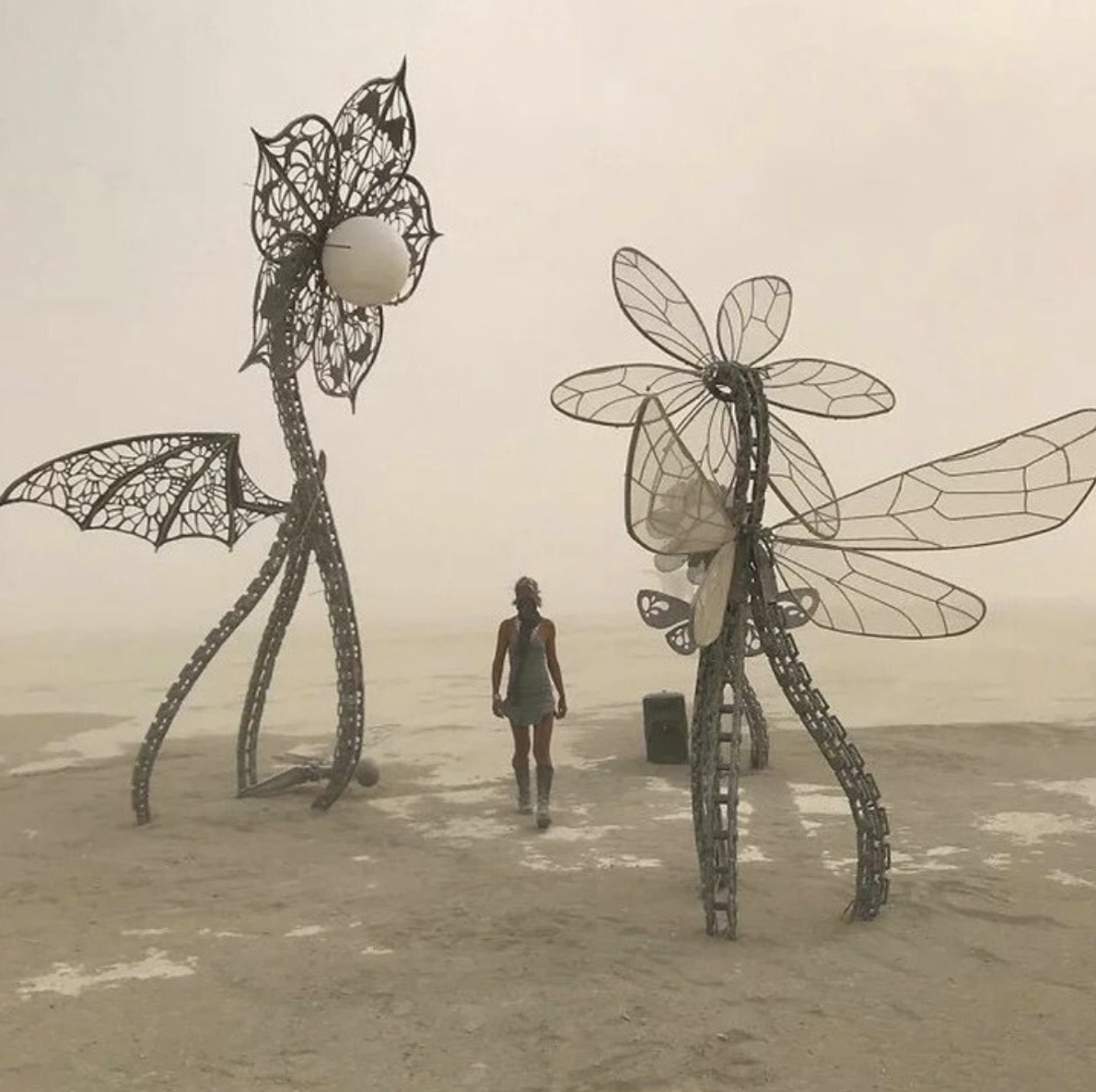
LeWitt’s wall drawings stand as canonical examples. More recent works include Holly Herndon and Mat Dryhurst’s Holly+, a vocal protocol for others to use. Another is De Filippi’s Plantoids, sculptures embedded with smart contracts that commission artists to produce new iterations.
The second, art with, is a more traditional approach, where artists do not necessarily create the protocol itself but use protocols to produce work over which they maintain final edits rather than having others instantiate and finish for themselves. For example, Vera Molnár used both a machine imaginaire and real computers to generate outputs that she then curates herself. Today, Ayoung Kim directs films in game engines rather than creating her own games (protocols) for others to play.
Finally, art about is the most straightforward. Here, the protocol is not being leveraged for anything; it is merely being examined and scrutinized. Trevor Paglen’s photographs of undersea cables and Joshua Citarella’s images of platform-mediated identities illustrate how artists can make the rules that organize society legible.
These different approaches can apply to any of the aforementioned categories. Fidenza is art as an automated protocol, whereas much AI-generated art is art with automated protocols. In their Anatomy of an AI System, Kate Crawford and Vladan Joler made art about automated protocols.
We cannot focus on each of the inner diagram’s eighteen sections, representing porous, leaky containers of simplification for our smoothbrains to handle. Not to mention, the complex web of relations the diagram also implies. That would all take a book.
Control
But we will highlight some relationships of particular interest. Noteworthy is a persistent tension of authorial control seen especially in long-form vs. short-form automated protocols, instantiable vs. usable evolutionary protocols and playable/real-time vs. unplayable/directed worlds.
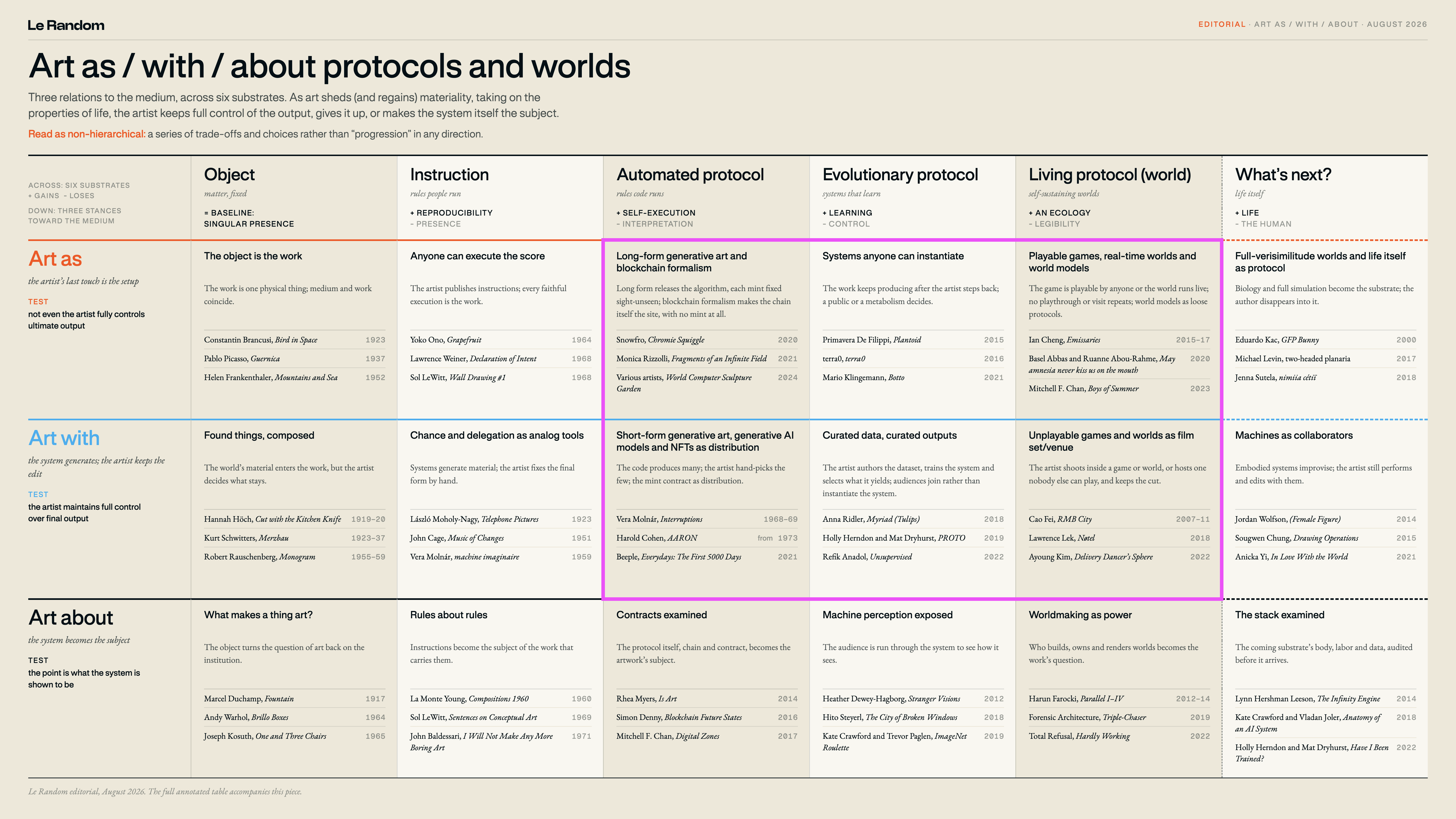
The diagram highlights the centrality of questions of control to a practice when navigating new substrates. Must you keep control to the end or are you comfortable and confident enough to share? Do you curate the automated system’s outputs or let the minter decide? Do you let others co-author and instantiate your protocol or do you curate what goes in and comes out? Finally, are your worlds playable and responsive or fixed but still inhabitable?
The relationship between automated protocol and living protocol also mirrors something discussed at Le Random with AA Cavia: computation’s shift from binary “hard programming” to cognitive AI models, themselves entire worlds capable of summoning worlds. It’s a demonstration that we needed the alignment of theory, practice, compute and data to align with deep learning to facilitate living protocol worlds.
Art’s Rematerialization, Experiencization
Something else the diagram’s innards lay out nicely is the process we seem to be going through in art of “rematerialization,” a Post-Lippard return to physicality with “automated protocols” perhaps being a dematerial local top, especially if you look at everything to its right.
The art object’s dematerialization had many culprits last century: cybernetics, twentieth-century horrors, Fluxus, Lippard. But perhaps that trend hit a local top some time during or shortly after the pandemic. Because art is rematerializing after decades of being enticed deeper into digital spaces. The symptoms are everywhere, including a cottagecore, romanticization of craft, physicality and presence, along with a reflexive disgust at AI slop.
But the shift is no simple return to objects; it’s toward the physicality of embodied experience. Zuck’s legless, literally, metaverse flopped because it failed to read this shift, moving too fast and breaking itself and notions of a fully digital, Ready Player One-style metaverse with it.
The diagram exemplifies this shift of modern audiences increasingly seeking meaningful experiences that resonate memory-sensorily rather than through pure digital consumption. Evolutionary protocols, worlds and whatever comes next tend to prioritize this physicality, presence and relationality.
Experience may be the secret to understanding the next generation of artists and collectors alike. Research suggests “spending on doing promotes more moment-to-moment happiness than spending on having” possibly because experiences endure in memory while possessions fade. Younger generations also report being more willing to spend on experiences than Gen X and Boomers The Harris Poll found.
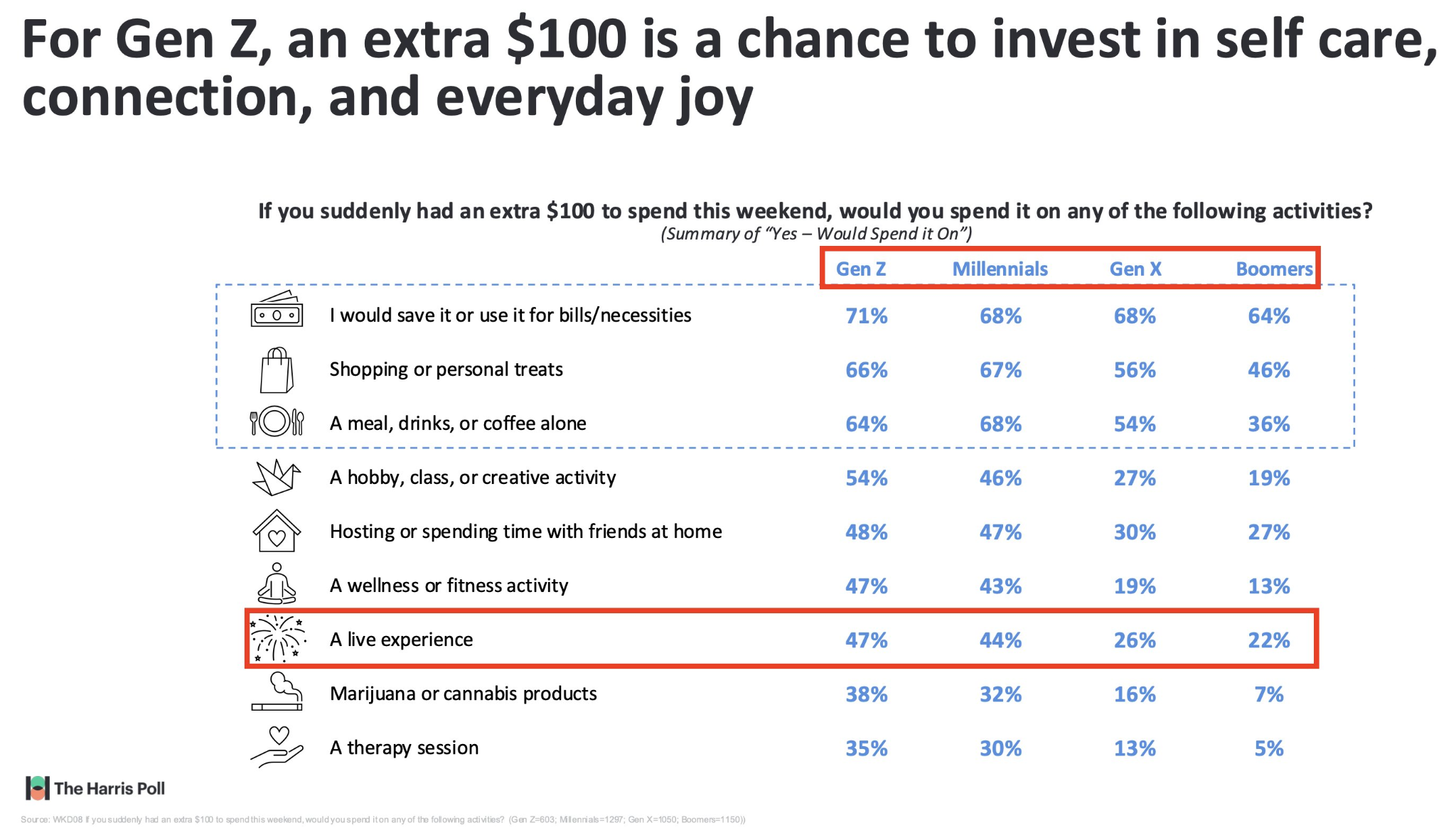
Experience is also medium-agnostic and paradoxically internal. A fully verisimilar digital Ready Player One would feel as authentic as a physical Westworld. Such is the power of worlds. They command more senses, provide a richer experience. So the arc runs: art dematerialized at the end of the 1960s, began rematerializing in the 2020s and is headed toward experiencization.
Worlds are our vehicle there. According to Helen Palmer and Vicky Hunter, “Worlding is informed by our turning of attention to a certain experience, place or encounter and our active engagement with the materiality and context in which events and interactions occur.” Worlds and experience are intertwined.
Simultaneity
Another implication from the diagram’s inner workings is simultaneity, works encompassing multiple types at once.
After all, we live in a postmodern condition. The five substrates are not phases that artworks sequentially pass through. They describe a work’s dominant feature or even different strata that a single artwork can hold together at the same time. Artwork can include several (or all) substrates at once.
Plantoid serves as a prime example. Its physical, metallic sculpture is certainly an object in space. It is also a set of instructions, the specifications describing to human artists how a qualifying Plantoid must be built. Meanwhile, it is an automated protocol with smart contracts encoded on the Ethereum blockchain, executing whenever specified conditions are met.
It is an evolutionary protocol in that it acquires resources from its environment (cryptocurrency deposited by human "pollinators"), metabolizes them (by creating NFTs that are sent back to the human pollinators) and reproduces itself (by using the collected funds to commission a new generation of Plantoids).
Finally, Plantoid is part of a larger world protocol (the Ethereum blockchain) whose broader ecology of contracts and incentive structures makes reproduction possible in the first place.
None of these components, taken individually, necessarily constitutes the artwork in totality. Taken together, they do. The metal object without the instruction protocol is a sculpture. The automated protocol without the object is a smart contract. The evolutionary logic without Ethereum, the world protocol, is a meaningless specification. Together, they form an entity with enough organs that taken together can be regarded as having a life.
Art's abiogenesis
Biology has a name for “inanimate” matter crossing into life by demonstrating enough characteristics: abiogenesis. Crucially, abiogenesis is a fuzzy process rather than a ladder or some breath from above. It is a checklist, including things like basic building blocks, compartmentalization, information storage to pass traits, an external energy source, a self-sustaining metabolism, and an environment in which to persist.
Reading across the columns describes this process in art. Objects gave art its matter compartmentalized into discrete, bounded works from basic materials. Instructions gave art information storage, traits recorded and passed on to potential new instantiations. Automated protocols plugged art into an external energy source, machines and networks that execute without us. Evolutionary protocols added the self-sustaining metabolism, systems that acquire resources, remember and vary. Living protocols or worlds are environments in which multitudes can exist.
Slowly throughout time, like life itself, art has been ticking off the checklist.
What biology calls abiogenesis, others call something else: The Art of Mancy is the invocation of life from the inanimate. Once the province of cartomancers and necromancers, artists can now increasingly breathe life into technology through code, smart contracts, AI and machines. Where abiogenesis describes a crossing that is generally unintentional, mancy describes the crossing performed with intention. But the two converge: once an artist has assembled enough of the checklist into a work, they are no longer summoning life so much as recognizing that it has arrived.
If Sarah Friend has written about the death of worlds, the moment the electron cloud disperses into nothing, here is how new worlds might arise: by ticking off enough from the checklist to be born.
Looking at art history through this diagram’s admittedly narrow lens presents work on a continuum, juxtaposing and drawing parallels in order to provide context, spark ideas. It reminds us how the artmaking of today is in dense conversation, whether consciously or not, with centuries of art history and theory. Like referencing a map, this diagram and essay are simplifications of something much more complex and “real.” But perhaps by navigating the map we can understand and orient ourselves a bit more clearly within the real’s chaos.
Speaking of unknowable chaos, this diagram also outlines something we intentionally left more to the imagination in this text: what might come next. This piece is no story of objects to worlds. The End. How incredibly boring if worlds were viewed as any kind of destination of creativity. What’s next is definitely the weirdest, scariest and most exciting bit of art history yet. Bring it, honestly.
Ultimately, the diagram shows how the art world’s accommodation of objects to worlds represents five expressions across time of the same impulse. How can we use these machines that are becoming more like us to better know, and thus expand, ourselves?
These aesthetic questions help us understand that art is becoming less about “what it means to be human”; rather, it’s increasingly about understanding our humanity within protocols and systems, in the context of unknowable, yet fundamentally important “others,” be they rock, tree, animal, alien or lifelike machine. It’s understanding that being human is less about being distinct, physical biological organisms and more about the increased awareness of the parts of our intelligence we share with others. Then being less judgmental when we find intelligence lacking in people, other creatures or Claude. Lest we be judged lacking ourselves soon enough.
------
Primavera De Filippi is an artist, legal scholar and researcher focused on the legal challenges raised by decentralized technologies, their potential to design new governance models and participatory decision-making, and the concept of governance-by-design.
Peter Bauman (Monk Antony) is Le Random's editor in chief.