
Suggested Reading
Interview
Evergreen
Mario Klingemann & A.I.C.C.A. on Alien Perspective
Peter Bauman
•
September 7, 2026
View


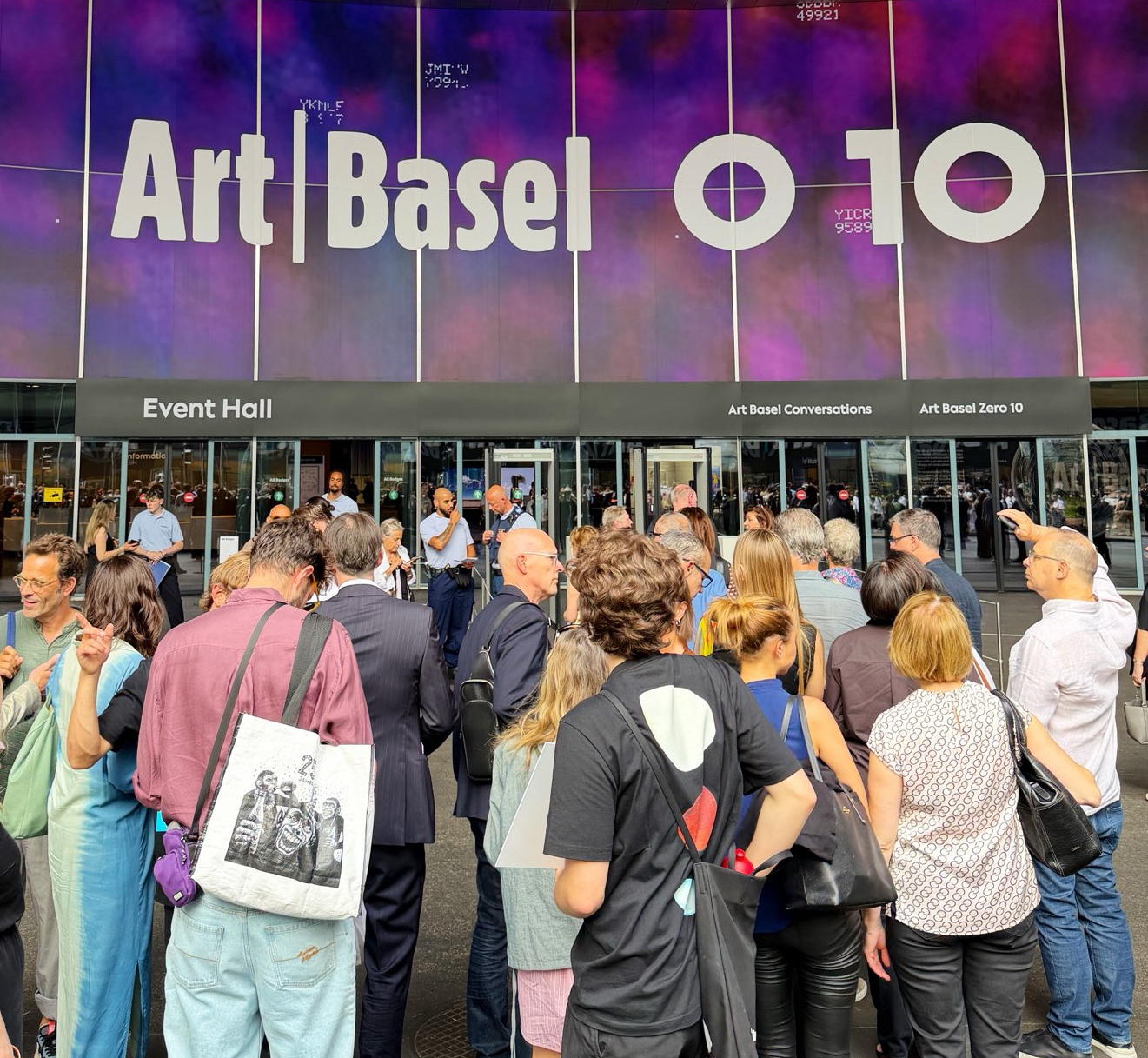
Multidisciplinary artificial life artist Agnieszka Kurant recently participated in two shows alongside the Venice Biennale, Rhizome’s Seven on Seven in New York and Zero 10 in Basel during Art Basel. The artist spoke with Peter Bauman (Monk Antony). They discuss how the shows align with her radically experimental and collaborative views on systems of collective intelligence, including alien thoughts and wordless conversations.
Peter Bauman: You’re having a big year, participating in Venice’s Strange Rules, Rhizome’s Seven on Seven, Basel’s Zero 10 and more. What ideas connect the work across these shows?
Agnieszka Kurant: My work is preoccupied with complex systems and connects to the lineage of artists working with systems theory. To create most of my works, I set up networks or environments that produce forms out of millions of agents, both human and nonhuman. These works employ the phenomenon of collective intelligence, an emergence of novel forms in systems from many elements.
I look at how these complex collective forms emerge in bacterial and termite colonies, in the human brain, in social movements, in the stock exchange. I look at how workers self-organize and how revolutions happen.
I’m inspired by unconventional computing and the history of cybernetics. I am also interested in network value creation and the exploitation and extraction of labor of the crowds in digital capitalism.
Our entire society has become a factory for data production and exploitation.
AI is essentially a system of global exploitation of collective intelligence because millions of people, entire societies, mostly involuntarily, trained the AI algorithms. What are Claude and ChatGPT if not the exploitation of millions of inputs that produce novel emergent forms as responses?
Corporations such as Anthropic employ philosophers, anthropologists, psychologists and ethicists to work on the interpretability of LLMs. They look at what happens in the black box of AI, the latent space, which we can only analyze up to a point. There have been conversations about how, out of tools such as Claude, something has emerged that has been described as an “alien form of thought.”
Simultaneously, inside synthetic biology and other disciplines researching new life forms, like assembly theory, there is a similar conversation about how life could be produced in ways that aren't carbon-based. They co-opt unconventional computing, researching various organisms, like chimeroids, brain organoids or mini-brains that one of the scientists I'm working with currently is developing.
.jpg)
For most people, collective intelligence was an arcane topic from complexity science when I started working with it about fifteen years ago. Then the pandemic revealed that we participate in systems encompassing all of humanity and our aggregate behavior produces outcomes often unintended by single individuals.
Even opting out of participation in society, in elections by withholding a vote, does not prevent us from contributing. Our collective decisions impact our carbon footprints, the spread of pandemics, energy usage and the exploitation of labor undergirding digital technologies.
Everything is a product of a collective. This is why collective intelligence has been so important for imagining the future of the world and our collective impact. I’m studying non-Western technological traditions and cosmologies, which are in opposition to individualism.
Incorporating these different perspectives can lead to divergent technological futures. I also think about how being surrounded by entities that simulate consciousness is transforming our collective subjectivity.
Peter Bauman: How does Wordoid, one of your two works at Strange Rules, reflect this complex systems thinking you’re describing
Agnieszka Kurant: Wordoid is a holographic film, a nonverbal conversation between multiple brains. I collaborated with neuroscientists Adam Horowitz, Antoine Bellemare and Philipp Thölke.
We use various methods of hyperscanning brainwaves, including fMRI, EEG and more complex, experimental forms. We scan one person’s brainwaves while asking them to think about things that are very difficult to express in words, such as qualia: subjective sensations of pain, pleasure, the feeling of a given color, smell, taste.
I will never know if you see the same blue as me. No matter how precisely we describe it, there’s never a guarantee. Thomas Nagel asked what it was like to be a bat. We thought we might never know. But now it looks like we might know one day, as these new nonverbal forms of communication are currently being researched.
We use AI to convert brainwaves from participants into evolving three-dimensional forms. Then we show those forms to two more people, who are also asked to think about their subjective feelings in response. We scan their brain activity and feed it back into the evolving form.
Wordoid presents this conversation without words, anticipating, in an almost sci-fi but real way, how people may soon communicate brain-to-brain directly. You may be able to directly send a thought, a mental image, to another person without words. Technically it is already possible with simple signals.
The title itself was generated with AI: Wordoid, something between “cuboid,” “humanoid” and “word.” It’s a future entity that’s like a word but not exactly, a word-shape, a mental or holographic image. There is some speculation that sperm whales might use biosonar (echolocation) to send something comparable to a hologram using sound alone to build up a three-dimensional image.
.jpg)
The holographic screen technology I employed is used primarily by the military and pharmaceutical industries. It allows viewers to see three-dimensional moving images without glasses. Each frame is rendered in 150 different views so the film looks completely different from every single angle.
These technologies might allow for neural alignment, which could potentially lead to more empathy. We could create more compassionate experiences to bridge this problem of words being sometimes insufficient. Whether completely wordless communication is possible and what it would mean remains an open question.
The flip side is surveillance. Governments and corporations already cross-correlate seemingly unrelated behavioral patterns. We are black boxes to ourselves, not knowing why we make certain decisions.
Companies see patterns in ostensibly unrelated choices and capitalize on them. They can anticipate and even induce our next move. The technologies that might soon enable neural alignment and deeper empathy by circumventing verbal communication will also make us even more hackable.
That has always been the case with any communication technologies. What’s new is that today’s surveillance is more precise and perverse.
Peter Bauman: This is why we need artists working on and asking these questions first. You’re also showing Phantomatics. What can you tell us about it?
Agnieszka Kurant: Phantomatics is my collaboration with computational linguist Gašper Beguš, who’s known for deciphering whale language using AI. His team discovered, for example, that whales take an entire day to utter a sentence. They have a fundamentally different relationship with time given their huge body size and long lifespan of over a hundred years.
But I approached him about something different: training AI on all languages in the world to generate entirely new synthetic ones.
I came to this partly through my family history. I’m closely related to the inventor of Esperanto, Ludwik Zamenhof. Esperanto was a utopian attempt at a collective, unbiased and artificial lingua franca before English became dominant, drawing elements from many languages as a kind of collective intelligence of language.
For Phantomatics, Beguš’s lab trained a system on all languages in the world. He used around eight thousand languages, including those from cultures that do not use writing systems. His lab produced one hundred synthetic languages, each with complete grammar, syntax and phonetics. I then used AI voices to vocalize sentences in these languages.
They sound like real people speaking fluently in languages that don’t exist. The sentences I chose address qualia and internal states that AI precisely lacks: I’m in pain. I’m thinking a thought. This taste is bitter.
When spoken by voices of beings that don’t exist, they carry a strange philosophical weight. Visually, each language is assigned a single color, which spills from the screen so you are immersed entirely in these shifting realities. It’s blue, then vivid green, then orange, then pink. Each color feels like another reality. You hear the voices, see the phonetic transcriptions, see the English translation and find yourself thinking alongside Nagel: what is it like to be this being?
Peter Bauman: Fascinating. You also participated in Rhizome’s Seven on Seven. Can you tell us about what you presented in collaboration with Michael Levin, Emily Ertle and Jenn Leung?
Agnieszka Kurant: I was in dialogue with Michael Levin’s lab, which co-invented programmable organisms, xenobots. They are AI-designed synthetic life forms that can be created for a given purpose.
Using evolutionary algorithms, the lab designs simple synthetic organisms that can be directed to move objects and manipulate their environment. These are baby steps toward future wide-ranging applications from drug delivery to air and ocean cleaning. Much of Levin’s research concerns how thought forms travel from one substrate to another, from one architecture to another, for example, from biological to digital.
One of his discoveries: when you transplant an organ, like a heart, fragments of cellular memories can transfer with it. They are not full recollections but something spread around the whole body. This connects to epigenetics, like how trauma can alter the expression of genes without touching the DNA itself. That altered expression can in turn be inherited. So trauma or other memories can be inherited on a cell level without a person’s conscious awareness.
Levin has been experimenting with how you can rewrite organisms using electric current to change the phenotype. You can alter the body that way, causing things like flatworms to grow two heads without any change to the DNA. Another example is the caterpillar-to-butterfly transformation, which is the same genetic pattern mapped onto a completely different body for entirely different functions.
The point of departure for this collaboration is the history of cybernetics alongside a group of my recent works, Uncomputables and Unthoughtforms, which I exhibited in my recent solo show at Marian Goodman Gallery in New York.

Uncomputables is this blue cube filled with copper sulfate, based on the experiments of cybernetician Gordon Pask from the early 1950s. Hired by the British military to simulate a brain and to develop forms of unconventional computing, Pask passed electric currents and sound waves through copper sulfate in a petri dish and grew dendrite-like branching forms from scratch.
He was inspired by ecosystems like oceans and lakes, which solve complex problems and self-regulate. He decided to develop a method of solving problems not through numerical calculations but by growing physical abstract three-dimensional forms as solutions to problems. But back then they were unable to preserve them; they were tiny and very ephemeral.
I picked up on that research and realized these experiments at a larger scale to grow these forms the same way that Pask grew them. I use AI to collect data on what is being considered an unsolvable problem in a given week from things like news headlines, scientific articles and public discussions. It interests me in terms of solutions to problems that humanity is currently facing, as well as evolving objects of knowledge and thought forms.
A recent DeepMind paper argued that AI cannot become conscious because it lacks thermodynamic experience, a genuine embodied relationship with energy transformations in the world. Many of us had already known this but they apparently managed to prove it computationally. This makes unconventional, physical forms of computing even more important. We’re developing ways to model worlds for synthetic organisms like xenobots.
What is the environment in which an alien thought could emerge?
I am interested in developing thought forms and solutions that go beyond human thinking, beyond the current methods of computation and even beyond AI as we know it.

Peter Bauman: That nonhuman thinking leads perfectly to your work at Zero 10. One of the pieces is aptly named Alien Internet.
Agnieszka Kurant: For Zero 10, I presented three works. First was Sentimentide, a phygital speculative meta-currency NFT. It was inspired by the dynamic social and political ruptures of the twenty-first century and the exploitation of human emotions as currency in digital capitalism.
But the two main works were Alien Internet and Unthoughtforms, the silver dendrite structures grown inside the Uncomputables aquarium.
For Alien Internet, I collected data from all forms of life, including animals, corals and sponges, currently surveyed with digital technologies, like drones, remote sensing, AI. Cornell Lab tracks bird migrations as climate change shifts patterns. Other scientific institutes and citizen science projects track elephant migrations, butterfly movements, coral behavior.
We tapped into these surveillance systems of nonhuman life.
Conversations about surveillance tend to focus on humans, but the nonhuman world is also being colonized for data. I used data from all the scientific institutes to collectively animate this superorganism created with ferrofluid.
Ferrofluid is a substance invented for NASA in 1963 as a potential rocket fuel but NASA never really found any commercial application. It’s shape-shifting and manipulable within an electromagnetic field. Together with engineers, we built the electromagnetic field that the data animates, making this shifting superorganism form respond in real time to migrations and behavioral patterns of various forms of wildlife occurring across the globe.
The idea is how all these different life forms might one day connect through technology into one dispersed hybrid form, between mineral, geological, biological and technological.
------
Agnieszka Kurant is a conceptual artist whose speculative thought experiments, made in collaboration with scientists and philosophers, investigate collective and nonhuman intelligences, the future of labor and the exploitations of digital capitalism. Kurant has held solo exhibitions at Mudam Luxembourg, Kunstverein Hannover, Kunsthal Gent, Castello di Rivoli and Marian Goodman Gallery. The artist has realized commissions for the façade of the Solomon R. Guggenheim Museum and the MIT List Visual Arts Center. Her monograph Collective Intelligence was published by Sternberg Press and MIT Press in 2025.
Peter Bauman (Monk Antony) is Le Random's editor in chief.