Suggested Reading
Interview
Evergreen
Ian Cheng on Composing with Systems
Peter Bauman
•
June 15, 2026
View



Virtual worldbuilding artist john gerrard spoke with Peter Bauman (Monk Antony) on the occasion of his year-long LACMA project, SPIRITS as well as work appearing at Art Basel's Zero 10. The LACMA work, SPIRITS, consists of live 3D sculptures of sandals and shoes from beaches across the world. The project culminates on June 21, 2026, with a summer solstice dance at LACMA featuring Richie Hawtin. They cover gerrard's twenty-year arc from early game engine works to browser-based public art; the entanglement of petroleum, plasticity, and modern life; and why gerrard believes the game engine is the most important medium of our time.
Peter Bauman: Your work centers geopolitics, technology, infrastructure and energy when all four seem to be palpably destabilizing our lives. How they’ve become entangled with our lives has been forced into mainstream consciousness recently with blockades, bombings, chips, AI, server farms, etc. What does your practice argue art offers in times of crisis like this?
john gerrard: It's a very interesting question but I would disagree with the first part. I would say “changing” over “destabilizing.” Technology, infrastructure and energy are all changing our lives very, very profoundly. They are changing culture very, very profoundly, society very profoundly and we have to pay attention.
The word I'm leaning into these days is luminous. On the one hand, we've got these extraordinary networks of data stretching around the world at the speed of light. They allow us to feel and think and share in different ways—to be networked people in different ways.
A very simple example would be music. I’m constantly playing music and the network on which I'm playing it is learning about the latest song I played and then offering me associated ones. I'm drifting through cultural networks finding beautiful moments in a way that I'm not sure has ever existed before in a global sense.
In electronic music or the dark dance music scene that I'm very interested in, I'm able to discover rich, powerful things in an unfathomably global and beautiful way.
But the next part of the question is undoubtedly true. We have blockades, we have bombings, we have chip wars, we have AI upheavals, thirsty server farms, burning the earth, all of that. That's the area that I'm coming from because I would say if there's a history to my work, it is in the prism of power on the one hand.
On the other hand, and inherently, if you're talking about power and consumption, you have to talk about energy because, of course, all of these things are about the exchange of energy between different places.
My earliest works were about power, like Dust Storm at Marian Goodman in 2007. It's about plowing America post-First World War, about taking petroleum, directing it to the landscape, and ruining the Middle American landscape in just ten years. One hundred million acres of the American Midwest were basically destroyed in ten years between 1920 and 1930. What people talk about when they talk about the Dust Bowl is actually petro power directed to the landscape.
What does any practice offer in times like this? I'm really drilling down on this idea of movement. I can't change the world because I'm just an artist. And all I ever want to be is an artist. But potentially what I could do is to move the world just a little bit.
The word “move,” if you pay attention to language, is a big word. It's an emotional word, to be moved. And it's also a physical word. I can move something.
My greatest ambition is to try and move the world—in tiny ways or bigger ways. Art is my lucid dreaming mechanism to do that.
Peter Bauman: Is that why your practice also centers how tiny movements lead to gradual change? You’re asking the audience to notice that even small changes add up over time. I’m thinking even of early works like One Thousand Year Dawn from back in 2005.
But then again, small changes can also be mistaken for transformation when they are really just repetition. I’m thinking of the petro wars your work from two decades ago was criticizing. Yet, here we are in 2026.
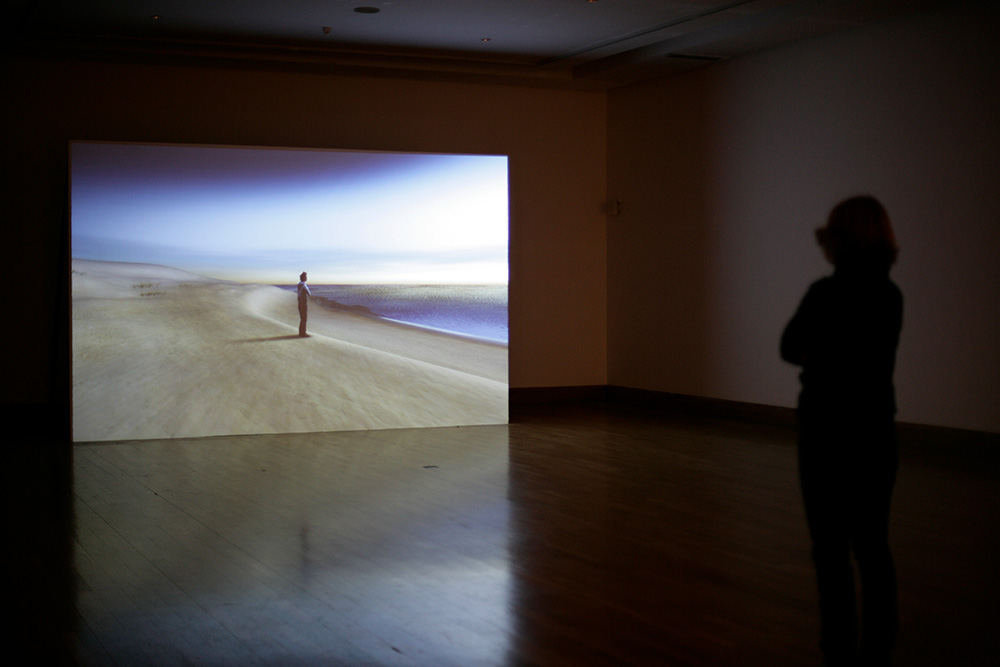
john gerrard: One Thousand Year Dawn was the first work I ever sold, which was quite a moment for me. It's a very, very important work for me. People don't talk about it very much so it's nice to start there.
In that work from 2005, you have a young person that is basically a 3D game engine character; it’s a portrait of somebody I met in Linz when I was in the Ars Electronica Center.
I overlapped there with beautiful people like Casey Reas, Zach Lieberman and others coming from MIT Media Lab at that time. It was a fascinating moment, 2001 to 2003. One Thousand Year Dawn is a minimal work where a young man looks at the sun rising but there’s been a glitch in the system. The sun will take one thousand years to rise.
I first started making 3D scans as an undergraduate in the UK in a beautiful little art school called the Ruskin [Oxford University] around 1995. In the early 2000s with this work, I brought the 3D scan into the game engine. This is a very early game engine-based work.
One Thousand Year Dawn really asked, “We're not making a video; we're not making a film; we're building a world. What are the conditions of this world?”
The first condition of this world is that it is theatrical, fundamentally. I can say to my actor, who is the sun in this instance, "Rise over a thousand years," and the sun will rise over a thousand years very, very slowly.
It's actually doing it in the work; you just can't see it. My character, in an almost Beckettian sense, being an Irish person, simply waits until the sun rises and, in 3005, walks out.
So we put this work up in Miami, of all places, in 2005, after I had spent ten years developing my work as an artist. I was cartoonishly broke. And we sold the edition of six in fifteen minutes, boom. For some reason, Miami in '05 needed to deal with grief, emptiness and time.
Then weirdly over time, this great enthusiasm for technology was tempered by, let's just say, social media emerging and all these other energies where we realized, “Actually, maybe it wasn't quite so good.”
But in '05, you had a collision of things pre-global financial crisis. The fair was young. I was young. I mean, Jesus, it was twenty years ago. But a bunch of people bought a game-engine-based work on a computer in a box with a screen and carried it off to their houses.
Peter Bauman: Well, we started at the start.
john gerrard: It's nice to start at the start because we end up in this theatrical void, which is literally a temporal void, but it's also performing a very new medium.
Because it's not media; it's data. It's not coming from the image. It's not coming from photography; it's coming from wargaming.
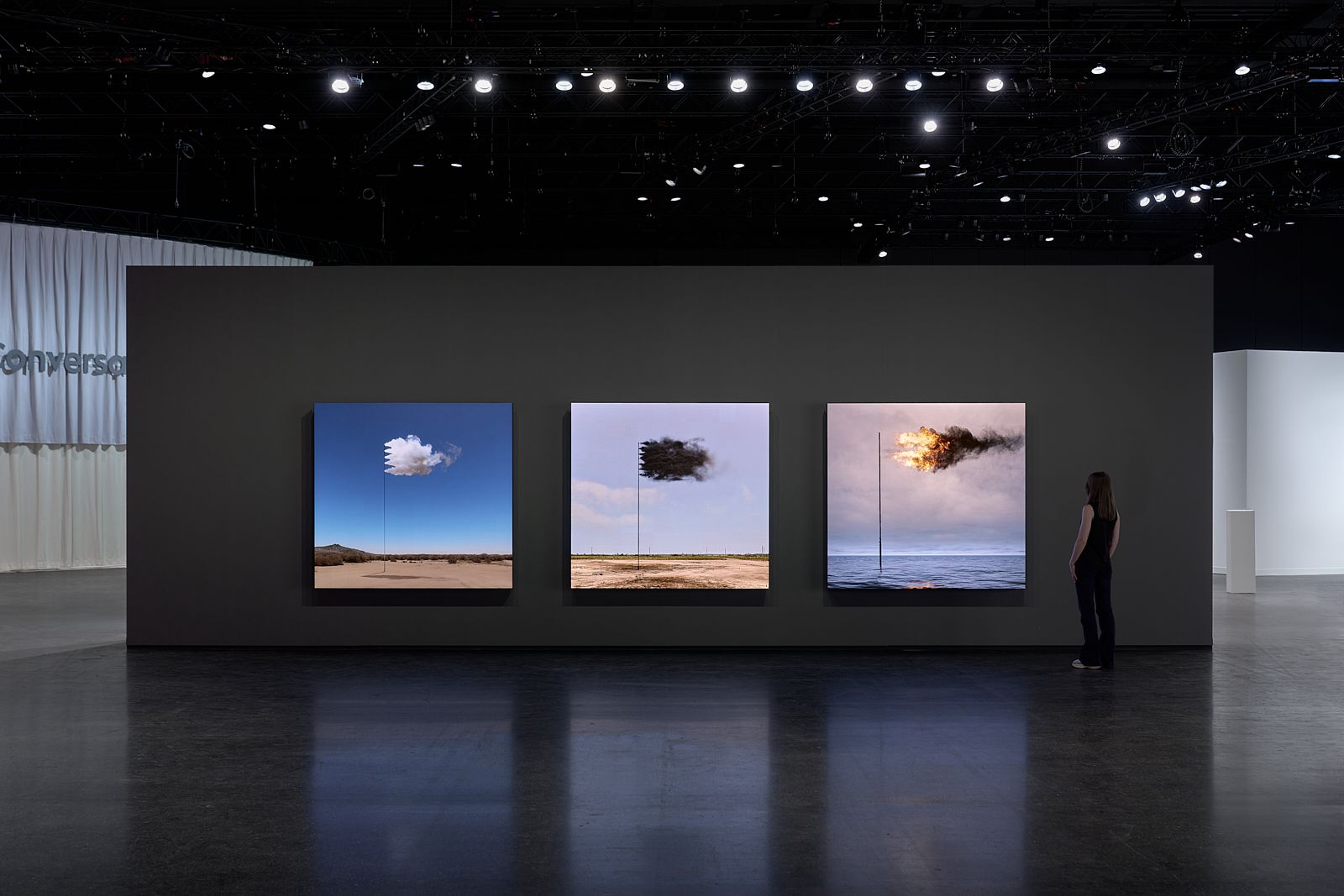
The histories of the engine are different from the histories of capturing media. It’s funny because, still, half the comments under any post of Western Flag argue how I could actually make such a polluting object. And I'm like, “It's not real.” They think it's a recording. Obviously we put a lot of love and attention into this liminal space between the real and unreal. That's why they feel like that.
But for the public, media is about the record, and they're not yet really dealing with data. Let's say worldbuilding, which is what I call it.
Peter Bauman: What gets misunderstood about digital simulation, or worldbuilding as you put it, in fine art?
john gerrard: If I were going to put my hand up and flag something, I'd say that the art world is disconnected from worldbuilding because computer science and contemporary art are quite profoundly disconnected.
Contemporary art has all its histories and all its poetry and computer science has all its power.
They're only just starting to meet each other in a profound sense now, if at all. I've had to build such a weird little world here to work in the engine ambitiously.
Peter Bauman: What was next after the void?
john gerrard: We start with the temporal void of One Thousand Year Dawn. Then in the middle, we have slightly weird works, which were these six series of trees made from smoke.
They're an inversion of the norm. Trees are making smoke instead of absorbing carbon. In the next series, I found representations of dust storms.
If I were going to lay down any threads, I would say ecology, technology, power.
Peter Bauman: From the start you were thinking about those intersections of art, technology, ecology and power. Those all surface again in SPIRITS, your year-long, browser-based LACMA show. SPIRITS centers this tension between natural energy sources like the sun and extractive resources like petroleum. What is this work contributing to the conversation?
john gerrard: Petroleum is an extraordinarily complex material, fundamentally. I mean that in many senses but it holds sunlight. Historically, sunlight hit the earth and was held as petroleum. Then that solidified upon the earth as plastic. Now plastic sits upon the beaches of the earth because fundamentally plastic is an infernal material. It cannot die; it just haunts the earth.
It is a twentieth-century material that has no place in the twenty-first century, a remnant of the oil age. Western Flag is, in a sense, a monument to the twentieth-century oil age based in Spindletop, Texas, where the first big strike was.
The dynamics of the twentieth century are the dynamics of modernity—modernity and petroleum are firmly aligned—and petromodernity sits with us fully at this exact moment.
Think of walking along the beach and finding all the washed-up flip-flops. I don't know what the stories are; they're unknown. I collect them and I carry them, as a kind of witness, back to my studio or production space. Then we take fifty to sixty photographs of each one to produce what's called a Gaussian splat. A 3D data object is probably the best way to describe it.
When I was an undergraduate in the mid-'90s, I called my 3D scans image-objects. I felt that 3D scanning—I'm a big raver—completely changed the history of photography. I'm coming back to that idea of an image object now. It gets interesting when you bring the Gaussian splat into WebGL, which is obviously the game engine in the browser. It’s an incredibly powerful way to build compelling worlds.
I want to make a proposal that the browser is really the most important site for public art we have right now.
Funnily, I'm just coming back. If you look at my work across the years, you will see twenty years of me on the street. It’s LEDs in the real world.
Peter Bauman: How is the LACMA work a departure?
john gerrard: For this LACMA work, my next street is the network. LACMA have presented really for the first time, a mainstream solo show only in the browser, and it's up for a year.
It centers on four great bodies of water: the Pacific, the Indian, the Mediterranean and the Atlantic. It's all of these beautiful shoes that I found and transformed.
It's almost a global orbit in a line, starting with the Pacific, which is close to LACMA. It goes on to the Indian, the Mediterranean and the Atlantic. Then we mapped that orbit onto the cardinal points of the year. So it launched with LACMA and the Pacific during the winter solstice. Then for spring equinox, we launched the Indian Ocean.
Now this summer we have the summer solstice launch for the Mediterranean. That's appropriate because the solstice is the longest day. That day we’re organizing what's called the summer solstice dance for two thousand people at LACMA. It’s June 21st with Richie Hawtin, the esteemed electronic musician.

At the heart of this project is the proposal that touchscreens are a cultural superpower that we have to take very seriously. We have to take global consciousness extending through the arm to this kind of electromagnetic relationship with touchscreens as a super-potent cultural interface. My whole LACMA project is my bid for a little room in that cultural space, which is super-dominated by social media. But this is a piece designed for the phone. It's a phone artwork.
The flip-flops are meant to be touched and manipulated. In reality, they are entirely made of solidified petroleum even if it's made to look like woven cotton or leather. It’s solidified with chemicals, and then it's coated in fire retardants, but it is petroleum.
Our two-year arc of production has brought us to this point where when you touch the object on a screen, it can reveal what it's made of through touch. It is a touch-driven transformation of an object into a kind of a psychedelic aesthetic.
Maybe it will make us all more aware of what we consume. Maybe this moves audiences to think about their trainers a bit more and to say to Nike, “Give me some seaweed-based trainers.”
Then on the bottom left-hand side, we have a little sound symbol that plays a generative sound system where you can play this object as a techno system. You build the track through touch, and then you manipulate it through touch.
Artists are locked out of phones. But this is my bid to get in. Music is one way and is at the heart of the SPIRITS project; it's at the core. I worked with a wonderful emergent algorithmic composer.
Peter Bauman: So each season the aesthetic effect and music also change?
john gerrard: Yes, Winter is very minimal. The first touch is light. If you keep touching, you enter a kind of ‘60s psychedelia. Then you get ocean. Then you get burn, a dark black. And basically you end up with what we call the void.
Going backwards, Spring is not minimal and is ridiculously exuberant. In Spring you have ecological and cultural tipping points. The first touch again reveals a light language. The next touch is a deep gloss language. Gloss sells a lot: cars, lipstick, you name it. We've invented all these languages ourselves and call it function crafting.
Then we have a section based on Aphrodite's Temple rave flyers from the '90s. Fundamentally, acid house blew up in Detroit in the ruins of the motor industry in the mid-to-late '80s. It hit hard in the '90s and kind of changed the world. So I'm talking about cultural and ecological tipping points: the world changing along with industry and culture. How are the kids responding?
For the release on the summer solstice, we’re taking over the front page of LACMA for 24 hours. The performance will be from 6 PM until 10 PM at LACMA. Some local LA musicians will perform first before Richie Hawtin takes over and kicks it as a transformative rave.
Then the piece will go to Ibiza and we're going to try to launch a track called Pico Summer as a dance track. It’s not because I want to be a musician, because I'm not; I'm an artist. This is a conceptual strategy to try and get especially younger people into this dark world where they basically ask the question, “What am I wearing and what does it mean? And what kind of a world do I live in? And why do I live in such a world?”
So that is SPIRITS.
Peter Bauman: Just as a way to summarize or wrap up, how does this work relate to your theory of worldbuilding? How does it constitute a world in your eyes?
john gerrard: I suspect the game engine is the most important medium of these times.
If you take the idea of generativity and extend it into the complexity of the engine, which is a generative space, a conceptual space emerging from code, literally performed. Then you put that work into the phone, where the public has this hyper-sophisticated, theatrical, performative, social, cultural relationship to it; things are going to happen.
The world is changing. What we might have considered a museum is probably changing. LACMA is becoming a place to hang out. But is that where the most potent culture is occurring? I'm not entirely sure. Technology drives change, always. That is the lesson from history.
We're entering an era where that lesson will happen at warp speed, for better or for worse. Climb on the dragon and try to steer it to beautiful ends. That's my proposal.
At the heart of art and technology is worldbuilding: auditory, visual, conceptual, social, cultural, ecological. It’s not about sculpture, not about painting. This is all going on right now. It's the most exciting time.
------
john gerrard is an artist whose game engine-based works construct virtual worlds that probe the entanglements of power, energy and ecology. His work has been presented at Tate Britain, LACMA and the 53rd Venice Biennale, among many other international institutions.
Peter Bauman (Monk Antony) is Le Random's editor in chief.