.jpg)
Suggested Reading
Article
Evergreen
The Cerebral Samba: Protocol Art, Worldbuilding & Our Two Brains
Peter Bauman
•
May 25, 2026
View


Virtual worldbuilding artist Jakob Kudsk Steensen speaks with Peter Bauman (Monk Antony) about the centrality of fieldwork and process to his practice. They discuss archiving vanishing environments in virtual worlds, the play between structure and daydream in his creative process and the embodied sensibility behind Steensen’s slow, textured approach to digital worldbuilding. An exhibition of his work, Otherworlds, is on view at Phi (Montreal) through September 13, 2026.
Peter Bauman: You center environmental storytelling but do it through digital tools that create virtual worlds. It seems like a bit of a paradox. How can the digital reveal something about the natural?
Jakob Kudsk Steensen: It was never such a rational, conscious choice. I grew up in the Danish countryside. As a teenager, advanced three-dimensional virtual worlds became much more common through video games in the late '90s and early 2000s.
Back then I started modifying video games to build virtual landscapes. The level editors, the tools you use to build three-dimensional video game engines, have been in my life since basically Unreal Tournament '99.
Then I started uploading worlds to forums and became friends with people who did that. Using virtual tools like that became almost like playing an instrument, the way you program, the way you design. I work with a lot of musicians and composers for the same reason. It's a very intuitive way of engaging.
Then over the years I’ve become friends with several marine biologists and people working in environmental protection. It's part of who I am, as a friend network, as what I think about, what I read, where I go, people I meet, everything.
Both worlds have just been part of my life: a strong environmental perspective and a passion for the creative tools behind making three-dimensional video games.
What that offers for storytelling is that when you find yourself in these environments, they’re the result of me spending months at a time in natural places and working with natural historians and field biologists.
I record sound; I digitize things with photogrammetry so you're experiencing reality from the perspective of a field biologist who spent twenty years in a place, seeing with your own eyes things that you otherwise wouldn't see. Then when you put them inside the video game engine, suddenly you can see them a hundred times larger.
You can create pathways of sight that are completely non-human. You can fly around; you can look and feel and move and play with scale far beyond the human body.
Video game technologies really provide a way of playing with time, movement and scale that feels closer to the actual environmental narratives or philosophies of these field biologists than if you're just talking or writing about it.
Peter Bauman: Your fieldwork is direct encounter with a place. But the digital worlds you build are constructed, curated. What does your attention to process add to your worlds and is the goal simply to perfectly recreate natural worlds in the digital?
Jakob Kudsk Steensen: There are two things. One is, of course, the environmental part. Working with video game technologies allows me to build an archive over time. All the assets—the 3D objects, the sounds—I digitized and collected myself. Or I worked with collaborating sound artists and natural history institutions. I do interviews with biologists to share how people's memories of a place and emotions connect to climate change and its impact on that place.
That library is quite expansive by now. I just opened Otherworlds at Phi in Montreal; the oldest work in the show is from seventeen years ago. Some of these places don't exist anymore.
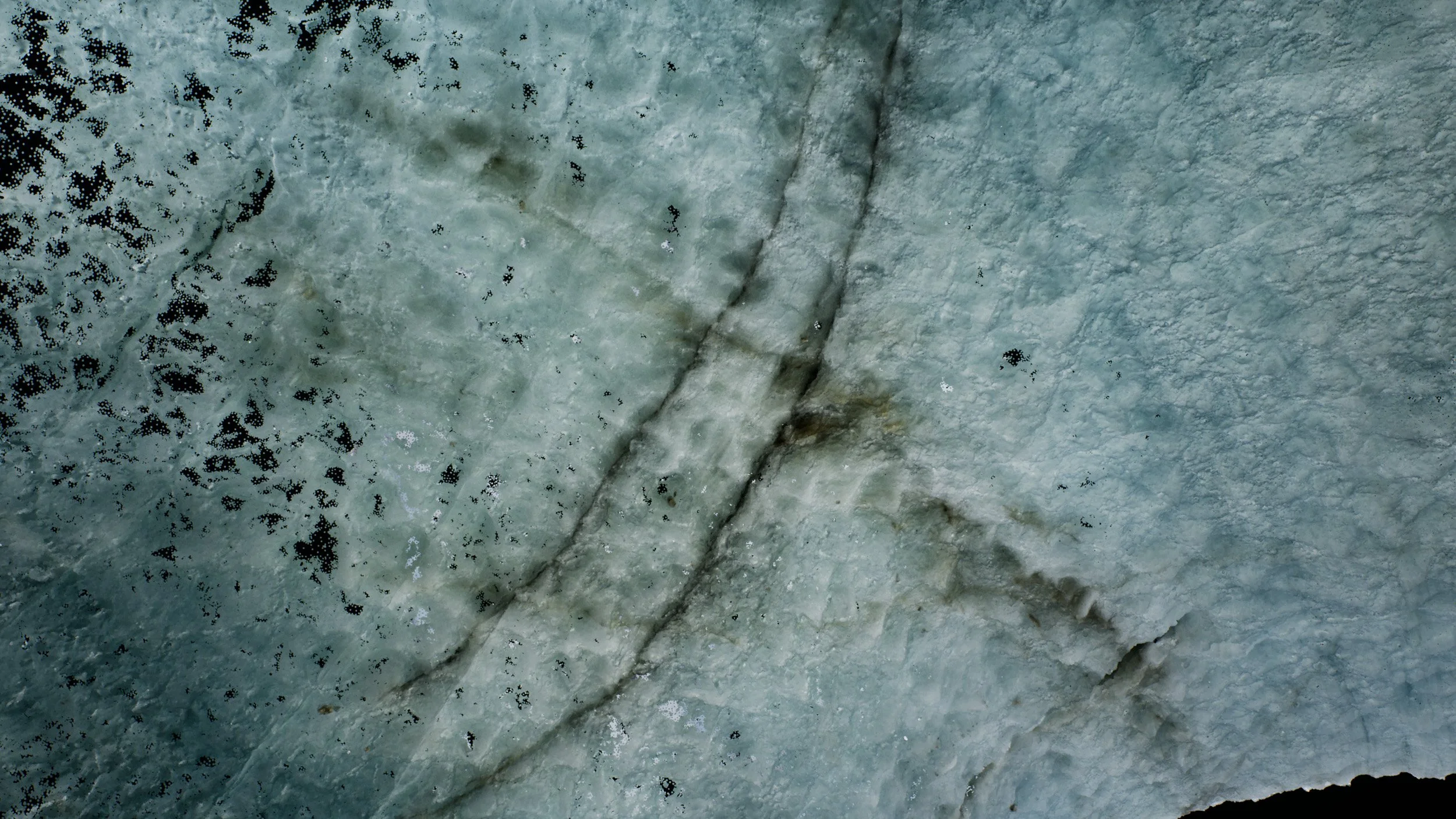
For Tongues of Verglas / Les Langues de Verglas (2022-2023), I digitized the Arolla Glacial Cave in the Swiss Alps. One year later it collapsed. So I went again and we interviewed a glaciologist in her mid-eighties, who went there sixty years ago to document it. It means I have memories from people who've seen this place, and I have a full, three-dimensional interactive copy of a three-hundred-meter glacial cave that doesn't exist anymore.
The other thing is what I was saying about the play with scale and senses. There’s something rhythmic or emotional about it. It's not really about high fidelity to the original; it's much more about texture and transformation. I'll often create work that begins looking very photographic and then becomes transformed, metaphysical, glitchy or fractured.
It always depends on the exact story of that work. In Berl-Berl, I worked a lot with vanishing wetlands and rivers in Europe. I also did a big project, Psychosphere (2025), on underwater volcanoes. That body of work over the last five years is very textured and high-detail because it's photographic and based on fieldwork.
But earlier works, like Aquaphobia or Primal Tourism, were fully virtual reconstructions, not photographic at all. They were locations built entirely from 3D modeling based on people's memories.
My style is never fixed; it always depends on the exact story, environment and project. But there is a consistent sensibility running through it besides an interest in vanishing natural environments.
It’s also about a more crafted and textured sensibility to the world when we work with digital technologies.
Most digital culture right now places a heavy emphasis on the output rather than the process of creating it. To me, those two are inseparable. I know these worlds through the process of crafting them and I believe that process directly impacts the emotional experience of the final work.
Culture at large is obsessed with outcomes rather than engaged processes. So I also slow down time to a quite radical scale compared to most things made with video game technologies. Some works are just incredibly slow. It's like an hour moving around a tree and some rocks. But people are captivated by it because there's this texture.
You see and hear all the differences in something specific. That's what I mean about time; you can slow it down and allow people to perceive the world at a different pace than they're used to.
Peter Bauman: You mention that people are captivated by the texture. How do you use full-sensorial immersion with visuals, sound, even scent as a worldbuilding tool?
Jakob Kudsk Steensen: There are two ways of thinking about immersion: one is for the audience and one is the process of creating it. These go hand in hand. Through fieldwork I digitize all this material from an actual landscape. But there's a point where I also write and draw a lot. You don't see this so much in the work but it's essential to how I decide what to show, what's the pace and the color and so on.
Those ideas only arrive after having been immersed in an environment for like a month. When you close your eyes, you see things that you've looked at physically and virtually, and they’ve fused together.
This is like my dreams, my psyche, my body merging with the digital copy I've created of this actual place. That's the point where it starts to feel like art to me, where it's not just documentary or digitizing something and showing it at large scale.
It's the transfer of that feeling, pace or psychological response in relation to the technology and the environment that I focus on in the art installations.
It's very hard to define verbally but you have to imagine. I do about one project a year and maybe six months of that is creating that pace and that feeling for the audience, which draws on all these incorporated memories I have that I create as an experience.
There are two ways to achieve that. One is the actual installation design. When dealing with large crowds and museums, right now I create environments where I like to think I create an open world that allows someone to enter it quite at ease at first.
They might think they're entering a room; it sounds nice, it looks good, there are large screens and sound around. But then you stay and there are these cadences in the work where you may go from familiarity to alienness, from something very pleasant to very dark. Different moods happen throughout.

I create installation designs like you go into a park and you're there and you start noticing things. Then the weather changes and things happen around you and you start to pay attention in a new way, but it takes some time. You need to lull people in, get them in, and then after a while, suddenly they start seeing things they didn't notice before.
I had a show at the Museum of Aarhus in Denmark, and some people sit there for three hours where they get into this kind of rhythm with the work. The sound, the visuals, the scale of things are continuously changing. That's the state I hope people enter.
Of course not everybody does but in order to get people there, it helps that there's this continuous rhythm that people enter. It's very hard to describe, because that's the craft of it, that's the art of it, that's the experience of it.
It's a very complex process to achieve it. I write short stories and poems that I share with collaborators. I create pictures to invite, for example, collaborating sound artists who also have to feel like they enter that world.
So I have to craft an area in a virtual world for the whole team and they all have to inhabit that to make it come together in the end. Then that's what an audience enters, this kind of orchestration.
Peter Bauman: It reminds me of something I wrote recently: that the way artists build worlds and their connections to rules is a play on the brain's own two hemispheres; worlds can be seen as an attempt to share that internal mind state.
Jakob Kudsk Steensen: It makes a lot of sense. There are many different ways of using language to describe it. For me, I know the work through a practice I've developed over fifteen years. I have a way of knowing the actual world, of how to enter different types of environments to see things or hear things often missed.
I have to go through all these processes. It's almost like anthropology with a landscape and the people who are there and you learn from them to access parts of it you don't perceive at first.
Then there's the virtual part. It's not something I talk about so explicitly normally.
There is a whole process I need to go through so that you have this daydreamy, floating part of your brain that then connects to an actual environment.

But in between, I have an actual technology and a work I need to program. I need to work with all this structure to develop that.
There's an interesting play always between something very structured and technological, and an actual world that's been digitized. Then doing it in a way where, within that framework, you can also let go of yourself to an extent, as a creator, and hopefully for the audience it becomes more floaty, dreamy, associative.
I work with a lot of composers because I think of my work as composing. It's this kind of story unfolding as an instrument over time that takes you on this journey. I very explicitly think about mind and matter and technology and psyche, but my language around it always changes for different projects.
In Boreal Dreams, I worked with a leading dream researcher from MIT, Adam Haar. We went to a forest research facility in northern Minnesota in the summer of 2024, where they are simulating future climates in reality.
He interviewed the scientists and wrote stories in response to them about how climate change changes our dreams and our relationship to natural cadence and light. I also worked with the sound artist Matt McCorkle, who joined us and recorded sounds of these places.
That’s how we created Boreal Dreams as an immersive installation for art museums. The work uses the literal language of climate change and dreaming.
But every project I do, I change my language. I adapt to the environment and the people thinking about it. Because then I created this other project, Psychosphere, which is about the origins of life and psyche in the deep sea with another philosopher, Melanie Challengers, who thinks differently.
The way I keep being inspired is to keep molding my mind and the language around it each time. When working with technology and engaging deeply with game engines, I need to categorize, design and code everything. So I need a language to do that and I try to switch it up every time. The final outcome is this virtual world and experience.
Peter Bauman: What work has come closest to your own philosophy?
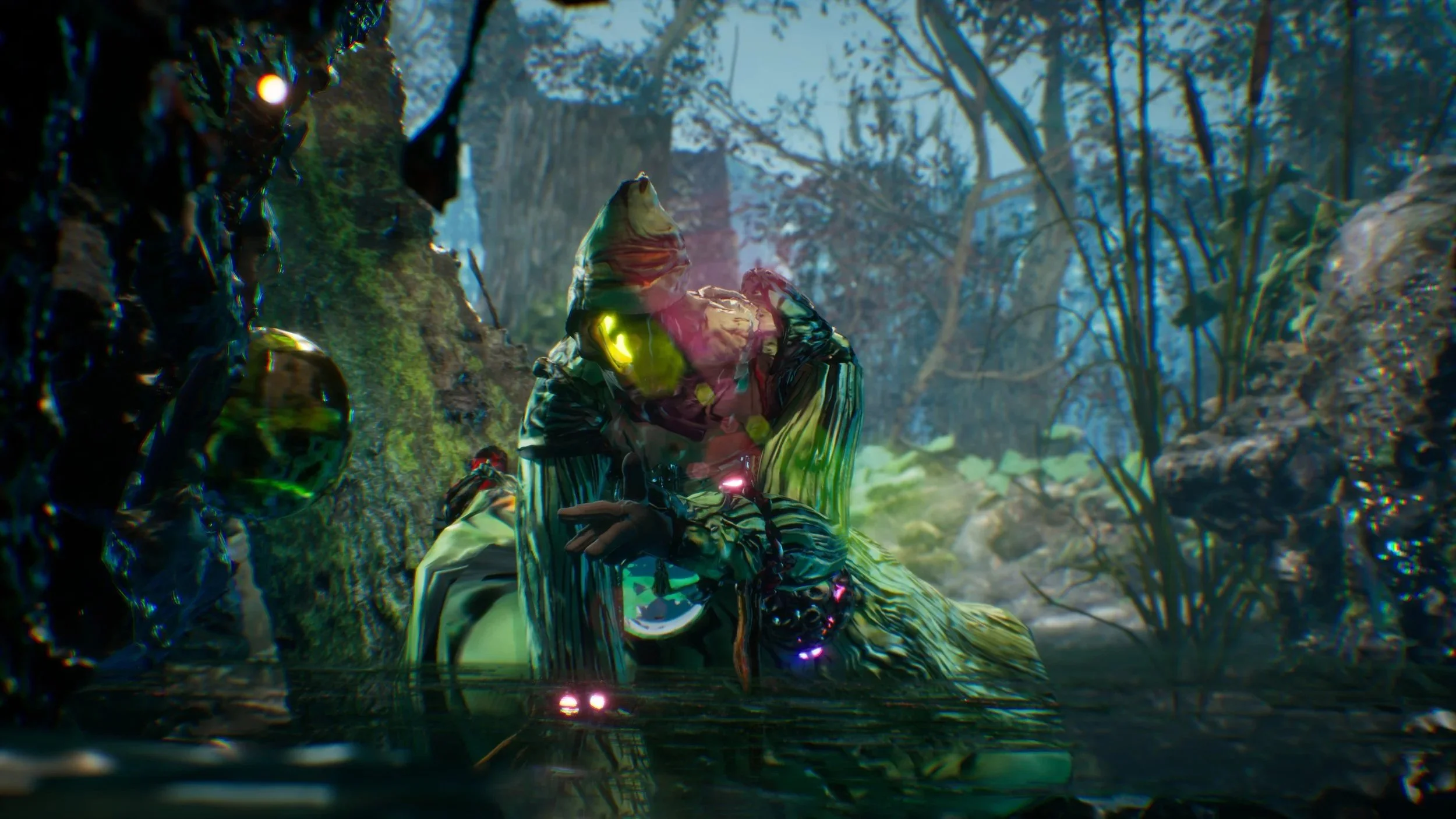
Jakob Kudsk Steensen: The Song Trapper is the first work in a while where it's more my own philosophy; these are my quirks, my way of thinking about the world. The work is about a character, the Song Trapper, who cannot speak. It can only record sounds of the world and remix them in order to express itself. It’s an analogy for how most people express themselves today.
We're always talking through a technological mediator: the interview gets edited and remixed; social media is like that, too. We remix all sorts together in order to express ourselves from the inside.
The work was also made as part of the Louis Vuitton Foundation, which has an experimental art program. They invite artists to do something they haven't done before. I told them I wanted to write a poem, and then work with a dancer and motion capture, as they transformed my words into motion.
I hand drew a character with watercolor and then used an AI to turn that into a rough 3D model, which we completely remodeled over three weeks so it could be performed by the motion actor. She moves through four different virtual environments I've created in the past. The character reflects on the role of technology and the impact of having an individual voice as a means of expressing yourself in relation to the world.
It goes on this whole journey, even meeting another character that actually has a voice. They end up accepting that that's just how the Song Trapper experiences the world, through remixing, and that's okay. Then it tries to look for a new personality at the end of the work.
It is more or less my experience of the world. I know these natural environments by digitizing them, then I express myself through this remix.
I think about how we have so many generative technologies now. More and more people will express themselves through this kind of remix, which is an extension of your voice, your emotion, your body language, everything, through technology.
I feel like that's the world we're entering now, as artists, as people.
Peter Bauman: If digitizing natural environments and expressing yourself through that remix describes your practice, how would you characterize your worldbuilding toolkit?
Jakob Kudsk Steensen: I'm thinking a lot about that this year with the opening of Otherworlds. As we mentioned, it’s a selection of work created over two decades. Seeing that made me realize I've gone from video game installations to more immersive experiences.
But the one thing I really believe in more and more, that I want to keep doing when it comes to worldbuilding, is an insistence on reaching an imagination or an expression. It’s a relationship to the world when using virtual tools that you cannot imagine before you start the process of creating it.
There are many different ways of doing that. You can do it in a more desktop style: the way you draw or design. Or you can accept that you're going on a journey of exploration. But I cannot get there without going to these environments or experiencing sensibilities that are completely outside of that.
The more we have large industrial tools impacting the way we can express ourselves, the more important it becomes to use them in really esoteric, different, unique and personal ways for small communities. That will create a more unique, personalized response to the world and to technology.
So with worldbuilding, I accept that there is a lot of structure, language, technology, financial support, all these systems that need to be in place. But I very intentionally, for every work I make, design a journey that allows me to get lost within it, where the journey of creating the work is part of figuring out what it is, like writing an essay or doing research.
I believe we have this kind of embodied, other way of sensing, a softness, maybe. A lot of my work is pretty soft or slow. There's emotion in it that’s worth finding ways to nurture and include when designing virtual worlds. More and more, creation is centered around the final outcome, and we're going to keep cutting away at encountering all sorts of things you cannot imagine when you sit down to design something.
I'm exploring that right now: What does it mean to keep making work? I think exploring those sensibilities, a very corporeal and deeper emotional use of technology, is where I want to go. And that can be translated into exact design principles, methods and structures.
Peter Bauman: In designing those structures, how do you think about authorship? Do you see yourself as hands-off creating emergent conditions or like the composer you mentioned?
Jakob Kudsk Steensen: Both. And then a third thing. The way I create is that in the beginning I start very controlled and rational. I look at a map of a place; I look at it through human history, natural history, geology, from a satellite view. I always start with an actual place and figure out what the work is later.
So in the beginning it's very top-down research, analyzing it and finding a story. You write grants, get a commission and so on. I line up the rational, fairly academic, analytical narrative. There is a lot of structure there.
Then I go to the place and work with people who have a similar worldview of it, often from a natural scientific perspective. After a few weeks, I try to get to a point with the scientists where they show me something they're very passionate about in the place but that may not be what they normally focus on scientifically.
For Berl-Berl in the Camargue wetland region in southern France, after a few weeks, the guy who'd been running it for forty years looks at this little bubble in the ground and goes, "Look at this. I know this is not what you want to know about, but look at the way organisms grow inside of this bubble in the mud." And he loves these.
That is part of building virtual worlds for me: getting access to these sensibilities and ways of looking at a place. Then starting to let go.
From that point, when I'm in an environment digitizing things, I float around with these ideas and sensibilities.
I try to let it go to the extent where I'm almost just living in this weird daydream of a place for a month. If I don't do that, I cannot create that response in people in the final artwork either.
So I build the entire virtual world, and once it's done, I invite musicians or programmers in. I might make a design and say, “Some of this soil needs to react to the sound and move like this.”
I start to collaborate with others but they are entering the work at a point where I have already created a world that has a particular worldview or philosophy—or multiple. It can inhabit five contradicting ideas and then artists can respond to these in music or code that I discuss inside of it. I have to let go of that control in the end so I don't feel like the final word.
The actual artwork is the outcome of having built that world and then other people also making inside of it. That creates a third thing that neither I nor anyone I work with can fully imagine on their own. And that's what an audience enters.
I believe doing that will create something people haven't quite sensed before; that's why they get curious about it.
I believe that process becomes outcome. The whole art, for me, is the process.
------
Jakob Kudsk Steensen is an artist working with environmental storytelling through virtual world building, video games, spatial sound and large-scale installations. His work has been commissioned by institutions including Fondation Louis Vuitton, Fondation Beyeler, Serpentine, and the Mori Museum, and is held in the collections of LUMA Foundation, KADIST, ARoS, and SMK, among others.
Peter Bauman (Monk Antony) is Le Random's editor in chief.