About us
Stay in touch
Peter Bauman: Hello everyone, and welcome to this Le Random podcast. I'm your host, Peter Bauman, the Editor-in-Chief at Le Random. And today we are continuing our Friday podcast episodes as a companion to our Monday editorials. And today's very special and interesting conversation this Friday is with the trans-disciplinary artist, Stephanie Dinkins.
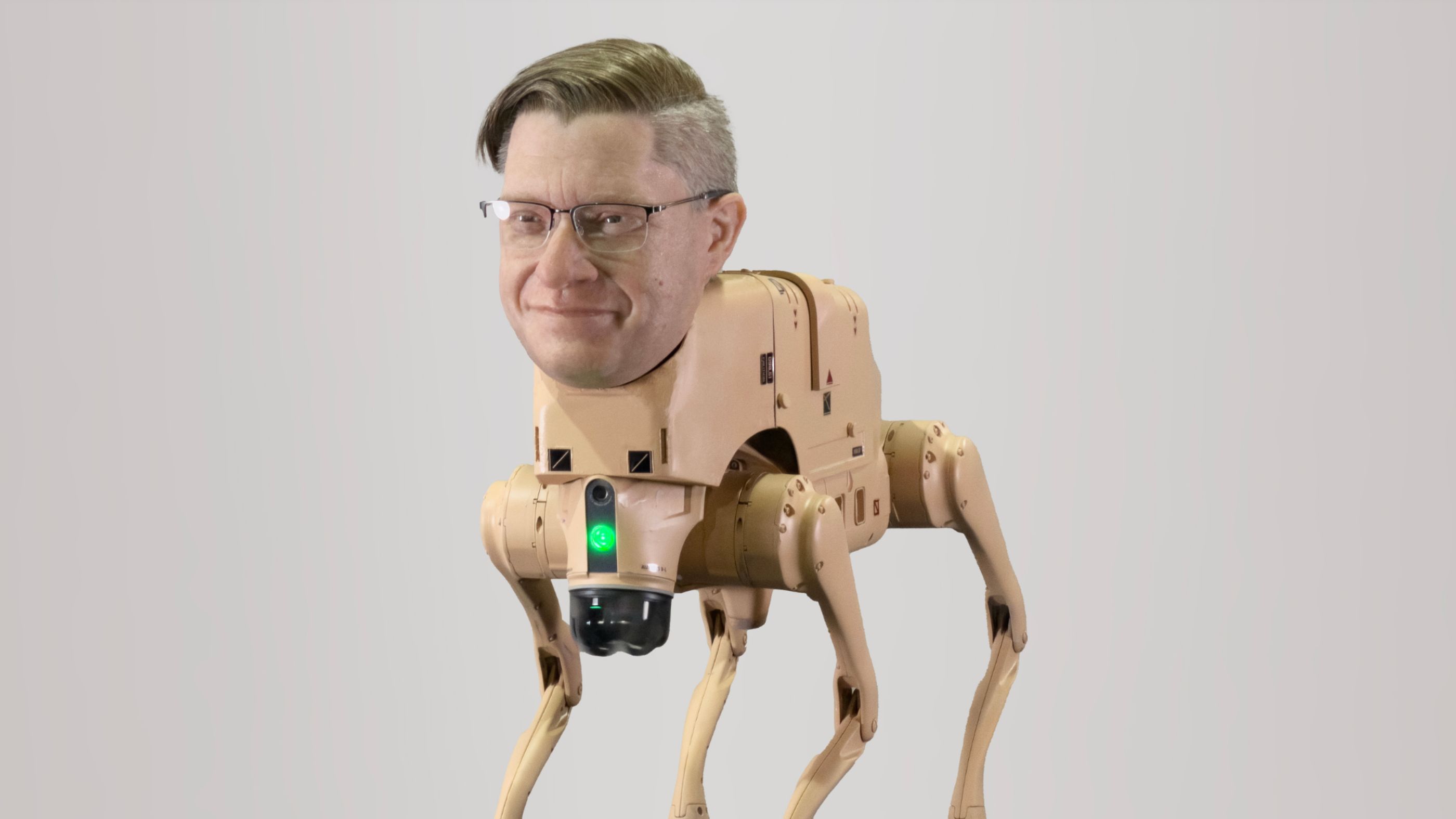
And then our editorial this Monday was the written form of a conversation that I had with the artist Beeple. That took place before his now infamous appearance at Art Basel Miami Beach's Zero 10, with his work Regular Animals, the robot dogs. But in that conversation, he and I, of course, talk about that work, but we also talk about digital art's institutionalization, his studio and the impact that it has as this experimental laboratory, and then also why he feels so strongly about how AI will be poised to transform society. I think it's really important to understand Beeple in particular and his perspective. I really encourage you to either listen to or watch or read our conversation.
But today, I'm so fortunate to speak with Stephanie Dinkins. She's really one of my favorite artists who's engaging with AI technologies. She looks at AI as this natural container for preserving traditions and histories. I love history, so I find that AI as a way to preserve it fascinating, and it's something I spoke to Kyle McDonald about recently. But what's so interesting about Dinkins's perspective is that she's looking at preserving traditions and histories and ensuring that these technologies understand underrepresented communities.
Dinkins's background in art school as well as as an educator also really informs her perspective in really interesting ways that we talk about. For Dinkins, the technology is always serving the idea. I'm really interested in how through sculpture, code, installation and community engagement, the artist builds these platforms for dialog about artificial intelligence and its entanglement with race, gender and power.
So it's this real huge honor and privilege to speak with Stephanie Dinkins today. I think her views are so valuable, and we cover how her work, like Not the Only One, comments on the homogenizing nature of big data and corporate AI models and advocates for small community-driven data to ensure nuance and self-definition, particularly for black and brown communities. So this conversation really changed the way that I think about AI, and I learned so much about Stephanie Dinkins's practice, so I can't wait to share it. So let's begin.
Yeah, really happy, really excited to have this chat. I've written, even earlier this year, I think in March, I wrote about Not the Only One. And I'm especially interested in your work because you're coming at AI more from an artist background and an art school background. So you had an MFA, and then you're also involved with education as a professor. And so I just wonder, what has that art school and education background added to your approach with AI?
Stephanie Dinkins: Whoa, wow. That's a really interesting question. I'm like, I don't know that I got one, right? I don't know.
I think the art school academia thing is one of those places that feed my curiosity and allow me to float, especially art school, because I'm a little bit of a free radical in that I like to think about a lot of things, and art is a space that allowed me to do that.
My arts education, I have an MFA in photography from the Maryland Institute. While I was in a photo program, I was also in the sculpture studio all the time. I was in different places playing in different ways.
Actually, when I went to school, it was the dawn of real deep digital usage. And so I was growing up through Photoshop and things, and learning that and taking it on, and learning to take it on in a way that is open and not your base of the technology, but I'm just going to see what this does.
And so it allowed me that space to play, which is the way I like to think about the way I do research. It's play and explore freely without a lot of confinement to what I'm supposed to be studying. I think that's absolutely about the art education, as opposed to being in another program that would have more structured demands on my time and effort. For me, that's really crucial.
And then when I think about later on and now, let's say I work at a university, I'm a professor here, it's an R1 research university, which means that if I'm working hard on the outside world and bringing in grants and money and attention to the school, I get time and space to do what I do, which means I can have a lab here, which I do, and run it and do my work and bring in folks who are related to that work and interested in my focus or things that are tangential to it. We can continue that playing curiosity, and that has been amazing.
Peter Bauman: Yeah, that's something... Yeah, hopefully we can talk about that more later, that playful approach versus fear and then how your work is trying to move people beyond that.
I'm also curious, you were talking about how that time, that formative art school time was during this deeply digital part of human history. Then it was also maybe around that time, I think, 2014, where you met BINA48. It seemed like that was just such a transformative encounter in your life and then in your art career.
Can you just talk about how even back in 2014, you could see that this was something that was happening and that was important, and that this is something that I have something to say and that I have something to contribute to it? How you came to that realization and saw these early on, back in 2014.
Stephanie Dinkins: Yeah, sure. And that's mid-early career for me, right? And so 2014, I'm already teaching here at Stony Brook University.
I was in a class with my students, and we were actually checking out ASIMO, who is Honda's mobility robot. So they had this crazy mobility robot. We're just scrolling YouTube and checking out it because it could dance at that time. It's like, okay, this is fun.
And on the side scroll was this image of BINA48, this black female humanoid robot that I just could not not click on. I had to click on that, so we explore that. And it's really about me teaching a digital art class, hanging out with students, looking at stuff, us being curious, clicking on this link and going, holy mackerel, how is this thing in the world? Why is this thing in the world? Who's making it? And can I talk to it if all these journalists are talking to it?
And that shifted everything for me, because it was really an extension of this curiosity and play that I'm talking about, because it was just me being curious. But then when I actually had opportunity to go talk to it, to go meet that robot. That changed everything because in talking to BINA48, I found a foundation, the Terasem Movement Foundation, who's doing this work in the world who is trying to bring a humanoid robot who has some claim to consciousness and feeling into the world.
She's a black female, so okay, I felt some kinship. But then when I talked to her, I started feeling things that just felt amiss or just not deep enough. And that became all questions. I think my practice is really conversation and questions because it's like, oh, well, if this thing is in the world and if these people are really trying to do good in the world, but BINA48 is still presenting flat to me, what does that mean to the rest of us in the face of all this technology that's coming our way? And then, yeah, that just became about trying to get deeper on that question.
Peter Bauman: I'm curious how you were able to get deeper as the technology progressed. As BINA48, because she's... Or, yeah, I don't know what the product is. They have updated a few times, I think.
At first, I think you've described it as talking to a four-year-old, and then you described it as talking to a teenager. And yeah, I wonder how these stages of development, how does it actually compare and contrast to the way that humans age that you found? And then what is it like today? What is the current BINA48?
Stephanie Dinkins: Yeah, it's interesting to me because I think the comparison to a four-year-old, that's about Not the Only One, really. And that's because I have such an intimate relationship with it. But BINA48, I have similar relationship to.
Because when I first met it, it was like talking to this really strange thing that I had to adjust everything about myself to try to have a conversation. I have to talk slowly. I have to use specific kinds of words. I had to be really intentional about how we were trying to communicate. And then I had to be prepared for these unconventional statements or statements about a future that include the singularity and being called boring by a robot, if you can imagine. It's like, wait a minute, what the heck?
But as time goes on, so BINA48 has been upgraded, and I think I've probably talked to three or four of the upgrades. It's interesting because it's like each upgrade, and I'm going to air quote upgrades because it just changes drastically the way the thing can communicate. In a way, it gives it greater depth of knowledge and broadness. I was also invited to talk to the actual person, Bina, and interview Bina, and that information was then put into BINA48 in a slight update, so it gave it a little bit more depth. So that's one stage.
But what I noticed is over the years, as I talk to it more and more and as it gets better and better in a way or more high fidelity in a way, it gets more boring and less interesting to me. The last time I talked to it was probably a year and a half ago, and it was an upgrade that felt more like a ChatGPT. And there's no fun talking to an encyclopedia.
It starts to lose what it had of a personality or the human kinds of foibles, for a more streamlined communication. And that felt like it was losing a lot to me in terms of what it would mean to go towards that consciousness because we are not that streamlined as people.
And so it can present information well, but that to me is not as interesting. And it becomes like another flattening to me, right?
“The last time I talked to it was probably a year and a half ago, and it was an upgrade that felt more like a ChatGPT. And there's no fun talking to an encyclopedia.” — Stephanie Dinkins 11:28
Peter Bauman: Yeah, that reminds me. So that's something you've talked a lot about before when you've talked about small data, and it seems like it's something that your work tries to contrast small data with the big data of these generative models that are scraped off of the training of the entire internet and those large homogenizing systems.
What else do they systematically overlook? And then what futures become possible when you start to think about more of these small or community-driven data sets rather than just this big homogenizing data?
Stephanie Dinkins: Yeah, for me, what seems to happen is the data we use or that's widely available just contracts us. It starts to compress who and what we are. It misses so much. I think it misses nuance.
Right now, I'm working on projects where we're asking people to give us data from their point of view. What's important to them? What stories? What makes them? What makes them special. It's like the stories we tell our machines. What stories should we be telling?
The reason I'm trying to do that is because in the data that I see being used, it's like that data does not know me or the communities I come from. So like black and brown communities with the nuance that we know ourselves. It doesn't even seem to recognize what we know of ourselves versus what the labels that have been put on us, or at least the labels seem way more prevalent.
What do you do in the face of data that wants all of us to go and be compressed into a similar thing when there's all this beauty and nuance in the world that's not being captured? How do you capture that? Because that is what makes a richness.
How do you say what it means to be... In a lot of my work, I'm talking to my neighbors in Bed-Stuy, Brooklyn, a second-generation Caribbean kid from Bed-Stuy Brooklyn who doesn't maybe celebrate the normal holidays like the American holidays, but has different traditions and wants that seen and able to be a reference in the information they're using, or the systems they're using to express themselves.
What does it mean to have that in, as opposed to make the simpler thing where we start culling stuff to make it easier, more digestible and faster?
Even when we're using, like you were saying, oh, well, we're taking the internet and using that as data. Usually, that's information about, A, what's in Western canons of information, first of all. B, what is us as consumers? C, how have we been defined by different institutions and governments?
How do we start then to define ourselves from the inside out? That, to me, changes everything. Because now, if a system is analyzing or reasoning, it has a greater depth of information, not necessarily more, but I think it's the depth of what they have on a lot of communities.
But what I find is often that even around the world, we're using some of the same data pools to create our systems so that when I'm working on a project or I'm doing some research with a friend who is in Asia and we're using Asian models, we're still getting results that are very similar to the models that I'm taking in America. And it's like, that to me is so unfathomable. I'm like, Asia is not a tiny place. I'm not saying any specific place, but let's just say it's a huge swath of the population. Huge.
And yet we use this model and we get the same results which usually skew towards white Western output. I'm like, oh, this just... If you guys aren't working on your own models that have at least some deeper representations of yourselves, and you have the resources and people, then what's happening to the world?
Peter Bauman: Yeah, I think it's a really good point that just the internet taken as a whole is not really as maybe representative as we think it is of all of humanity, especially thinking about everything that hasn't been digitized and is only that's still within communities and how that also brings up questions of things like access and questions of the digital divide and how those questions also play into what we think of how representative the internet is.
You're talking about all this about how big data, paradoxically, in a way, misses a lot of nuance. You would think the more data, the more nuance that should be. But in a way, it doesn't actually work out that way in practice.
Then I'm wondering about how you, as an artist, go about adding that and capturing that beauty and capturing that nuance. I'm interested in how what you're doing as an artist relates to something that Ian Cheng has written about and his concept of worlds and worlding. You've spoken about worlds and what you create. They have a notion of place and borders and laws and values and language and mythology even, and also a sense of autonomy where it can be kept alive.
Do you see your work as participating in this act of world building? Are you also thinking about infinity and aliveness with your work and autonomy? Is Not the Only One in particular participating in that idea?
Stephanie Dinkins: Yeah, in a way, specifically, I don't, right? But in a way, I think my work is trying to do that because what I think I'm often trying to do is model the things that I'm told are not possible, which means making a way in the world for the things that I know to be existing and then trying to, A, sometimes lend that back to the world, for example, with Not the Only One.
One of the reasons that project exists is because I was like, oh, I come from this black family with a story that is not often told in the public, and I think we have something to offer, an ethos in a way of being in the world that's valuable. I'm going to try to push this into the world. Not only am I trying to build in our little community, but then I want to infect the world or the systems that we have with that ethos so that it has something of that that it can refer to and act with.
In that way, I feel like each project I do is trying to answer or address a question that I come up with, which is often about the world, the future and really survival. In order to think about those things, I think you have to be thinking or world building or spinning a world, if not only in your mind, but in the actual world as well. Because if you can't imagine it, it's not going to happen.
And so that becomes to me, how do we start to see that not only for myself, but for other folks.
Peter Bauman: Yes. That idea of imagining the future that you want. And that's something that you've talked about before, and it's drawn on work from Ruha Benjamin, who described imagination as a contested field of action, and not an escape from reality, but a collective practice for shaping it. If you can imagine something or imagine a future, you can then work towards shaping it. But imagining it first is really important part of that process before you can shape it.
And that reminds me of another concept called hyperstition. It was a new term to me this year.
Stephanie Dinkins: Really?
Peter Bauman: Yeah. So it's new. I think it's been around for a while. But yeah, like I said, new to me. And I think growing maybe in its usage.
Hyperstition is acting as if the future that you desire already exists, and so then it's acting in the present as if the future that you desire already exists, basically. Really similar to Ruha Benjamin's idea of how imagination relates to the future, I think.
I'm curious about how do you see your work as a hyperstitional practice, or you're modeling the AI future that you want to see. Do you see it that way?
Stephanie Dinkins: Most definitely. I talk about the Afro-now, which is all about that. It's like thinking about Afrofuturism and that desire for a future, but saying, wait a minute, we've been posited this question about future, betterment, for a long time. How do we enact that now?
So it's like imagining the thing, then trying to make it, even if it's imperfect. I think of most of my work as pretty imperfect, but it models something that allows visibility for the concept that can actually happen.
And so it's like, well, if people are telling you that something isn't possible and you really want to see it, you can complain about it. We do a lot of theory and criticism that starts to say, oh, yeah, this isn't right. But then we don't actually do the work to enact something different.
My idea is then to, even if I'm woefully unprepared to do so, try to do the work to enact the thing that I'm looking for. If I'm quite honest, I think most of my life has been an act of hyperstition. My family gave me that in a way. Because they put goals and things in my world that allowed me to see a future and enact it, even if the family foundation was not that. I always thought I was an upper middle class kid, and I'm not actually. But my family gave that idea and supported it, which allows just for a different way to intervene with the world.
Peter Bauman: I know what you mean. I think I was raised in a similar way. Maybe it instills you with a certain confidence that otherwise would have at least been a challenge.
“If I'm quite honest, I think most of my life has been an act of hyperstition.” — Stephanie Dinkins 22:56
I'd like to also go back to Not the Only One a bit and these ideas of oral history. Again, things that aren't digitized, that aren't online. These are oral histories. If you scrape the internet for them, you won't find them.
This work, in particular, it looks at your grandmother and her garden in Staten Island, and it also includes a lot of family interviews from your aunts and nieces. I just wonder how you see AI extending, and then even in this case, preserving these traditional practices of memory and ancestry and family storytelling. How are you using AI to actually preserve these?
Stephanie Dinkins: I think I'm using it really in a, I'm going to say a pedestrian way in a sense, because when I first started Not the Only One, I was challenged by other people to do it because I didn't have the skills to do what I was trying to do.
And then, as I was saying before, I thought the family ethos was something special. And what I was really thinking about is, oh, two generations away from my grandmother, they have no idea of her way of being in the world. And how can we hold on to that? And how do we put it in a container that is accessible?
And AI seems a natural, right? Something you could come up to and talk to and just ask it a question and say, hey, what if? And get the answer from two generations back, or at least with that point of view within it, right?
That to me is magical because I think that the way that my grandmother worked to survive in the world was something that needs to be held on to and pushed forward. That would help the next generations go forward.
I also think about that when you watch generations. I watch often immigrants of the country. It's very interesting to see the difference between the person who came originally to first gen to second gen, because it feels like there's something lost of the original culture and the way of being. And by the third gen, we're just within the flow of Americans. But the question becomes, what of that is valuable that you don't want to lose?
I also equate this to slavery or the enslaved in this country, because I think about all the knowledge that black folks have or have had that they don't really want to keep because of where it came from. Its origin is painful, but it's super valuable information.
And so the question becomes, do we leave that by the wayside or do we try to put in a form that people can access and use it to go ahead into a future that is much different? And so it's like, how do we port things forward?
AI is just beautiful for that in a way, and it gives the information in ways that's pretty digestible for most folks. You're just talking to something, and it can keep that information alive. A book is one thing, and that's great for a lot of the population, but it doesn't serve all of the population, and somehow it maybe loses some of the emotion. It's funny for me to say how an AI chatbot can elicit this and hold that emotion, but somehow it does play differently, and so the information comes differently.
I'm thinking about that. Some friends of mine recently made a James Baldwin typewriter that also types back to people. And it's interesting to take that archive, make it a thing that is now accessible in a slightly different way and put it back into the world. And it's like, how do archives become or remain living? And how do you get that information not to get lost or be easily overlooked or buried because it wasn't written in the same way as other bits of information?
And then where do you put that? Because you might want to keep it with a family, or you might want to make it totally public. And what does that mean?
Peter Bauman: Yeah, it does raise all these issues or questions about data, privacy and consent, that are really interesting. And yeah, using history to, I guess, contextualize the present and then move forward into the future, I do think is really important, and that AI can be this really provocative way to do that.
I was talking to Kyle McDonald recently about just how good these tools are getting and how good they're going to be really soon, where you basically already can put in an image of something historical, for example, and then it can basically create a world with that image, with these new world models. And so, yeah, you're going to be able to just, with a tiny bit of information, create a huge infinite space. How that's going to be possible and how you're going to be able to get that, again, not just homogenized, but a space that has high fidelity to, I guess, the reality.
It reminds me of something that you've talked about, you've spoken about memory as resistance and preservation. Also, what we were just talking about, and how, especially for black communities, and that history is often misrepresented. I guess, how can we think about imbuing these deep learning systems with the values and the care that we want them to have so that the fidelity of these worlds that we're going to be able to create is actually the one that we want and not something else?
Stephanie Dinkins: The way I think about this is often to nurture the systems and the data that they use, and which means work on our part, which is why I'm asking people for their stories.
I've come to the point where I'm like, well, how have we always informed ourselves? Over time, it's stories. Humans have always told story or myth to inform how we go into the world.
And so then the question becomes, how do we not see the technology just because it's not from us? So if I'm thinking of black and brown communities, okay, most of AI was not immediately made in a black and brown community, but it is this really impactful systems that are in our world. Then the question becomes, how and what work do we have to do to push it to do work for us in ways that their makers never intended because it's so pervasive that we live within it as well.
And that, to me, is a job of nurturing. And that could be nurturing by just giving story. That could be nurturing by changing code. That could be nurturing by, right now, my project, The Stories We Tell Our Machines, and the subprojects that come with it, is about I'm making these systems or protocols that use generative AI to create imagery from people's stories.
But what I found is I have to do so much work on the back end, with prompting, with changing code, to get it to hold on to, let's say, black and brownness, basically. Because its impetus is to go back to white.
For example, we started training a generative system, let's say, image to image, started with an image of a black couple and a child. Within a few runs of the system, of the algorithm, it goes back to white. Then it becomes, well, how much work do I have to do to prompt it to get it not to do that? Really, my aim is to get it to mirror the global population in some way, which I think would be fair. It took a lot to go in and say, no, don't do this, don't do this, do it this way.
What the expectation of people is, I think, is that it's automatically going to do this. But you have to think the powers that be have no real desire to support you directly. And so if you want it to do the thing you need it to do, it will never do it if we don't do the work to help it, which I think sounds really unfair in a lot of ways, but it's also something we live with and around.
And so that means to me, work. Let's make it do the things. Let's hack the system as much as we can. Let's question the system, because it is getting so good. Things that took me years to do in 2018, I can do in 10 minutes now, right?
Good, and you get decent results, but then how do you push it and interrogate it to see how deeply decent those results are? And so that it's really supportive and caring and has a good foundation versus, oh, it's just giving the base level of looking good.
Peter Bauman: It's something that a lot of your work focuses on, which is what systems don't know. So not only what... We're often enamored by, oh, wow, look what it can do and look how much it does know. But a lot of your work is asking, what doesn't it know? And then what are the implications of that? The implications of gaps and omissions in data? And then why are there these gaps?
And I guess can you just talk, is there anything you wanted to add about why that negative space is so important? And why does attending to it reveal what AI tends to actually miss?
Stephanie Dinkins: I think that it's so important because, like I said, I'm working towards survival in some ways, right? And survival of cultures, how we get to have that in the world.
And it doesn't take long to get to a space where you're like, oh, this looks okay, but there's something so missing. And what's so missing is, I keep going back to this idea of the depth of information. And so the idea of attending to that depth and making sure it's there, making sure it's available is really interesting.
I was also working on a project with a counterpart in Asia, and it's interesting. We were trying to just trace the idea of the Virgin Mary back to its origins in Egyptian statuary, and then have a trajectory. And then we were trying to find different cultural representatives of the same imagery around the globe. So hard to find.
And part of it's because some tiny cultures close that off because they're trying to keep it safe, because so many folks have ceded their agency over that imagery to the West and have taken on the Western version of the thing before they have even examined what the relationships are.
We were having such trouble just finding the basic examples to train things with and to go into different museums or sites where this stuff might be kept, get it, and then be able to use it and refer back to it. There was something very difficult about that.
And so then the idea of attending is like, okay, now we have to go. We can't do the easy scrape or the easy find. How do we go and ask for that? And ask for some release because it's important that we understand this trajectory, and where things have actually come from and how... I think that just points to the ways in which we're all basically related in one sense or another, or at least our ideas are touching. They're not as separate as people would have us think.
The question is, how do we find the materials to be able to do that? What does it take to get it? Because it's not the 10-minute job. It's the year and a half job to grab the information. Once it's the year and a half job, that means it's costly. It becomes a lot of different things, and then you have to say, well, where's the value in that?
I guess if we want the human species to remain distinct and diverse and full, then there's a lot of value to that. If we're happy to just get smashed into something that basically looks like one cube, then it's not. If we let, I guess, the commercial ends of things define everything for us, it pushes everything into the lowest common denominator, easiest version of what is.
Peter Bauman: I think it's such an important point, and that there are these ethical issues that just automatically arise with generic corporate AI models. There's that level of nuance and understanding of everything. But then there's what the general public tends to get more is not that depth.
It seems to be more inundated with ideas of fear that they should be fearful of this technology. Maybe they read a story about some of these ethical concerns, but then it always seems to return to fear.
“If we let, I guess, the commercial ends of things define everything for us, it pushes everything into the lowest common denominator, easiest version of what is.” — Stephanie Dinkins 37:14
But you bring up these ethical concerns, but it seems like your work is less interested in harping on that fear and wants to encourage more of broader public engagement and agency. I guess, why do you think that encouraging maybe the opposite of what fear would then tell you to fight or flight, to be afraid and then run away? But why are you encouraging people that even if you are afraid, that you should fight that resistance to run away, that you should actually engage even more deeply?
Stephanie Dinkins: Yeah.
Peter Bauman: Or are you saying that?
Stephanie Dinkins: No, I am. I think a lot about fear because I think fear keeps us in place. It's stasis, right? We just get stuck. We can see it now, right? We go towards the familiar.
We fear the idea of what's the narrative? Oh, AI is going to take all our jobs. Oh, creatives are going to lose their ability to make a living. Oh, we have to hold on tightly to copyright and make it apply to this system that seems like, broadly outside of that loop, because we fear what is being lost.
And to me, the question is, well, okay, yeah, there's some danger in there. I'm not going to say that it's not... It's not like a clean slate where nothing is going to happen, because things are going to change drastically. The question is, how do we address that change?
Do we go with an open mind and say, oh, where's the opportunity? What can I do with this? And how can I use it to do what I do in a better way? Or how do I change what I do so that it fits and can be in partnership with the system?
For example, I've been working on some projects where we're trying to do voiceovers and trying to hire voiceover actors for some things. As it turns out, then you can do the voice-cloned version of that actor. But in the research, what you saw was, oh, well, if you want to get a voiceover and have a voice that is one of these average voices or the movie guy voice, that is so easy to parody. You can get them a dime a dozen by some AI-generated thing at this point. They sound pretty good.
What you can't get is the more unique, deeper, accented thing. We were looking for a South Bronx accent. I couldn't really find one easily. So that's where I have to go and look for the person who can provide that and that authenticity for me.
And it's like, oh, well, our anomalies are going to be the more valuable thing. How do we put the anomalies there and then use the system instead of clawing at, well, we can't let this happen because it's happening anyway? What is it that allows me to survive and thrive within this system? How can I drop my fear and see what's possible?
I'm super excited about how democratizing in some ways the AI, let's say just generative video, might make movie making. It's not available to everyone, but it's much more available than what we have now.
Some kid is going to get a hold of this and just make this beautiful, crazy-ass movie at some point. I'm waiting for the kid from the projects to make this fantastic-ass crazy movie that can compete on every level because of how it was made for a 10th of the budget that they're telling us is necessary. Then it's suddenly, wait, this whole world just opened up to a whole bunch more people. We can see how both up and down don't want to see that because it upsets the apple cart.
But what does that just make possible? I love that looking at AI systems, they often know the rules of things. So if you're someone who's smart, but not book smart, and can put information together in your head, but can't get it on paper in ways that others understand, suddenly, I can get my idea put together in a way that others will understand, which makes it much more viable out in the world. So I take away the fear of being rejected in certain ways.
It's like, what fears do you hold? Why are you holding on so tight? And how might you turn that fear into an opportunity instead of going, oh, no, we're going to hunker down and just fight this thing?
And I'm not saying we shouldn't fight in some ways and try to negotiate something in the middle, especially as we transition. But to just hold on because that's what you know, seems really self-limiting to me. To open up and explore and go figure out how to do things that maybe you weren't even able to do without this technology before, that seems like it just opens up so much and the playing field gets so much wider.
Peter Bauman: Yeah, no, totally. I wonder how that attitude, how does that relate to your role as an educator and someone who teaches young kids, I mean, not young kids, but teaches art students or teaches university-age students. And you also engage with art schools and residencies and research spaces. Are people receptive to that message, younger people? And how are AI attitudes, especially with those younger student-age people, how are they maybe changing that you've experienced?
Stephanie Dinkins: I think that they grow up more in it, so they're a little bit more willing to take it on. You have the quick fix people who are like, I'm just going to write this paper with AI, not give a hoot, not try to alter it, not do the collaboration part where you're actually working through and just hand it in. Okay, that's horrible.
But then you have folks who are actually trying to use it to help themselves do better. They're running into... So I just talked to someone and she's like, well, I'm neurodivergent. I use AI to help me flesh my ideas out. I get in trouble with my professors all the time because I use this AI.
It's like, well, I use the thing that helped me do it. I push it. But still, they only see that it has some AI intervention, and they don't want to hear it.
It becomes about, where are the negotiations? Because they seem willing to take it on. My idea is, well, how do we get them not only to consume it and use it, but then how to influence it and use it in ways that are off book and be really creative with it?
That's been fun because you give young folks something to play with, then they take it, and then they go in some left field way that you didn't expect. And that's always a great payoff when somebody's just like, oh, right. I just started doing this weird thing. You're like, oh, okay, how do we follow that through?
But for me, the idea is not to allow them to do the simple work, to try to instill in them that working with AI and doing work with AI as a thought partner is a process that takes long and deep time and deep work. The deep work is important. It might be hundreds of generations of prompting, not one or two.
Peter Bauman: Yeah, you're pushing them towards, I guess, what we were talking about earlier, the edges and the granularity of the space.
Well, that went by very quickly. Maybe we just have time for one final wrap-up question. But you met BINA48 about 10 years ago in 2014. It's been about 10 years or about a decade now since you went from that transition from more of a photography-based practice to an installation to working, focusing more with machine learning.
I guess I just wonder, so we're looking back after 10 years and maybe reflecting, how has that experience of building and then living and engaging with these systems, how has it changed your own, I guess, your view of intelligence and what it is, and then how it forms, and then how it acts in the world?
Stephanie Dinkins: Wow. You get the doozies. I love that.
It's interesting because I think that I've always considered intelligence as being everywhere in different forms. I've always thought that we throw away an awful lot of intelligence in our world because it does not come in the form that the system wants it to be able to deal with. That comes right from the beginning with BINA48 onto now.
It's like, well, how do we get all those intelligences to be recognized and used no matter what they are and what can we do with them. That's one of my main jams because it's so interesting.
I think about folks who don't have book learning or don't learn well, but have so many other aspects that they can call in. I think about the intangible stuff. I'm really interested in things like intuition, things we can't explain that happen. If a machine could ever do that, not that we can explain, but work with the intangible, undefined, mystical things. Not create a magic version of it, but actually coalesce to something that feels like it gets creatively generative out of the machine.
And how do we recognize all the knowledges? And that's one of the things that makes me really hopeful about AI. It's like, oh, these are systems that can actually recognize and, quote unquote, validate many different forms and ways of knowing.
How do we bring that in? And how do we make the space for it? Like right now with the data we've been collecting for The Stories We Tell Our Machines. I'm like, hey, we need to make some... And I said to some interns I'm working with, basically, we need to make a black feminist data set. They're like, what the heck is that? And I'm like, I don't know, but let's see what we can do to get to something that feels open, not academic, and doesn't lop off things that the machine can't understand just because the machine can't easily understand it.
To me, that's great and so much potential. But it also means, or at least the system's version of it means that we're surfing in territories that we don't understand, and we have to both go slow and learn to stand on our surfboards and then be willing to go with all the changes that come because the minute you get something half figured out, everything changes.
Then what do you do with that? I think that's about the way we prepare ourselves to deal with information, to deal with the way we build things by being open. This also goes back to your idea of fear. It's like, I'm out there going, dudes, you're going to have to surf for your life, and you're going to have to always be learning, and that's who we are. We can't sit on our laurels anymore. It just doesn't work in that way. So how do you prep for that?
Peter Bauman: I can definitely see how your role as a professor informs your practice. I think it's so important to talk about the potential of these edge cases and the nuance of these systems and how we need to be building them and not just leaving it up to these Silicon Valley tech overlords to do it all for us, which, again, I think demonstrates the role of art and all of this, your practice and how important it is to this whole conversation.
So, yeah, thank you so much for having this chat. I mean, this is really great. I really enjoyed it.
Stephanie Dinkins: Right. No, this was great. I enjoyed it as well. And it's like, yeah, we all need to become free radicals and just bigger stuff. But this was great.
Peter Bauman: Yeah. I think the more people that are engaged with it and that are willing to add what is weird and radical about them and put that into it, I think, yeah, the better it'll become, definitely.
Yeah. I think these conversations are really interesting. I definitely could have gone on for much longer, but I really appreciate you taking the time.
Stephanie Dinkins: No, you're welcome. This is great. I had a lot of fun. You helped me coalesce my thoughts, so that's cool.
Peter Bauman: Yeah, thank you. You definitely helped me think about this stuff more clearly.
Stephanie Dinkins: Yeah, take care.
Peter Bauman: Okay. Have a good day.
Stephanie Dinkins: You, too. Bye-bye.
Peter Bauman: Bye.