Suggested Reading
Interview
Editor's Picks
Val Ravaglia on Electric Dreams
Peter Bauman
•
December 3, 2025
View


Eli Scheinman, inaugural curator of Art Basel’s Zero 10—a 1,000-square-meter space dedicated to digital art at Art Basel Miami Beach—speaks with Peter Bauman (Monk Antony). They discuss how Zero 10 marks a long-term commitment to making digital art legible to all collectors, while amplifying the ecosystem’s own norms, histories and eccentricities.
Peter Bauman: In early November, you introduced Art Basel's new digital initiative, Zero 10. Can you describe what Zero 10 is? What are you building and what is its core mission within Art Basel's larger framework?
Eli Scheinman: Noah Horowitz, the CEO of Art Basel, has had a very long-standing interest and engagement with all forms of new media and experimental art.
Finding a cogent home for artists and gallerists, explicitly focused on digital art, has been a long-standing desire of his within the fair ecosystem.
As curator for the inaugural edition, my role is to bring the perspectives of the digital art community into constructive dialogue with Art Basel’s aims. I’m focused on representing the ecosystem I’m part of—its artists, collectors, gallerists, platforms and builders—while helping shape a framework that supports and uplifts their work.
I aim to find ways to foster the norms, behaviors and those individuals within the Art Basel ecosystem.
Art Basel's desire with Zero 10 is to foster those norms and behaviors and provide a space in which we can help amplify those artists, galleries and collectors who are pushing boundaries across collecting behaviors, use of medium, discourse, internet culture, blockchain and crypto.
Zero 10 is a home for exactly that, not to pander to the contemporary art world, but very much the inverse: to amplify the eccentricities of the digital art ecosystem that make it special.
Peter Bauman: Can you say anything about how the project evolved from its first conception to realization?
Eli Scheinman: From the very beginning, there was a desire to have a physical instantiation and a space dedicated for the artists, gallerists and by extension, collectors from this ecosystem at the on-site fairs. And initially, those conversations pointed towards, “Okay, let's find something on-site, but maybe it's in its own space. Maybe it's self-contained. It can be its own little world in many respects.”
As we went through the process—and this is something that was critical from my perspective—we did not treat this ecosystem, these artists or these galleries as something other than. We wanted very much to integrate Zero 10 and this initiative into the very core of their experience so that it's viewed as it should be.
These artists and galleries should be viewed, as they are in reality, as critical contributors to the contemporary art world at large.
Where we landed, which I'm very pleased with, is around 1,000 square meters on the main show floor at Art Basel Miami Beach adjacent to Meridians on one side. That then gives us a very open entry and a dialogue between Art Basel's Meridians and Zero 10, as a space that is fundamentally, deeply integrated into the core fair experience.
Peter Bauman: You mentioned how important this direct integration is. It’s in contrast to previous attempts by the blockchain community to be incorporated into the main fair.
Eli Scheinman: It's really interesting because Art Basel, in Miami, in particular, has become this somewhat amorphous thing. You'll hear many people en masse saying, “I'm going to Art Basel,” and you'll hear brands say, “We're hosting an event at Art Basel.”
I think it's important to add some precision to what it means to be a gallery or be an artist who is at Art Basel.
Part of the way in which you do that is to leave no open questions about whether a gallery and an artist are a part of the core fair or not. And by integrating Zero 10 within the main fair, it resolves that ambiguity and those open questions.
Peter Bauman: Yeah, there are a lot of people who take advantage of the amorphous terminology around doing “something” at Art Basel. Can you talk more about the decision to choose the title based on Malevich’s very famous 1915 exhibition, 0,10?
Eli Scheinman: Naming things is really hard. In particular, when you're taking a legacy brand like Art Basel and you want to express something that has a new energy and a different pulse. But you're also trying not to play into tropes around digital or technology. It's quite hard to name things effectively.
I wanted to find something that alluded to what we're trying to do and represented the digital art ecosystem but was not so on the nose and overt that someone new at the fair, either a collector or a gallerist or just an attendee to the fair, does not look at the name and immediately think this is a digital offering that's not for them.
Just in terms of the process by which we were thinking about a name, that was all a very important consideration. Also, for the actual name itself, there's this allusion to binary and code but that's not the main point.
Peter Bauman: You mentioned that this part of the fair was not a part of the normal selection committee because you did the curation. Can you talk about your approach to this inaugural presentation and to selecting this particular mix of participants?
Eli Scheinman: My approach with this inaugural exhibition from Zero 10 was to identify the artists and, by extension, the projects that are tightly interwoven across many different mediums to express the digital art ecosystem in ways that are sincere. We want to make digital art legible to a new audience and to the Art Basel audience. I wanted it to be accessible in the right ways, not pandering and not sanitized, but available to the tens of thousands of attendees and collectors who will be there on site.
I also wanted to demonstrate and express the lineage of the digital art ecosystem over many decades. I think that's demonstrated through what bitforms and Steven are doing with work from Manfred Mohr to Casey Reas and Maya Man.
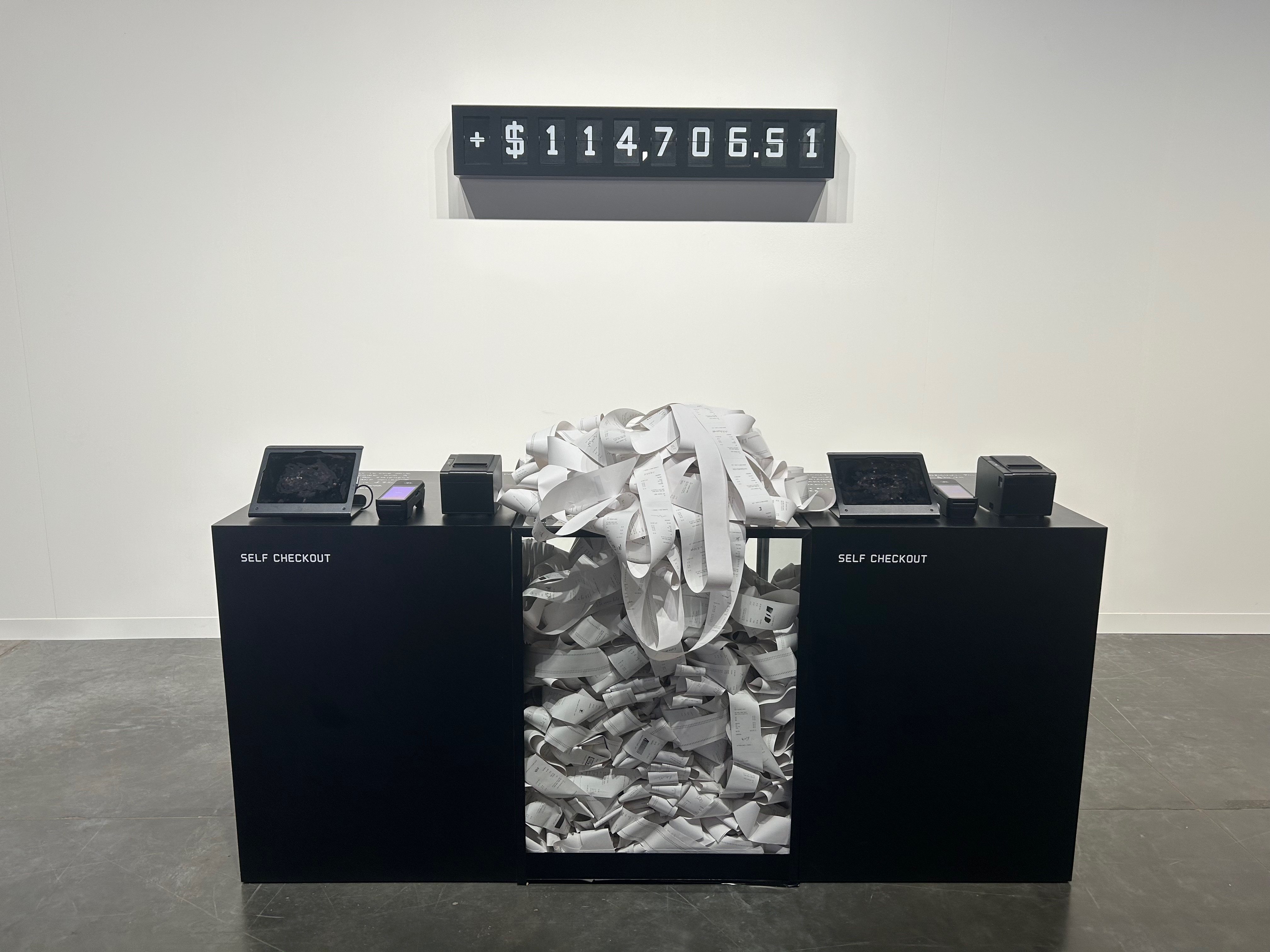
Then to have someone like Jack Butcher, who is utilizing the tools at his disposal and the medium to bring that discourse on-site with an interactive work called Self-Checkout. The work will engage brand-new audiences in a conversation that's overtly about cryptocurrency and artist income structures. That felt like another dimension of the expression of this ecosystem as it exists today.
Peter Bauman: Noah Horowitz, Art Basel's CEO, describes Zero 10 as “signaling that digital art is no longer at the margins.” I just wonder what kind of long-term commitment that entails or signals from Art Basel?
Eli Scheinman: The most challenging thing in a relatively large organization is to have buy-in from leadership when you're trying to do something net new. From the very beginning, Noah has been incredibly switched on and engaged with Zero 10.
The idea here is to scale Zero 10 in the coming years. We have a multi-year plan for how we evolve this and how we build and scale. My job is to help lay the groundwork for that to be true and successful. But from an organizational perspective, Art Basel has very sincerely committed to Zero 10 and to this ecosystem over a very long time horizon.
This is happening in a climate when you are seeing other entities actually go the opposite direction and reduce their investment in the ecosystem. I think it's quite meaningful that in this moment, Art Basel is doing a lean-in and is doing so in a really sustainable, durable, long-term way.
Peter Bauman: There’s long been a challenge of finding new digital art collectors. How does Zero 10 position itself with both the traditional collectors and also this crypto-native community? How does it plan to be able to bridge that gap?
Eli Scheinman: It's really incumbent on me, in some respects, to bring the digital art collector audience to Zero 10. I really put that on my shoulders. But the other dimension is about ensuring that Zero 10 does not feel like a tech demo or a history lesson but shows work and shows projects that are deeply resonant and compelling as contemporary artworks.
If we can do on-site with enough contextualization but without being pedantic, then I think we will be able to create memorable experiences that are both interactive and slightly more passive and contemplative. We wanted to present work that very much speaks to that curiosity of this cohort of collectors who are more inherently digital. They are drawn to these tools and the ways in which artists are utilizing them to comment on the increasing ubiquity of emerging technologies in everyday life; they are more readily engaged in the idea of collecting these artworks.
Peter Bauman: This on-site work, is it sold as NFTs?
Eli Scheinman: In this first instantiation, there are two dimensions of it. All of the projects, galleries and artists are empowered to handle the sales and transactions as they like. An artist can mint on Tezos; they can mint on ETH or BASE. I think ultimately, almost all of the artworks that are there that are sold as NFTs will be on Ethereum L1 or Shape, I believe.
But more directly to the question, there will be a mix. There will be some artworks that are sold only as physical artworks, as sculptures or as paintings. There will certainly be some interactive works that are a mix. The byproduct of your engagement with the work on-site is a physical artifact of that participation and the ability to receive a digital complementary version of that participation.
There will certainly be some fully digital works sold as NFTs. It's a mix across the space and the projects. This is not overt in the communication everywhere, but many of the artworks and projects have an NFT dimension.
Peter Bauman: Maybe that ties to the last question, but what outcomes do you hope this initiative will create for the artists and galleries that you're now introducing to the main fair?
Eli Scheinman: The top-line outcome for Zero 10 at Art Basel Miami Beach is that if it was a memorable experience for participating artists, gallerists and collectors, it will be a meaningful success. This is a little mushy, of course. How do you quantify this? But that will feel like a successful outcome and a real win.
More pragmatically, I think we can all agree that the digital art ecosystem would benefit greatly from increased collector interest and increased collector demand.
From a market dimension, if we can do that work, meaning being on-site and having these projects in front of tens of thousands of collectors and gallerists, that leads to increased interest, demand and capital towards these artists, the ecosystem and a longer tail of other artists. That will, of course, be a really significant step in the right direction.
I think there are many things this ecosystem continues to evolve and iterate on and needs in terms of building blocks. But amongst those maybe at the very top is a more robust, real collector community who is here collecting for the right reasons.
I'm naturally a skeptic but I see Art Basel as an entity and I see Noah Horowitz as the leader of that entity, as a group that's sincere in their desires to amplify this ecosystem and to do it in a non-extractive, long-term, sustainable way.
I think Zero 10 at Art Basel Miami Beach is a really important and meaningful first step along this journey together. I think we'll see in the coming months, but more importantly, years ahead, the Art Basel ecosystem becoming a critical point of amplification for our ecosystem at large. What’s at stake is not only these fifteen or so artists and twelve exhibitors who are in Art Basel Miami Beach, but also a much more diffuse impact across the ecosystem over time.
-----
Eli Scheinman is a digital art strategist working at the intersection of art, technology and collecting. He is curator and program lead of Art Basel’s Zero 10.
Peter Bauman (Monk Antony) is Le Random's editor in chief.