Suggested Reading
Article
Essay
Zero 10 Part 1: Beeple Casts a Spell
Kevin Buist
•
December 22, 2025
View


Kevin Buist attended Art Basel Miami Beach’s Zero 10 to observe digital art's shape and vibe post-NFT boom. In part two in a two-part series, Buist looks beyond the headline spectacle to the works that treated the fair itself as a medium—interactivity, systems and the shifting terms of ownership on view. Part One centered on Beeple’s Regular Animals and its crowd-drawing theater.
The 2025 edition of Art Basel Miami Beach saw the introduction of Zero 10, a special section of the fair dedicated to digital art. Zero 10 was at its best when artists built experiences with digital media (blockchains, screens, user interfaces, pixels, code, robotics) that would be impossible otherwise.
The NFT boom of 2021-22 came and went without the art market undergoing a vast digital transformation, leading some to conclude that art on blockchains was a passing fad. But NFTs are certainly not gone and digital art, which of course preceded the blockchain, will continue with or without it.
What the best artists working with digital tools realize is that they have the chance to redefine what an art object is, what it means to own one, and even rewrite the very experience of art itself.
Zero 10 succeeded when artists tapped into these possibilities. Not everything on view rose to the occasion but it was enough to constitute an exciting leap forward for digital art.

Zero 10, curated by Eli Scheinman, a senior advisor to Art Basel, was wildly successful both in terms of sales and buzz. The section broke the format of the typical grid of art fair booths with thirteen galleries showing the works of eighteen artists, allowing them to spread out, embracing interactivity and dynamic installations. Along with the adjacent Meridians section, where large-scale works are displayed, Zero 10 felt open and energetic. Even when works drew very large crowds the layout allowed for flow.
And draw very large crowds they did but by far the most popular work at Zero 10—and all of Art Basel Miami Beach—was Beeple’s Regular Animals (2025). The installation featured robot dogs with the heads of tech moguls and artists that wandered around pooping out NFTs and small prints. For a complete discussion of that work, see Part One in this series.
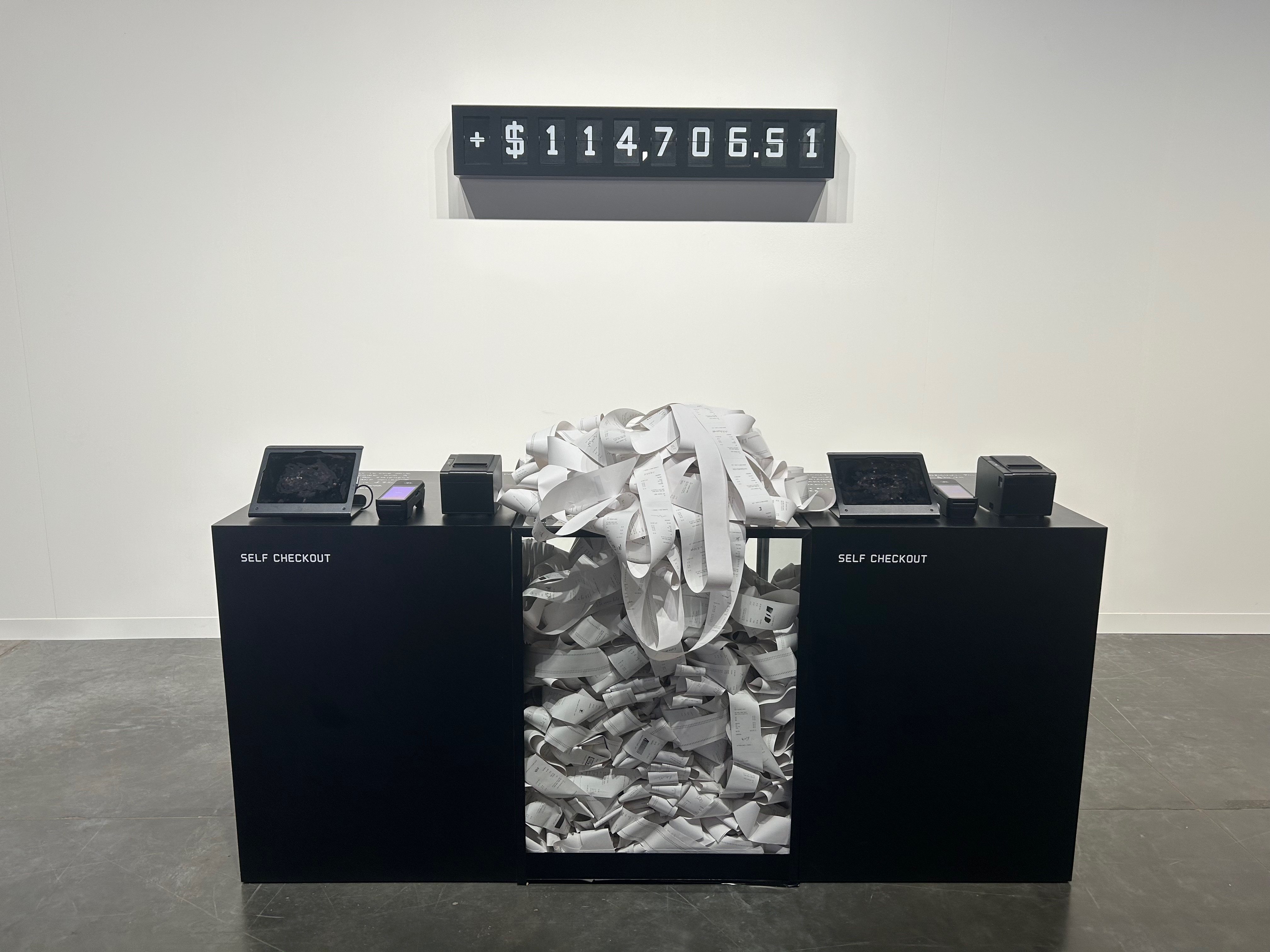
Many other works stood out for their use of interactivity, using technology to create responsive systems that engaged the viewer. One work that seemed initially like a one-liner—but I later came to think of as the strongest work in the show—was Jack Butcher’s Self Checkout (2025). The installation consisted of a large split-flap display on a wall that began at -$74,211 and counted up into positive territory throughout the run of the fair. The negative number reflected Butcher’s entire cost for participating in the exhibition, including the fee for the booth, which he paid for through his own organization (Visualize Value) instead of working with a gallery.
In front of the sign was a simple black counter with two touch screens, which allowed visitors to use their credit card to purchase a conceptual artwork in the form of a receipt for any amount they chose. Using standard point-of-sale hardware, the installation created two copies of each receipt: one for the visitor (and now collector) to keep and the other forming a continuous scroll of paper that gradually filled a glass vitrine in the middle of the counter.
The receipts displayed each dollar spent as a line, meaning that the biggest spenders received the longest receipts. The receipts also contained a twelve-word seed phrase and a web address where an NFT minted could be claimed. By the end of the exhibition the vitrine was overflowing with receipts and the split-flap display had made it to $114,706.51.
Butcher created a participatory game out of the unforgiving—for some—math of art fair participation. As Tim Schneider pointed out in The Gray Market, “Every dealer at a Miami fair has been doing this exact calculus in their head all week; Butcher is just making it visible and, in a way, quasi-crowdfunding his participation.” Schneider got what was going on but other observers from the broader art world were stumped. Hyperallergic’s Valentina Di Liscia said of Self Checkout, “A monstrous specimen of art as social commentary takes form when the work in question replicates the mechanisms the artist boasts about subverting.”
But what was Butcher claiming to subvert? He and other artists in Zero 10 seemed quite pleased to be participating in the capitalist spectacle of Art Basel.
Worried I was missing something, I asked the artist directly about this critique. Butcher’s response was as eloquent and minimal as his installation: “Transparency is seen as critique.”
It occurred to me that the misreading came from the fact that the work is so direct. There is no posturing, no tricks, no irony and no activist pretense. Butcher, who has worked as a designer, approached participating in an art fair as a design problem and devised a solution with an uncommon level of transparency and precision. Art fairs are commercial endeavors and Butcher seemed to be saying, “This is what it cost me to be in this fair; would you like to buy a part of that experience?”
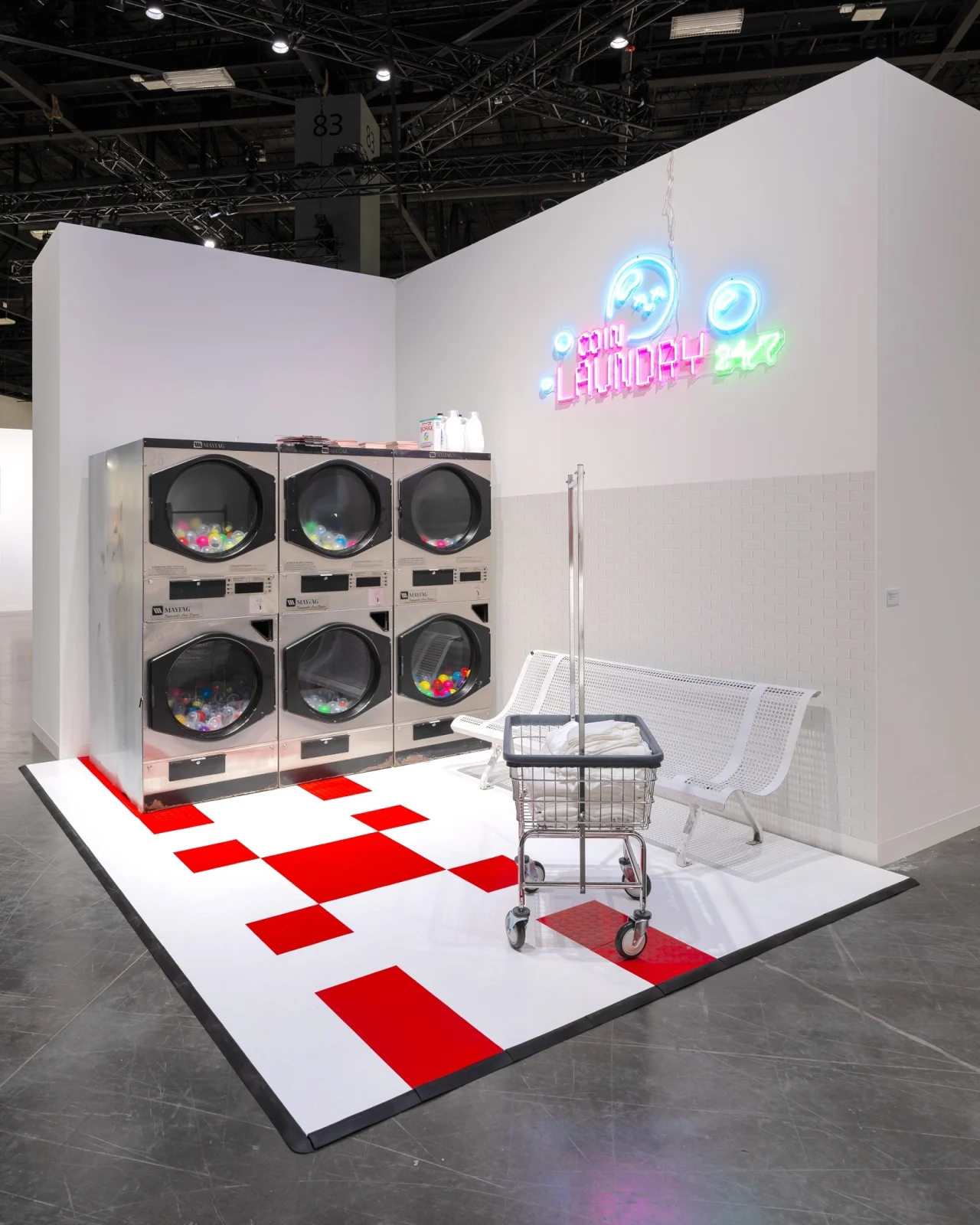
Other interactive works included XCOPY’s Coin Laundry (2025), where visitors could obtain NFT claim codes out of a wall of laundromat washing machines. The NFTs are simple sprites of bubbles but the catch is that all but one bubble will randomly pop—and be destroyed forever—over the next ten years. Someone holds the one everlasting bubble but no one knows who. It’s a simple conceit but demonstrates how digital art can completely upend what it means to own a work—and then not.
Mario Klingemann also presented an interactive installation with an NFT component. In Appropriate Response (2020), visitors could kneel on a prie-dieu, or church kneeler, before a split-flap display. It used AI to generate pithy and sometimes odd pearls of wisdom, with each phrase initiated during the fair collectable as an NFT. AI interactions in general are becoming quasi-spiritual and this work leaned into the odd phenomenon of consulting a twenty-first-century oracle.
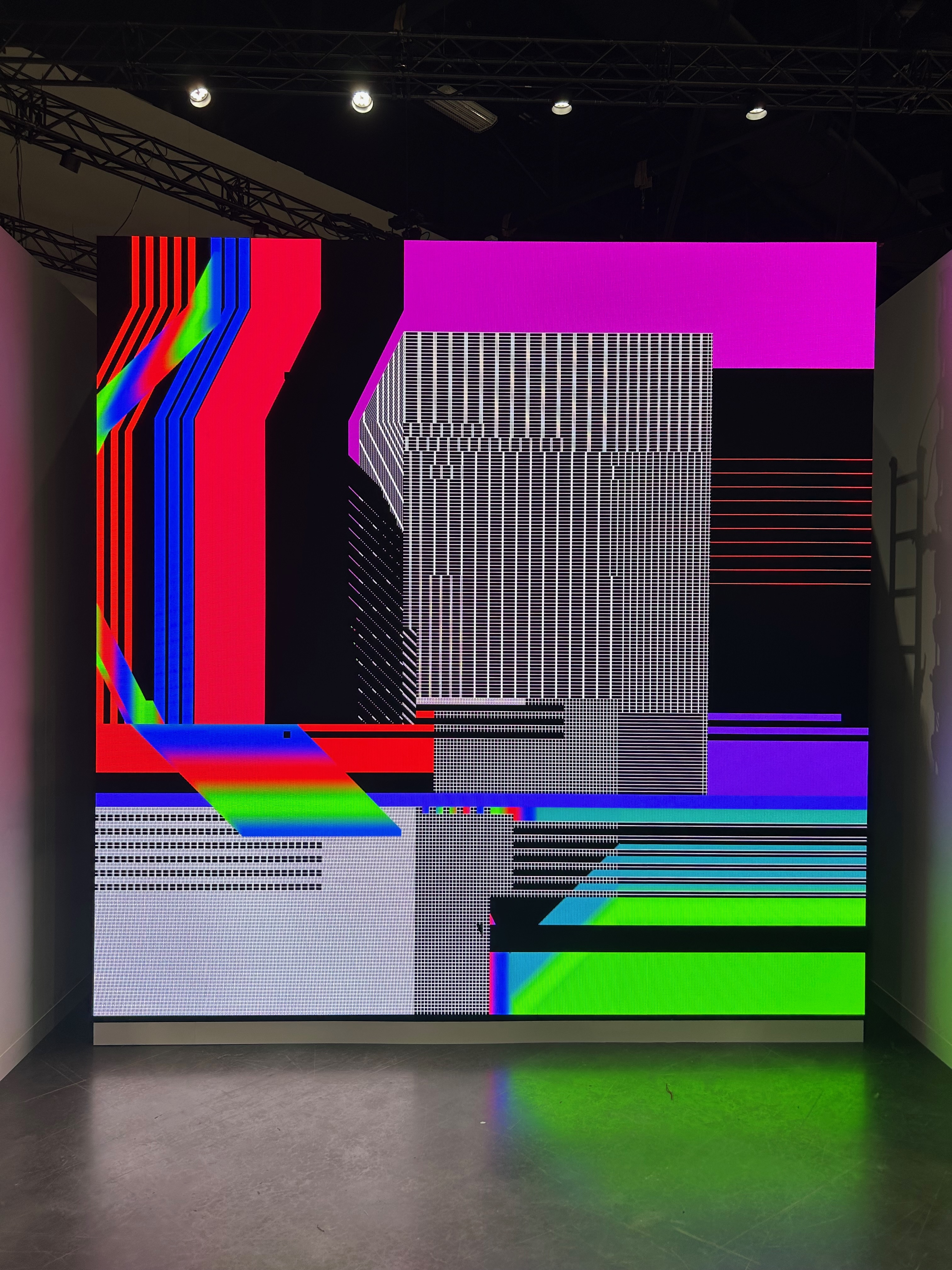
IX Shells, Joe Pease, Kim Asendorf, Yatreda, Lu Yang and Dmitri Cherniak all presented strong works on screens. Prints and sculptures were also included in Zero 10 but these failed to stand out among the more traditional work in the rest of the fair while losing connection with their digital origins.
The purely physical works suffered because they were less conceptually rigorous and less entertaining than the interactive and screen-based works nearby. On top of that, these works were in Art Basel, which inevitably includes some of the most renowned artists of the last century. Competition is steep.
Perhaps the strangest inclusion in Zero 10 was a room by Pace Gallery containing two light and space works by James Turrell. Turrell is an icon and, while immersive, these works barely qualify as digital. The color of the light gradually shifts over time so it is programmed and therefore digital in some sense. But Turrell’s work exists mostly in a different strand of art history and felt out of place here.
On the ground, Zero 10 drew a who’s-who of the crypto art scene; the mood on the show floor and online was defiant and exuberant.
Many veteran NFT collectors, artists and others commented that it was a watershed moment, an epochal event that changed the space forever. They had arrived.
Galleries selling blockchain-based work hoped to onboard new collectors and there are anecdotal reports that this happened. As for the more traditional galleries in the rest of the fair, the hope was that crypto-oriented collectors might broaden their horizons to include more physical work. Again, informally, this seems to have been less successful.
The crypto art community sees themselves as degen Davids facing off against trad art world Goliaths. This underdog mentality can be endearing but it papers over the fact that Zero 10 was not a unified infiltration of the art world proper. Instead, it was a diverse group of artists and galleries with varying sensibilities, approaches and levels of success.
Some artists leveraged digital tools to present work that fit into Art Basel but didn’t stand out. Other artists reprogrammed what an art object can be and what it means to collect. At its best, Zero 10 showed that artists thinking deeply about their digital practices can reimagine the established rules.
Read part one "Zero 10 Part 1: Beeple Casts a Spell" by Kevin Buist
------
Kevin Buist is an independent critic and curator based in Grand Rapids, Michigan.
Travel support was provided by Fellowship.