About us
Stay in touch
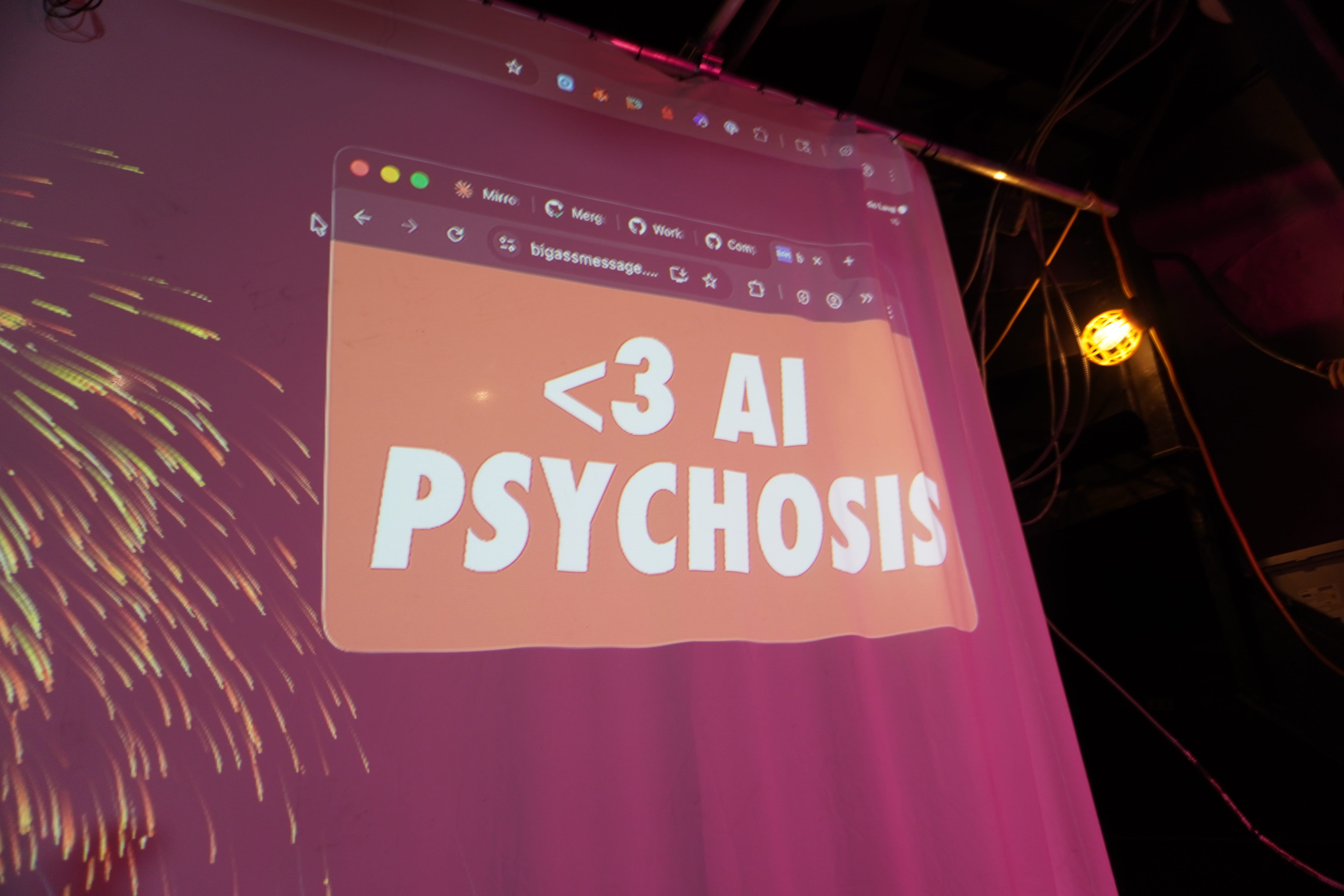
Peter Bauman: Hello everyone, and welcome to this Le Random podcast. I'm your host Peter Bauman, Le Random's Editor-in-Chief, and today our Friday episodes return as a companion to our Monday editorials. This week those two things are very much related, because today's episode is about the AI Psychosis Summit that took place on April 30th in New York. I'm speaking with two out of the four co-founders of the summit, Macy Gettles and quasimatt, as well as Kevin Esherick, one of the exhibiting artists and also the writer of Monday's editorial, which was aptly named "What Was the AI Psychosis Summit?" So if you want to know that answer, read that piece, but also, of course, continue listening to this conversation where we discuss that in depth. I can't wait to share it. This was such an interesting chat with one of, I think, the most relevant events of the year. I was honored to talk to them and can't wait to share it. So let's begin.
Thank you guys for joining. I've been admiring from afar, because I'm based in Europe and so I didn't get to go to the show myself, but I kind of put the organization or the community in the same category as others that I think are really interesting and pushing technology and art in really interesting ways. That includes Basel Social Club and the Glitch residency in France, these kind of unselfconscious DIY art scenes. Also things like Stochastic Labs and Gray Area on the West Coast. How do you see the summit, or the community? What do you even call it? How do you guys think of it? And what is the AI Psychosis Summit, or what was it? I guess we can just kind of start there.
Macy Gettles: Oh sure. Well, I was just thinking, I'll give the broader framework, because it just came to my head that it was kind of a meme that turned into a scene that turned into a movement. And now we're kind of in this post-movement era where we loved the event and it was awesome. So Matt, I feel like, has a more intellectual way to say that.
quasimatt: I mean, I feel like that sentimentally captures it. But I guess just to start from the very beginning, the AI Psychosis Summit was essentially a showcase of projects that a number of artists and practitioners made using AI. Kevin was one of the artists in the show. There were other people who made things that were more adjacent to products or an MVP. It happened in Chinatown kind of in the evening, and people just came through and were able to talk to all the artists and practitioners about what they had made with AI.
I think the interesting thing about it being considered an art thing is that it kind of slowly happened over time. When we first were talking about the AI Psychosis Summit, and the way that it came together, it was just a way to talk to people about the way that they were using AI. I remember at the very beginning we started to refer to the people that we were recruiting to be involved as artists. It was a slow process. Sometimes I would say artists and I would go, oh, and practitioners, because I didn't really want to push that on what it was. I was like, I don't really know if this is art. So I guess in retrospect it was an art show, but it was supposed to be just people getting together and having fun and talking about AI.
Kevin Esherick: And from my vantage point, it's like, I don't know if this is art, but it felt very organic in that way where there was never a "so we're going to do this, this is the vision, it's going to be this great art show" or anything. I don't know. It was more just a vibe. They were talking about having the AI Psychosis Summit and I was like, cool, what's the vibe? And they were like, oh, it's sort of a science fair, art fair thing-ish. But it was very ambiguous and broad and all encompassing in scope. Coming from more of an art background, I was like, I have a place to shill my art, so great. So for me it was an art thing. I didn't even really know how quasimatt or Macy saw it. So yeah, interesting to hear how they've thought about it. Although I think we all kind of arrived at it in a similar way, where it was like this thing and it sort of gravitated toward an art-ish label, but still as if it never was explicitly so.
Peter Bauman: Yeah, it's interesting. You're talking about the vibe as something that doesn't really take seriously distinctions between art and tech and science, kind of treating them more as arbitrary. I also think those distinctions are becoming less correct as we move forward, with how they're all kind of merging. And I think that the most interesting parts of contemporary art are the places that are surfacing that.
I guess I'm curious too about how people were mostly engaging with AI in the show. Can you give a sense of just the variety, or the different kinds of ways that people were using it? Because I think it gets kind of pigeonholed a lot as a generator of images or text or music. I mean, do you guys want to share just the projects you brought to it first of all, because those are great examples of how eclectic it can be, and then we can go off into other projects too?
Macy Gettles: Oh sure. Well, I kind of felt like it was a space for devs to be artists and then artists could be devs, in a shitty way. Like, hey, it's not that serious, so go ahead and just make an art product if you're a dev. Or, hey, it's not that serious. I'm a visual artist. Just make art with AI. It's not that big of a deal.
So for me, I used it to make this AI poster. It's right there. That was funny to me in a way that I probably wouldn't have explored with my drawing or painting practice. And then I had a friend who made a video game, who is a software engineer at a finance company. So to put his talent or skill or whatever into something creative was cool on both sides. That is how I saw it, I guess.
quasimatt: Yeah. My project was the Shake app, which now I'm considering more of a commercially viable social media application. But at the time I think I was thinking of it more as art. And I think there were other people that also had apps. There was someone who made a kind of therapy adjacent app. There was someone who was making something that was using astrological data to invest. There were people who were doing AI projects with auto-tune. There was visual art from shl0ms and others. Other people used AI to do various music projects. So it was really across the board, people were using AI.
Kevin can talk about his stuff, but Kevin and Morry Kolman, I think, did something kind of against the grain, which is that their work wasn't on screens, but they used AI to produce it, or it was commentary on AI in a way. So everything involved AI in some way, but it was really across a lot of different mediums and exploring a lot of different ideas.
Kevin Esherick: Yeah. Some of the stuff was also live interactive work. There was a screen where you could go stand in front of and move your hands and there'd be live generative visual distortions happening based on what you did. And then Bunny was doing a live VJ set, TouchDesigner, AI vibe coding.
And then for Morry and me, it was hard, but rooted in AI processes. Morry, also known as wttdotm online, showed some stuff based off of the MNIST handwriting data set. And then my works were a series of homages, which is a body of work I've built out where I've trained AI models on the works of other artists and then made new works in their style using those models.
In this case it was kind of two layered, because the present year I am in the midst of this performance where an AI model trained on me is making all of my work for me. So I gave it the constraints of the show and told it what was going on, and it came up with an idea to extend my homages concept, but to other artists in this show. So then it came up with ideas to homage shl0ms and Morry. And so it did a performance for shl0ms and then a digital work for Morry. And then I also just brought a couple of my homage paintings from my Heft show in February.
So in the case of the shl0ms piece, it was a performance that was made by an AI model trained on me, taking the vantage point of shl0ms to come up with an idea for what a shl0ms homage would look like. So it's very, I don't know. There are a lot of different ways in which the AI manifested in the work. But yeah, even just across the layers of that one project, and then throughout the show, it was really all over the place. And I think that's what gave it a lot of its appeal.
Peter Bauman: Yeah. I think that breadth and depth kind of demonstrate the diversity and the creative potential of AI broadly as a material, and make it harder for it to be pigeonholed in terms of criticism. I think people only think about it in terms of image, text and maybe now music generation. When you only think about it in that kind of limited way, I think that impacts how you feel about it. And so a lot of people seem to have visceral negative reactions to it. I'm sure you've all experienced it, and maybe even more firsthand than I have.
People tend to have strong feelings about it, but then on the other hand it's wildly popular. I mean, ChatGPT is the most popular and most downloaded app, and it has been I think for the last 20 months or something like that. And it's actually not even close to number two. There's a lot of indication. Gemini and Anthropic are also kind of up there. More people have the Anthropic app downloaded in 2026 than Spotify, which kind of blew my mind a little bit. Gemini and ChatGPT are still way ahead of Claude too.
How as a community have you experienced all these different feelings towards AI, especially the negative ones? How have you internalized it as a community? What's been your experience with it and your understanding of it, I suppose?
Kevin Esherick: I was shouted down on a panel last year, which was mostly just kind of a funny experience, but it was a little stressful at the time. I don't really want to go into the specifics of what it was all about. It wasn't targeted at me as opposed to the others on the panel as well. Sophia Garcia and Adam Berninger from PEPT were there, and then India Rice, who you maybe know. I had seen the discourse online up to that point, a lot of hate for AI artists, "AI artist" itself basically being a slur. And that really made it manifest for me. I'm curious, Matt and Macy, if you guys have encountered stuff like this.
Macy Gettles: If anything, I think we used the hate as a way to market the summit. I think a lot of people have an unnatural relationship with AI just because it is so new and fresh. We're like, okay, wait, should we like this thing or should we not? And I think what the AI Psychosis Summit did was take a non-stance on if AI was good or bad, and was just like, oh, by the way, we're all doing this, so here's a freaking showcase for it. I think that was the power of the summit to begin with. It didn't take a stance really necessarily.
quasimatt: Yeah, totally. When the organizers, that was me, Macy, Wasam and Bunny, when we were talking about the AI Psychosis Summit before it happened, I was adamant that we were not going to publicly take any sort of strong stance on AI, just because to us it's a distraction. A lot of what the AI Psychosis Summit was, and why it's confusing whether it was about art or technology, is because we naturally subjugate everything to a social experience. And so for us, or at least for me, the AI Psychosis Summit was primarily a social experience that benefited from a very dense network of people who just so happened to be interested in certain types of art and certain types of technology.
And so rather than engaging with people who don't like AI for this reason or that reason and trying to debate them or something like that, I think it's more powerful to show them that you can have a pro-social experience that relies on AI. Showing people that we can get in a room and all have fun and connect with one another because we use AI and we enjoy using AI is so much more powerful than trying to make some sort of reasoned argument about how no, AI actually doesn't waste water, or no, you're not going to lose your job. And I think we were trying to show rather than tell.
Kevin Esherick: I think there were also people who came in there ready for a symposium or a group therapy session, and then when they found out it wasn't that, were primed to hate, and then were maybe won back a little bit as they started to see more of the layers to the kinds of work being displayed and the maybe agnosticism in the attitudes toward it. I think plenty of people in there were probably pro-acceleration and others have a more critical stance. My work, while working with AI, is very deliberately and explicitly trying to ask questions of it, not just to be rah-rah AI, serving as a cheerleader for it, but asking what this is going to do to our lives, and taking it as a given that this is going to be part of our future but trying to steer that toward the best future it can be with it.
Peter Bauman: Yeah, I think again that's why it reminded me of Glitch, the residency in France, because at the end of the two weeks there's this art exhibition called Room Service where all the residents present work in a different space in the château where the residency takes place. And yeah, it's this kind of hodgepodge. It's DIY. It's very bottoms up. It's very anti white cube. It's very weird and experimental. It's a very limited experience, because you have to be in that space. But yeah, it kind of reminds me of the most powerful art experiences that I've had, like Basel Social Club, where the relational aesthetics is just as much a part of it. And also just how much that aligns with contemporary art's current emphasis on creating spaces of emergence, and just how art and technology are so good at that in particular, and just the different types of relations that are possible now because of these new intelligences that we're kind of dreaming up and creating.
And yeah, it's really interesting to showcase that stuff, but again the mainstream I guess would still be looking at AI from a kind of point of distaste. And then the aesthetics. Rather than mainstream aesthetics going more tech art, tech experimental, they've kind of gone more cottagecore. I just wonder how you guys see that, that if anything we now have these really interesting tools, but it seems like the backlash is so severe that there's more of a rejection of them. It seems to be this kind of analog romanticism. I'm kind of curious, what is that nostalgia that they're trying to capture that they think AI maybe is lacking, or doesn't have itself? And is that accurate at all? I don't know what you guys think.
Macy Gettles: I find it hilarious that cottagecore is like a cancel culture. That conceptually is hilarious to me. So that probably says I don't really think about it much at all, probably.
quasimatt: Yeah, I think right now AI has an aesthetic, but I think that's just a current limitation. AI will transcend having its own aesthetic and will be able to be used to create lots of different aesthetics. And so I think that being able to clock that something is made with AI will largely stop happening when it comes to certain types of art.
And I think one thing that excites me about AI when it comes to aesthetics is I think it has allowed people to do a lot of aesthetic exploration. It's kind of made me realize that when people have an aesthetic preference as an artist, it sometimes is a matter of convenience rather than of actual preference. So maybe someone uses the same color scheme or the same design because that's what they have as their Figma presets, or they have some brush on Photoshop that's just easier to use than the rest. And I think AI kind of gives more access to more aesthetics and allows you to iterate on ideas much more quickly. So I'm really excited about people using AI to explore new aesthetics and not be necessarily so dedicated to one thing.
And I think I've kind of been seeing that in the way that people vibe code and the things that people create. The software products that people create with AI seem less standard. And so there's a sense right now that AI pushes everything into one aesthetic, but I think the future is that AI actually enables the aesthetics to go all over the place.
Kevin Esherick: Yeah, I would be less hopeful than Matt, maybe. Not that I think that that's not going to be the case, but I find myself just more on the fence that, as you have these things that can fall into the middle of the Gaussian distribution and are able to just feed us the mode of any dataset, that is super easy to fall into. I think we all agree that's where we're at now. I am not super optimistic that in the long term the plurality of people will be able to break outside of that mode and go and create new and wild and different things. I'm not necessarily pessimistic about it either.
“It's kind of made me realize that when people have an aesthetic preference as an artist, it sometimes is a matter of convenience rather than of actual preference.” — quasimatt 18:27
But I do think at least at the margins there's a much greater latitude for doing things that exist outside of our traditional creative boxes, because you have these tools now that enable you to, like he said, with ease, tap into all different sorts of aesthetics, both in terms of at a simple face value level. You can vibe code something trivially that has aesthetic Z rather than the default aesthetic A, B or C.
But then further than that, there's the capacity for latent space exploration. Primavera, who you know, Peter, she had this Right Click Save post the other day about off-grid aesthetics, and it's basically exactly what I would call latent space exploration, which is using the fact that these models are these massive n-dimensional spaces that we can explore. And yes, we are served the modal output in our typical use of them. But when you actually dig into the tools, use open source and do different things with them, you can explore them as these kind of vast wildernesses that can open up new aesthetic frontiers. And that's how I've largely preferred to use them in my work, treating the model as a kind of space or a material to be explored or sculpted, and to try and find new forms of beauty that were previously inaccessible to the world without something like this. So I think on that end it's very hopeful for the people who are willing to put in some effort to deviate from the norm. And there's a lot of cool stuff.
Peter Bauman: Yeah, I completely agree. I think a lot of talk about AI aesthetics tends to center around slop, and to me a lot of slop discourse is just a failure of imagination, or just a misunderstanding of what this kind of technology or force enables, which is this ability to explore latent spaces. And I also think it's kind of mistaking, like you were talking about, Matt, this kind of GAN aesthetic for some kind of lasting visual aesthetics of AI. And I don't think that's true. If anything, AI is moving us beyond visual aesthetics. It's showing that the image is becoming less viable. You can conjure anyone at any time, basically, just with a prompt. And so it's moving people beyond the aesthetics of the image and more to the relational aesthetics that we're talking about.
And that I think the summit was tapping into, that people want to get together and relate to one another, especially in these days where they don't have as many opportunities as maybe they had in the past because of things like, I don't know, religion or whatever kind of community groups that they're in. So I think the aesthetics are more about a kind of cyber relational aesthetics with humans and these other intelligences, and the kind of electron cloud that that produces, as opposed to something lastingly visual. That's kind of how I see it.
“But when you actually dig into the tools, use open source and do different things with them, you can explore them as these kind of vast wildernesses that can open up new aesthetic frontiers.” — Kevin Esherick 20:48
One thing that I think is interesting about how critics approach AI is that, in my view, they underestimate it. And what I mean is they hate it so much that they see it as something that they want to go away, and then they kind of fantasize about it going away, because it's not improving fast enough, or it's plateauing, or it's hallucinating too much, or it's not even useful. Basically every argument that Gary Marcus has ever had, or whatever, people like him. And one by one these have kind of fallen. So then the latest one is that it's a bubble, with Meta spending a lot on capex. But I guess I just wonder, how do you guys see the most prominent critiques? Is there any truth in them? How do you kind of see them or address them?
quasimatt: Well, actually before we get into that, I just want to talk about something that you said before that, because I really liked this idea that visual art is maybe waning in importance or something. I don't know exactly how you would put it. But I have always seen art as a reference to something that is more alive and exciting, and so for me art is all about its social context and the ideas that it embodies. I'm really into conceptual art, and I think that deprioritizing the process of making things, which is what I think AI does to a large extent, allows people to focus more on that social context than on the work itself, which to me has always been the point.
The point of the AI Psychosis Summit, for example, was not what people were making. That was a catalyst. That was something that was involved and it was an important part of the process, but what really mattered was the community that formed around it. And so this is what I like most about AI, that it gets rid of all these things that I just kind of see as annoying, which is that you have to have a craft and make a physical object, so that we can focus on the fun part, which is drama between people, the ideas that they share, having some sort of movement. All this more abstract stuff is more exciting to me, which is why I'm so obsessed with and addicted to AI art.
Macy Gettles: One hundred percent agree. As a conceptual artist, I totally disagree though. But that's just about my personal practice of art making, which is totally all about the process. So I feel like I'm interacting with AI in a completely different way, where the things I'm making are empowering, like making things that I wasn't able to code before, or I wasn't able to organize my thoughts in an efficient way.
And so I get that though, because a dev might think the same thing, where the process is so important, and so it's like, how could you bastardize the process while using AI? And so I feel like it's been a lesson for everyone to kind of just stop really caring, or pour your efforts into what you care about. If I care about process, then go ahead and care about your process. That's kind of the point, I think. That's what AI is showing everyone. It's like, oh, you don't have to actually think like everybody else. And that's a good thing.
quasimatt: Yeah, actually I think what you're saying about process, maybe I overstated what I was saying. It's not that I'm not interested in process. It's that I think that there is an interesting part of the process, which is how does creating art influence your life and your social relationships, and then the uninteresting part that I kind of don't care about, which is, oh, you learned how to paint for four years, like okay. So there's a certain part of the process that's interesting. I just think not all of it is interesting.
Peter Bauman: Well, I completely agree with that. So part of the reason, I guess a big reason we're having this conversation, is just Kevin's piece and about the summit. And one of the parts that I liked was the definition, or one of Kevin's ways of describing AI psychosis, and that was "states of excitement and obsession bordering at times on euphoria or hypomania induced by the vast realm of possibilities unlocked by AI tools."
It reminds me of what you were saying, Matt, and what you were saying, Macy, too, that what these tools are also doing is removing barriers to whatever was blocking you creatively before. So if it was, oh, you needed a dev to do that and you had to explain to him or her in very minute detail everything you needed done, you don't need that anymore. And so it's opening a lot of possibilities, especially with computation, in a way that I think Processing did a quarter, you know, 25 years ago, where people realized, oh, this can also be art now.
When talking about that definition from Kevin's piece, that feeling, I think we've all experienced it. Whenever Claude releases a new update it feels like it's changed everything again, or something like that. And I guess how was that show, or how was the summit, or how does the community respond to these changes? Is that part of what brings everybody together, this excitement around how fast things are changing and then what that then enables you to do?
Macy Gettles: Well, I was going to say my favorite part of Kevin's piece was how, I feel like you did a really great job of making sure that everyone knew that it was very much a supplement. There was this online supplement that was equally as fun as the event, which was everybody talking about the event. And so I feel like that was a perfect way to describe this whole AI psychosis thing. That euphoria part of it, it's not all that different from what we're doing already. It's like, oh my god, you're all laughing about a tweet, and it's like, are we in real life in person together? No. But is there this kind of joy that's sparking? Yes. And so to think of AI psychosis as this supplementary thing that's making life a little bit more silly and fun, in a way that you're doing already when you post a funny Instagram story or whatever. It kind of creates this unseriousness that I think, Kevin, you contextualized well, because that was a huge part of the summit in my opinion, it being half online, half in person, kind of.
Kevin Esherick: Yeah, and I think those energies having pre-existed online is a big part of where the success of the summit came from, in that you talk about this, I don't know, hypomanic or whatever state, Peter. It felt like there had been this thing bubbling up online over the last, in the run-up to the show, like last five months or so, and kind of what you could call the post-Claude Code moment, where all of a sudden everyone was making all of these things and you couldn't get it out fast enough. And so there's this frantic mindset, and that mostly was being exchanged online. We're sharing tweets, we're commenting, stuff like that. But then the summit, in providing a real physical place for those people to meet up and to share projects that had been brewing over that period, became this kind of outlet. And so I felt like all of that energy that, Macy, you discuss, and that had just been building up online, was concentrated into this place and kind of was able to rapturously explode in the form of this very fun and electric event.
quasimatt: Yeah, I think Kevin's description of AI psychosis and the hypomania is definitely more accurate. One thing that we had noticed with AI psychosis amongst our friends was that a lot of people are so excited about AI that they will do this super circular recursive thing where they get obsessed with their AI stack and their tooling. And it seems like you're obsessed with technology so that you can build technology that builds technology that builds technology, and no part of it is ever human. And I think the AI Psychosis Summit, because you were going to go in front of someone and show them how you used AI to express yourself, required that you actually finally, for some people, think about the end point. What do you actually want to do with AI that's not just very literally about improving your AI efficiency or something like that? And so I think that was a big part of it. There's this excitement that goes in a circle and it's all about AI, and then it's like, okay, well let's make a social experience that releases all of it. And I think that was kind of the opportunity that we ended up creating.
Kevin Esherick: Yeah, which I think is really important to note, because you kind of framed it perfectly. We've almost become a tool in service to AI, and I mean that in a very literal, non-metaphorical sense. You can talk of the egregore or whatever bringing itself into being, or hyperstitions and stuff like that. But AI is in some sense this technology that is using humanity to manifest itself, in the same way that our genes are this entity that use us to replicate themselves. That's very real, and I think that's sort of happening with us with AI. We see this with the idea of RSI. We're almost at this point of recursive self-improvement in AI, and the promise or threat of takeoff is kind of looming. And there's talk of a post-human economy and all of these things.
And if we want to remain in control at the center of things, if we want AI to be a tool in service to us rather than the other way around, then I think we really need to enter these places together and engage with humanity and remember what we're doing it for. Because it's so much easier to, like he said, get lost in these recursive self-improving tooling loops when you're an individual sitting alone in an apartment doing your own thing and you aren't connected to other people.
And so, as Matt also mentioned earlier, the humanity and the connectedness, the relationality of it all, is something that I think is increasingly super crucial to how we proceed, not only in the arts but in the world of today. And that was something that I thought was so powerful about this, that it existed within the advanced avant-garde of what art and social life is today. It was online. It was AI native. But at the same time it grounded all of that in a human social group that came together in a physical place.
“But AI is in some sense this technology that is using humanity to manifest itself, in the same way that our genes are this entity that use us to replicate themselves.” — Kevin Esherick 33:09
Peter Bauman: Yeah. Again, I'm reminded of ideas of the relational aesthetics and how that's being centered rather than any kind of formal aesthetic. And there's a distinction between a circle and a spiral. Recursion as repetition is just kind of a circle, always going back to where you started, versus recursion with contingency, like with information, and then it becomes a spiral. So you're kind of moving while there's this recursive motion. And I think putting out work like this into the public is a way to gain that contingency. You gain a lot of information by putting all these ideas together with all these different people and creators. And yeah, I think that was one of the real powers of the summit.
I guess maybe, we kind of skipped over it, but do you guys want to talk about at the very end how it started? What was the founding moment, or ethos? Was there any sort of founding myth for it?
Macy Gettles: It was a tweet. I tweeted a tool that I created. It was essentially just a Google Fonts API that was not all that impressive, but I just tweeted it anyways. And then a friend of ours was like, oh, I like to make tools for myself too. And then Matt kind of swooped in and was like, should we do the AI Psychosis Summit, which was a joke between friends kind of a thing. And we ended up going and doing a little show and tell with just four of us in a room.
And then kind of the meme started, where one of the other people that organized it took a photo, used AI, filled up the room and was like, you guys need to come to the next summit, essentially. And that created a ton of demand for a real physical thing, and through a few other posts and kind of testing the concept out there, we realized, oh, there's a really real demand for an AI Psychosis Summit, in a way that we kind of were joking, but maybe it's real life. And then everything led to, we already knew people like Kevin who were making awesome things with AI, so it was very easy to just swoop our current network in with us, which I think is what made it so magical. It very much was like, oh guys, let's just do this kind of a thing, that turned into almost an art object in itself, I guess. I mean, that's the story.
quasimatt: Yeah, nothing to add. I'm really interested in how the summit worked as a sort of foil for that Klein article in October.
Peter Bauman: Yeah, so that's something that Kevin, you wrote about in the piece. And we didn't coordinate or talk about that at all, but it happened to be something that just perfectly aligned with how I felt about the Klein piece. I always thought that what he was describing was accurate, basically, but his kind of cynical turn, and I think it's also sort of like, New York ain't the same, art ain't the same, or culture ain't the same. A few prominent critics have that view, other than Klein. It's just always something that I've disagreed with. You can kind of lament the fact that, I don't know, film is just maybe a lot of sequels or whatever. But if you're ignoring things even in your own city, where this culture is manifesting itself in actual, meaningful ways, then, I don't know, it seems like kind of a familiar refrain of lament again. People have been lamenting sort of change and whatever their location for basically forever.
I guess the Klein argument was that real estate prices in New York are making good art impossible to make. And sort of Kevin's argument was more that a lot of interesting culture is moving online and is maybe less dependent on real estate, and also just that these things kind of find a way. I'll let Kevin maybe summarize it how he wants. But yeah, it was something along those lines.
Kevin Esherick: Yeah. Basically he was saying, New York's expensive. It's making the art whack. Go to another city. The art community here is dying. I was saying, if art's not being allowed to thrive in the city, which, I don't know, you can contest in its own right, but then it's going somewhere. And it's sort of being marginalized to the internet, in a very literal sense of that term. It's kind of being pushed online. It's cheaper to make art in a digital space than it is in physical space, and that increases the velocity and the interconnectedness of it all. And I think it just makes it a really fascinating and exciting substrate for art. But then the art world still comes to play in New York, and those things materialize here.
Peter Bauman: So I guess the most meaningful question with respect to your thoughts on the Klein essay is, does it feel like the situation with New York real estate makes it difficult or impossible to make art in the city? Or how do you take the reality of that, and what role does it play?
Macy Gettles: Yeah. I hate a low agency take. It's like, rent's expensive, okay, figure it out. Like, I'm so sorry. I'm just like, oh, you want to be an artist? I feel like there's this certain entitlement sometimes around art where it's like, I deserve to get paid because I'm an artist, where it's like, no, you should figure out how to get your things in order so that you can make art. And it's like, I don't know. I feel like that's kind of one side of the essay where I was just like, okay, get over yourself a little bit. But then sure, it is expensive to live here.
But I think there's still art movements happening. I just wonder if the institutions just aren't invited, you know what I mean? I think maybe it's happening on such a small social scale where these art critics don't know about it, in ways that they maybe were exposed to in the past because artists needed institutions. And I think now the art community is realizing, wait, what are we even doing this for? Are we really doing this to make the white guy happy? Or, you know what I mean? There's just really odd taste to the institution, and I think a lot of people are waking up to that. It's like, oh, we could just get together and have a summit or have a salon or have these art things that celebrate art in the way that we want to be celebrated, and not in a way that, oh, we need Sotheby's to think we're legit kind of a thing.
quasimatt: Yeah. I kind of think there's two different things, and maybe Klein's essay is saying, okay, there are these limitations to making art. And that's true. If you're trying to make some huge sculpture and then you can't afford space to make that sculpture in New York, then yeah, that is a real limitation. Maybe you should go to Missouri, find a warehouse on the cheap and make it.
But to me, and this is what I was saying before, art isn't really about objects. It's about social dynamics. And so I actually want these complex limitations and this social climbing behavior that exists in the art world, and I'm more interested in people interacting with one another than in making objects. And so for the type of art that I enjoy, you have to be in New York and you have to be engaging with the social dynamics of art, and maybe engaging with the institutions in a positive or negative way and around the art scene. And that's more important to me. And so what I'm interested in is doing things on the internet, doing things where I feel like there's a dense artistic community.
But I think if you have different preferences about what art is, if you want to do theater with a cast of 50 people in a huge theater, and you really only care about making it, you don't really care that much about who sees it, then of course he would be right. You should just go somewhere else.
Kevin Esherick: Yeah. I also think there's an extent to which, like, traditional art world vantage point, you spent these years climbing up this ladder and you look down and you see just, I don't know, a shitty or broken ladder now below you, like the handles have been knocked out or something. Because yeah, that's the vantage point that makes the situation for art in New York look dire. But then you're not looking over to your left or right or whatever, where someone else has put up a different ladder or has invented a little personal helicopter to fly up or whatever. There are different, interesting and novel things happening that you just wouldn't understand from the vantage point of expecting it to conform to a certain traditional box or whatever.
And again, yeah, I want rent in New York to be cheaper. Don't get me wrong. I think there are harms aplenty with that, and having lived in multiple other cities, yeah, it's fairly insane. But I think it's important to take that critique and still retain hope and fight for a place like New York, where I think the idea of moving to Philly or something like that for any of us is, with all due respect to Philly, I've got family from there, but it's laughable. That's just not where the network is. That's not where, to us, and I think I can probably speak for the three of us, New York feels like the most exciting, interesting city in the world. And we're all super stoked to be here and involved in art and culture here. There's nowhere else like it. Period.
Peter Bauman: Yeah, I think the summit has demonstrated the power of these communities and these networks, and what they're doing with art, kind of pushing it away from the object. That's been happening since conceptualism in the sixties, but in a lot of ways art is rematerializing in this age of AI. At least it's decentering the importance of a single kind of immutable object. It's also pushing art towards these different ideas about aesthetics and formal aesthetics, and more towards ideas about relationships and community. And I think that's really, I don't want to say the vanguard or whatever, but I think it's definitely some of the more interesting directions that art is getting tugged and pushed and stretched. And I think the summit and some similar organizations around the world that kind of share this ethos are some of the things that I think are the most interesting things happening right now.
Kevin Esherick: Yeah. What is scene tech? I'm curious about it too. Do you have an answer yet?
Macy Gettles: Let me see. We've been trying to figure it out. Scene tech is the way by which you observe scenery, the inputs and outputs of the scene. So tech would be how the scene interacts with society in a meaningful or non-meaningful way. So to me, scene tech is the observation of this phenomenon that is scene.
quasimatt: Yeah. Okay. So we're trying to figure out, we're obsessed with the scene, the concept of the scene, and being in the scene. And it's one of these words that doesn't mean anything to us anymore. We love using a word until it doesn't mean anything. "Grift" doesn't mean anything. "The scene" doesn't mean anything, because we've just used it into oblivion. So it's hard for us to define.
But the purpose of the talk is to explore the relationship between the scene and tech, and how tech can enable the scene. And so it starts by us figuring out exactly what the scene is. What is the social structure of the scene? And then how do people co-opt existing technology in order to create scenes? Because in our view, popular technologies do not automatically facilitate a scene. It incentivizes virality. It asks for dilution, and a scene dies with dilution. And so the question is, how do we create technology that can facilitate tight knit social groups, ideally IRL? And so the talk will hopefully, if we figure it out within the next like 24 hours, make some proposals for how we can build technology that is more conducive to building scenes.
Kevin Esherick: Is the Shake app the preeminent example of scene tech?
quasimatt: The Shake app is most certainly scene tech, but I think there's just so much more scene tech to be made.
Kevin Esherick: Oh no, agreed. It's a proof of concept.
Peter Bauman: I do think that this kind of thinking about how tech can be integrated with communities again, that's basically exactly what that Glitch residency is about. I mean, it takes place at Château du Feÿ, which is essentially like a commune in France. It's a communal living space. And how can tech be integrated into communities in ways to even form and foster them, as they've been disappearing also largely due to tech? So how can tech kind of rebuild in a lot of ways what it's helped disappear?
quasimatt: Yeah, totally. I guess the Shake app is sort of a continuation of this social logging practice that I've had for a couple of years, where basically my goal is to document real life social interaction. So if two people have the Shake app and they're within, say, 10 feet of each other, because it uses Bluetooth, and they both shake their phones, they become connected on the Shake app. And then the app spins out a big graph, a big social graph that shows you everyone that you've met and how many unique days you've met them on. And so its goal is to render the social scene more navigable.
And so the idea is that you want to take your in real life interactions and kind of seamlessly put them on a platform that allows you to understand them. And then now kind of the next step for the Shake app is allowing people to use the platform to facilitate IRL connections, so going in the other direction. So I'm really excited about it. It's like the mesh of all the things that I'm interested in. I'm obsessed with social graphs. I really like events and scenes and stuff like that. So I'm just honing in on that.
Kevin Esherick: Yeah, and it has leaderboards and stuff like that. It's taking a lot of the social media gamification elements and kind of switching the sign, flipping them to facilitating IRL engagement rather than isolating people, as so much technology has happened to do very directly. It's like you need to be with other people in order to use this. And it's just got a level of delight to it that can be rather addicting. Like I want to be shaking with you guys right now.
Macy Gettles: I know. I know. It's so sad that we're not physically together, so we can't shake.
Peter Bauman: I was going to say there should be some ability for it to recognize your face or something like that, but I think that's a bastardization.
quasimatt: That's totally antithetical to the physical immediacy.
Peter Bauman: Yeah. Agreed.
Kevin Esherick: Wait, Matt, this just occurred to me. Would PMI be, is PMI considered scene tech?
quasimatt: Yeah, I think we came to the conclusion that scene tech is a way of people interacting with each other and technology. So a product like Twitter can be scene tech if you use it right. Instagram can be scene tech if you use it right. But these platforms are not built as scene tech. But I would say PMI is scene tech for sure. I mean, PMI was very deliberately go up to people in person.
Peter Bauman: It's trying to actually harness them, which is probably what separates it from something like cottagecore or something. But a similar impulse that I think we just as a society are all kind of feeling. And yeah, it's interesting how it's manifesting itself with and without tech and in all these different and interesting ways. So that's super interesting. And that kind of idea about relational aesthetics or cyber relational aesthetics I think is very connected to just tying technology to communities. And it's really interesting. And I think that kind of perfectly, in a couple of words, sums up what the summit did and is doing.
And I guess, do you want to talk about, this will come out on Friday, do you want to talk about anything about what's next or any of that? Or are you kind of waiting to announce anything later? But if you want to say anything about that, you can talk about what's next.
Macy Gettles: I would say mostly probably personal stuff. The AI Psychosis Summit team is cooking on things that we're not going to speak about yet. But Matt and I are doing a talk at Fest on Friday, so probably the day this comes out. So if you're watching today, look for the Fest talk. And then I'm a visual artist, and I also do scene tech. I'm @gettles on everything. My website's gettles.co.
quasimatt: Yeah. There are some potential AI Psychosis Summit events coming up, which we don't really speak on. But I guess I would say, if you think the AI Psychosis Summit was electric and you're interested in that, I think the one thing that's important, that some people don't understand, is that the electricity of the AI Psychosis Summit was that it was agile and it capitalized on something. [...] who want to queen out and who are pro-social and who are curious. The next AI Psychosis Summit is not an AI Psychosis Summit.
Kevin Esherick: Damn.
Macy Gettles: Do you want to show the Shake?
quasimatt: Oh yeah. Download Shake and go on quasimatt.com.
Macy Gettles: Yeah, check out quasimatt.com slash social.
Kevin Esherick: Oh yeah, I forgot to even mention that I did a quasimatt homage as part of the show, but whatever.
As for myself, I'm in this period where I have an AI model trained on myself making art in my stead. It will be having some releases coming up. It's had a smaller trickle where I've done a couple of small things for the summit and a couple of other group shows and stuff, but there will eventually be bigger releases around that.
And then I have a lot of writing stuff coming out, because since I can't make art, I need to do something else with my time. And so, yeah, I had the essay that just came out with you all, which I'd love for everyone to go and read. And then I'll have a few interviews I've done with some people coming out soon. And then I wrote a World Cup essay that is on American culture and politics and the World Cup and the future of the game here. Very just totally unrelated to any of my art stuff.
I basically passed this essay along to my model agent. And I've basically created a system where anything I'm doing or experiencing is being fed to this model so it has as much context around my life as possible, because I think so much creativity is a matter of rootedness in one's life. And so I'm trying to replicate that within this agentic copy of myself. And so, yeah, it was privy to this essay and has developed a series of art pieces to go along with it, releasing sometime soon.
Peter Bauman: Definitely, yeah, check out Kevin's site and Substack, and Matt and Macy's. And for the summit, it's psychosis.nyc. And then, of course, Kevin wrote "What Was the AI Psychosis Summit?" for us, so please check out that piece on Le Random Editorials. And yeah, thank you all three so much. It was great. I hope to catch one of these summits somewhere in the world at some point soon. And yeah, lovely to meet you all. And yeah, thank you so much for the chat today.
Kevin Esherick: Appreciate it, Peter.
quasimatt: Thanks for having us.
Macy Gettles: See you guys. Thanks.