
.png)
Suggested Reading
Interview
Event
Seeing Machines: Luba Elliott on the 2026 CVPR Art Gallery
Luba Elliott
•
July 27, 2026
View


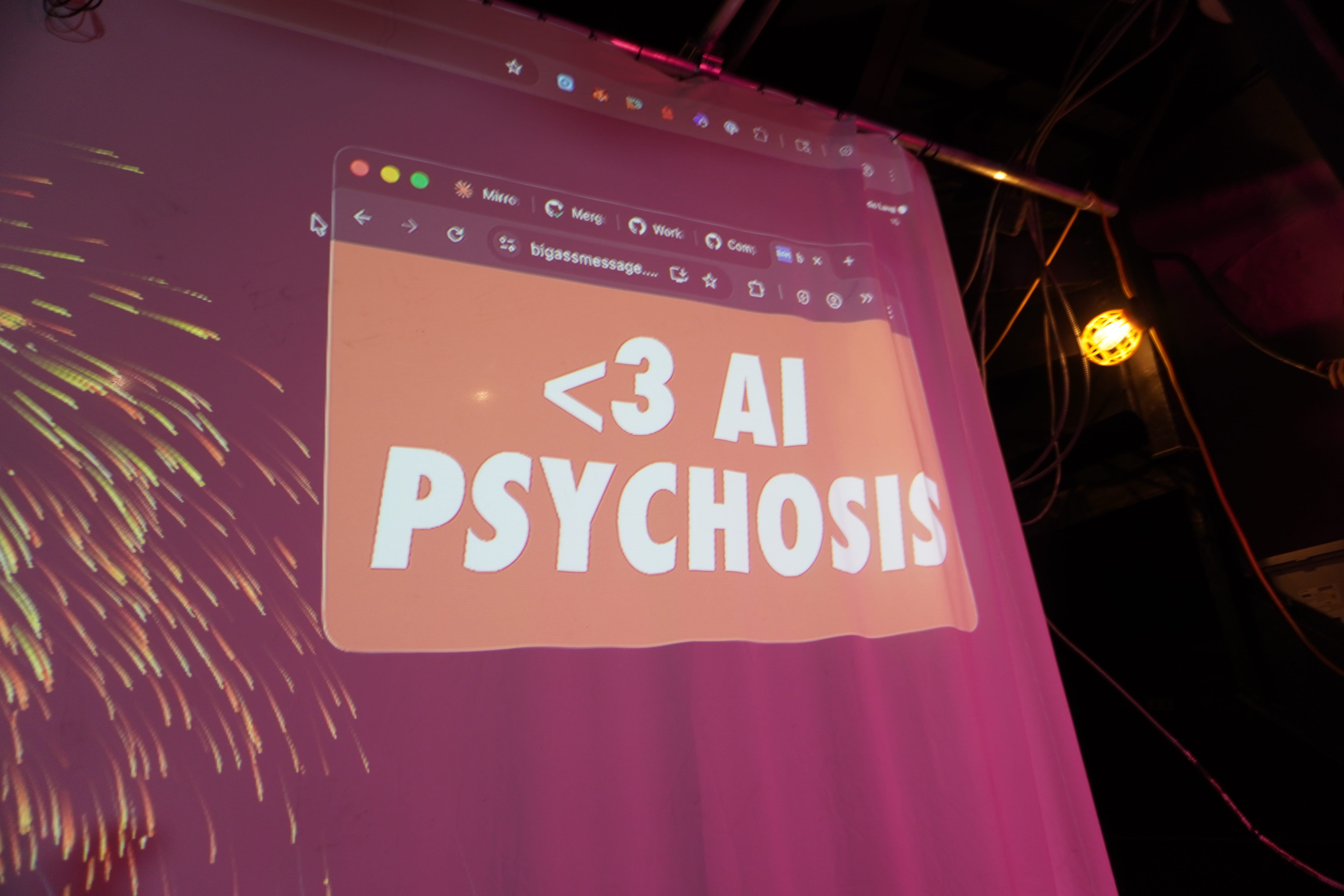
Artist and writer Kevin Esherick reflects on his experience at the AI Psychosis Summit. And what was that? It was a community gathering celebrating AI-made projects and arising out of a social circle that straddles downtown New York and the internet.
I’m in a sweaty, dimly lit room in the heart of NoDi, New York’s hottest new microneighborhood. Time and time again passersby in the mingling crowd ask me the same question: “What the hell is going on here?”
I’m at the AI Psychosis Summit, which is not really a summit and which, depending on your definition of “AI psychosis,” might not really have anything to do with AI psychosis. It is also—and I hate to use this word but it really is apt here—the buzziest event of the year within a certain branch of the digital art scene, of which, if you’re reading this, you are probably a part.
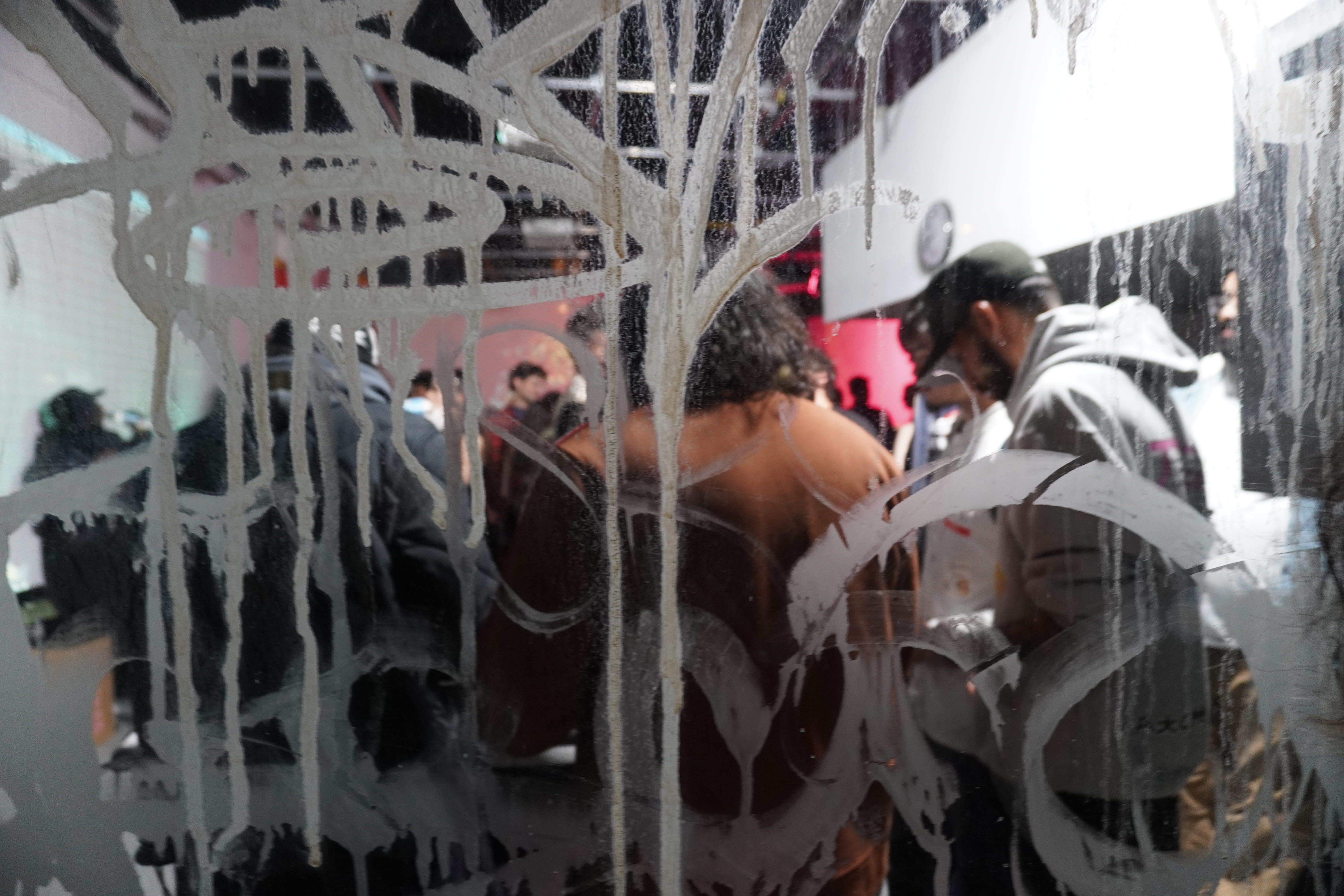
Yes, in a year marked by two additional Art Basel Zero 10s, the Node Foundation opening, a growing digital art presence at the Venice Biennale and cryptoart acquisitions at MoMA, among others—some real institutional moments for a once-fledgling scene—the most exciting moment of all came from a small, grimy, DIY event in a defunct, graffiti-covered bank in New York City’s Chinatown.
So what was it, if not a summit? Because it was also not a show in an art gallery. Neither was it, to the dismay of some attendees, a symposium on the clinical phenomenon of AI psychosis or a support group for those experiencing it. Nor was it merely a party or a hackathon.
It was none of these things, though we could, with almost equal merit, say that it was all of these things. The point of the matter is that there’s really no singular term for what it was because it was earnestly and unselfconsciously experimental, more in the sense of an independent scientist-tinkerer than of contemporary art.
The result felt like a hybrid of a science fair, an art fair and a startup demo day, celebrating projects made using AI tools and arising out of a social circle that straddles downtown New York and the internet. This inability to fit into any one box both confounded onlookers and fueled its success.1
Part of the difficulty in affixing a label lay in the event’s embrace of a wide range of projects. Some people presented vibe-coded computer games. Others showed off interactive generative software systems. SHL0MS gifted us with a supposedly leaked, Epstein-files-adjacent video of Donald Trump performing fellatio on Bill Clinton.
All were made using AI tools, and collectively they asserted the role of the creator in what many claim to be a creatively barren medium.
.jpg)
For several of these projects, I’m genuinely unsure whether the creators themselves would bill them as art. Quasimatt’s Shake app doles out points to users who shake their phones together in person, tracking connections. Shakers look pretty ridiculous in the act of shaking and befuddled spectators are a common sight. It’s rather delightful. The current record shake is something like twenty people at once—twenty people standing in a cluster, shaking their phones together with a variety of techniques, and an icosagram tracing those connections in-app.
The resulting leaderboards and graphs of users who’ve shaken together form a living map of the surrounding social scene. Is this art? Which part? The app? The graphs? The act of shaking? The whole shebang?2 3
Busy with sharing my own work and trying to take in the experience, I didn’t get to explore others’ projects to the extent that I would’ve liked (though I’ve done so since). Yet it still felt like I experienced the show in its fullness.
That isn’t to say that I wasn’t missing out on anything but that it wasn’t individual projects that carried the day. Rather, there was some emergent property of their coalescing over a humming energy in the room that rendered the event more than the sum of its parts. The works were most impactful for the eclectic, engaging pastiche that they formed, marking themselves a part of something bigger.
Still, much of this, in its attempt to explain what the Summit was, fails to convey what it was actually like. Which, for such a vibes-based event, may be the truer account of what the thing was anyway.
So what was it like? Well, there was the venue—downtown, graffiti-covered and stripped inside of all ornament, leaving behind exposed rafters and dangling cords above concrete floors. There was the line around the block to get in, queuing up fifteen minutes before opening. There was the ambience of sporadically flashing lights and moving images on screens over the backdrop of a persistent red glow.

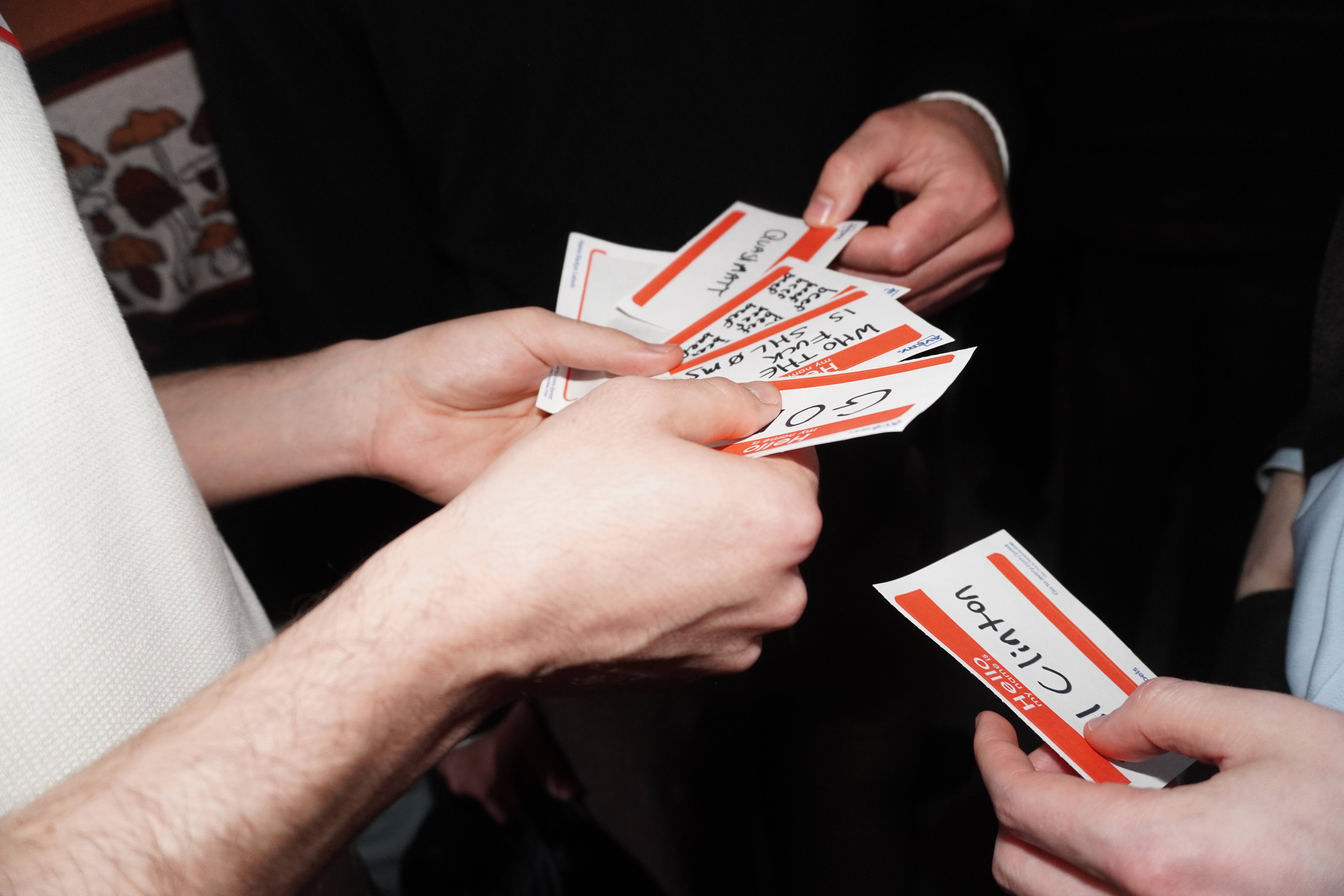
The patchwork crowd was complete with tinfoil hats, lobster claw hairbands, bikini shirts and backpacks galore. The aforementioned eclectic pastiche of projects adorned the walls, screens, projectors and laptops on fold-out tables. Then there was the sudden appearance of the media, seemingly out of nowhere. Writers from Business Insider and Reason. Someone from Vice. NBC I hear. Murmurs of the Times. Is that Jerry Saltz?
From the above we can draw an impressionistic sketch of what imbued the event with such energy.
It was experimental; it was new and different; it harnessed attention; it felt in sync with the times.
But there were more precise reasons too. The name was one. The term “AI psychosis” has risen to prominence in the cultural lexicon over the last couple years. It first emerged as a real and worrying but relatively rare phenomenon in which users of LLMs, enabled by the models’ sycophantic behavior, lose touch with reality.
More recently, and relatedly, it has come to be used in a casual register as something like a loose catchall for states of excitement and obsession, bordering at times on euphoria or hypomania, induced by the vast realm of possibilities unlocked by AI tools and the frenzied pace at which they continue to progress.
It is the feeling of takeoff, of gravity and a rocket ship playing tug-of-war over your body and soul. It is the low-grade psychosis of everyday living in AD 2026. My description makes it sound dramatic but the term has taken on a lighthearted, meme-y tone. The more terminally online you are, the more likely you are to be familiar with and to embrace this latter sense. It’s this usage that the AI Psychosis Summit veers toward.
Some, on account of the former definition, found it callous, and understandably so—especially if you’ve seen psychosis up close; such a cavalier attitude toward the matter can be off-putting. Others say “okay boomer.” Whatever you might think of its appropriateness, the title helped draw attention, treading just the right level of edginess to mildly affront or raise eyebrows while not being deliberately edgelordy. It was the right level of confusion to intrigue rather than put off. Such edginess as a catalyst for attention is of course nothing new in art and the ensuing pearl-clutching often looks quaint in retrospect.4
Marcel Duchamp attributed much of the success of his Nude Descending a Staircase, No. 2 to its title: “What contributed to the interest provoked by the canvas was its title. One just doesn’t do a nude woman coming down the stairs… it seemed scandalous.”5 So too with the AI Psychosis Summit.
It was exactly this contra-institutional DIY/grassroots character that underpinned the event’s success well beyond just the name. Large institutions and galleries alike are loath to embrace such edge for fear of drawing ire.
Even the smallest and most nimble of them have rent to pay and consequently are risk-averse. The Summit, by contrast, lacked institutional guardrails, fiduciary obligations or really any stakes at all. It was thereby able to just kind of do and be whatever and it was in this whatever-ness that it excelled.
.jpg)
The event was chaotically cobbled together by a hodgepodge artist-organizer-curator group of friends—Bunny, Macy, Quasimatt and Wesam—coming together to make something by, and predominantly for, themselves and their extended social circle.6
This was palpable in the room. From the artists still mounting work five minutes past opening (myself among the culpable), to the Diet Coke bar, to the general conviviality of it all, the disorder, informality and warmth alike evidenced it as essentially a community gathering. In the art world, people are starved for that these days. Events within the confines of the white cube are prototypically sterile, managed, risk-off. The AI Psychosis Summit was anything but.
The name was also a prime example of another key pillar of the event’s success, the organizers’ competency at what I would call “bootstrapping clout.”7 The four of them together wield overlapping and complementary social media skill sets that deftly blend:
All of these coalesce to generate attention through little more than the group’s interactions among themselves, as if out of thin air. But more than just attention, which mere sensationalist antics can command, the bootstrapping clout approach yields a sustained cultural congregation. There is a recognition of mutuality, solidarity even, that empowers them to “emerge in the scene” together. This shared understanding extends to many of the other artists/creators in the show as well, which turned the collective group activity around the Summit into a small-scale internet amplification engine, a kind of memetic perpetual motion machine.9
As just one example, Quasimatt fairly transparently started a rumor that the event had received funding from a16z by tweeting out asking who had started the rumor that the event had received funding from a16z. Through the ensuing attention, the event went on to actually receive funding from a16z, alongside retweets and podcast shoutouts from Marc Andreessen himself.10
This is a noteworthy instance of what I mean by “bootstrapping clout” but just as often it simply means consistently and devotedly liking and quote-tweeting your friends’ posts. As previously noted, there is a principle of mutuality in this, an internet solidarity that collectively buoys those who buy in and that was present across the lifecycle of the Summit.
Beyond the likes and retweets, beyond the feed, beyond the seemingly limitless bounds of the internet, what the Summit showed most convincingly was that this ethos and energy have the power to migrate into meatspace and retain, even strengthen, their vigor there. The vibes that had been building online in the run-up to the event, at that point subculturally viral, spilled over into the real thing.
To be present at the Summit consequently felt like being caught somewhere between your X/Twitter feed and the physical reality of your earthly body in that moment. It was chaotic. Usernames took precedence over given names. You could literally smell the online-ness of it all. Yet rather than it being dissociating, or perhaps because of it, you couldn’t help but feel invigorated. It was as if we had all long been experiencing the dissociation of two selves, URL and IRL, that were then and there made whole, reconciled.
This undoubtedly was not the experience of everyone who set foot in that big room and is a fairly dramatic telling of what happened for those who did experience it but I think it captures something real about the almost metaphysical-feeling underpinnings of the energy and success of the evening. The event in its entirety, its ambience, felt like the internet made manifest, and this was somehow a good thing. There was a quality of amphibiousness to the whole affair, an organic cohabitation of online and offline worlds. Their boundaries were fluid, porous.
This is the reality that Josh Kline’s recent lightning-rod October essay seemed to be blind to.11 The piece indicts New York real estate in what he bills as the death of the art scene in the city and the broader “ruin of American art.” Yet in his analysis of social dynamics and the art community here, he miraculously misses the internet almost entirely. He dwells on things like the lack of studio space for sculpture but makes scant mention of the internet, overlooking the fact that this is where so much of our lives is happening now.
For artists doing the most interesting, exciting and urgent work of today, the computer is our studio. The internet is vital to social life among young creatives in New York City and an account that dismisses the art scene here while largely eliding this fact is incomplete to the point of incoherence. Importantly, this relationship between the city and the online world is bidirectional: as the internet is vital to New York, New York is where the internet art scene most meaningfully materializes.
The AI Psychosis Summit illustrated this. Kline bemoans Christopher Wool’s 2024 show set in an abandoned office building as a well-capitalized artist LARPing a luxury version of “a punk past no longer available to the kind of young artists from working-class or middle-class backgrounds who, once upon a time, helped forge the template for this type of space.” Yet this was exactly what the AI Psychosis Summit was. Not as a LARP, but for real, without money or resources or institutional clout.
This ethos still exists in New York City if you know where to look. And it’s not really that it was hard to find either—several media outlets found their way in the door—it’s just that searching from the vantage point of weary traditional art world eyes will leave you looking in the wrong places. The overarching sentiment of Kline’s piece amounts to the old familiar refrain: “New York isn’t the same, man.” Of course it isn’t, and it never will be. Its rapid flux is precisely what makes it New York. It is the Ship of Theseus on speed, never the same and always itself.
That’s the nonconciliatory half of my take on the essay, but the reality is that I agree in substance with most of what Kline lays out, up until we reach his cynicism. Yes, New York real estate is insane. Agreed, let’s provide artists with more opportunities. Even the idea of developing artistic communities in other lower-cost cities is one I can get behind, despite my New York chauvinism. The internet enables communities to exist across these bounds now and we should support this.
But what Kline’s essay misses is more germane to this one because it’s exactly what the AI Psychosis Summit marks a convincing counterpoint to. New York is where the internet is realized. Philadelphia and others of its kind remain satellite cities when it comes to art. New York is still New York. Art in this great city, as an ecosystem and human endeavor, is more resilient than Kline gives it credit for. Artists, as ever, are responding to the call of their times.
In so doing, the AI Psychosis Summit and the scene surrounding it harken back to proper art “movements.” There are grounds here for a comparison to the Italian Futurists, whose embrace of the accelerating pace of life and the technologies developing in the cradle of European modernism feels not so different from the desire to experiment with radical new forms through serious creative engagement with AI. This is not to say that the two are perfectly equivalent—there is no manifesto this time around—but to nod in that direction, and to say that maybe a revival of a similar kind of movement, one forged of solidarity and shared belief, is possible. Maybe.
In today’s version of this movement, though, the internet is a fact of life. AI is a fact of life. We need what the AI Psychosis Summit brought to bear, because art that ignores the facts of life is inert. We are amphibious now, swimming between two disparate worlds that need reconciling. We need an art that reflects this, that attempts such reconciliation. This is happening elsewhere of course.12 But of anything of late, the AI Psychosis Summit felt the most immediate, the most connected to the cultural pulse of this precise moment, the most fluidly straddling its two worlds.
The mood following the Summit that night was celebratory but there was no afterparty. Instead, when I went home after, I stayed up into the early hours of the morning scrolling on FKA Twitter, where the festivities continued.
Post after post shared enthusiastic takes and a healthy dose of hate from people who weren’t even there. Curled up in my dark room, basking in the warm, Night Shift-ed glow of my phone, I watched my feed float on by, as if of its own accord. Like. Retweet. Like. I felt connected.
------
Notes
1. If I had to put a label on it, I would categorize it as not exactly a gallery show, but definitely still an art thing. Maybe this is because I was showing art, but also probably because I and others there like me entertain the notion of a broader definition of art in the software age, one that accommodates many of the kinds of projects shown at the Summit that would fall outside the traditional purview of “art.”
2. I reached out to Quasimatt to ask and he does indeed consider this to be art. I do too.
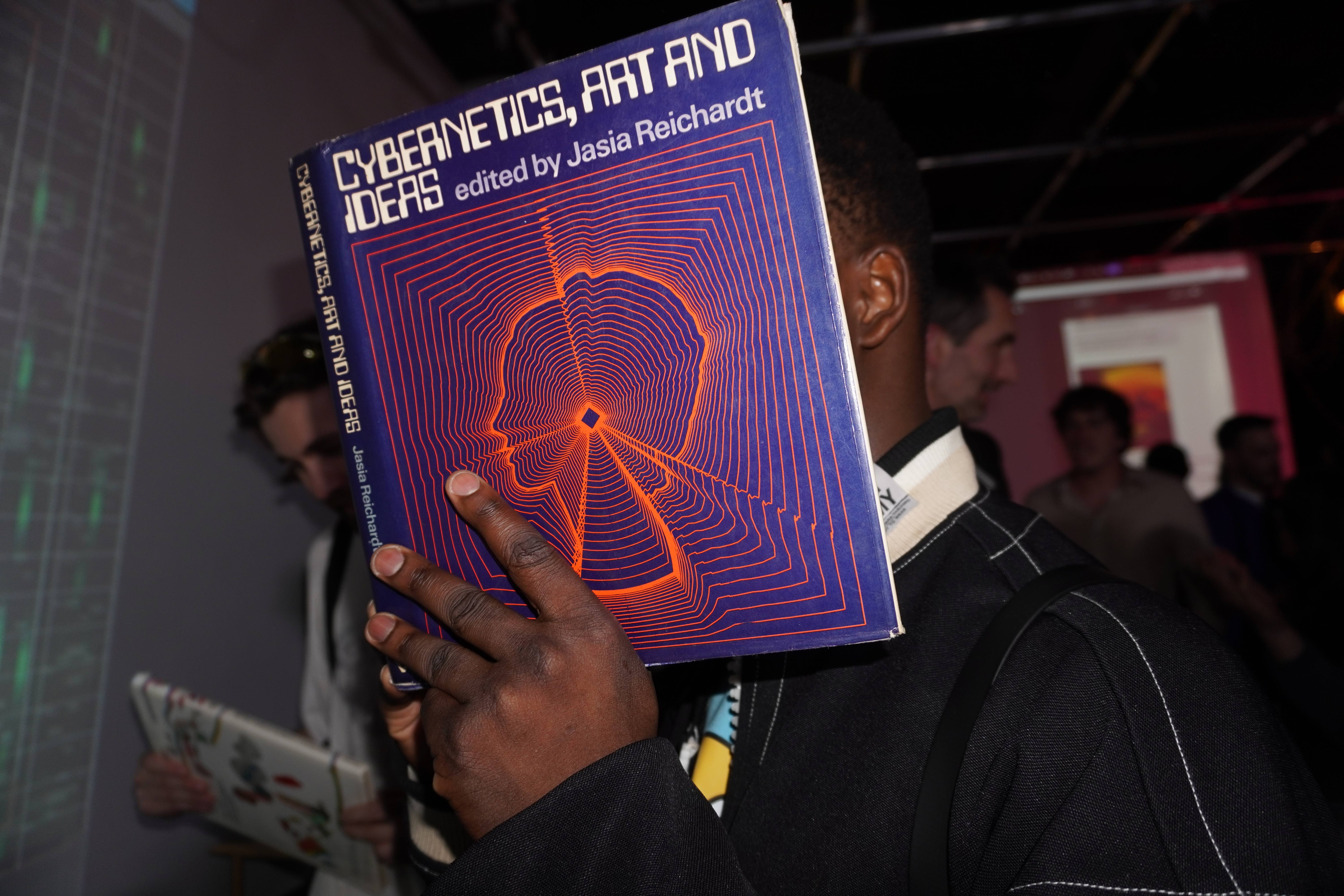
3. This ambiguity mirrors a wider collapse in this era of art into life, in all its forms and expressions. Marcel Duchamp threw down the gauntlet with that first readymade—Bicycle Wheel, not Fountain (the urinal), as many might assume—and the twentieth century answered his call. Performance art brought human action and experience of all kinds into the fold of fine art. “Relational aesthetics” was coined to carve out space for human interaction as an art form. Computers got in the mix. Now the digital/cryptoart milieu extends the privilege to things as esoteric and varied as smart contracts, internet trading cards and entire systems of cybernetic orchestration.
4. This doesn’t necessarily prove the pearl-clutching was in the wrong, even if on the wrong side of history. Hindsight is not without bias and history is not without error, or deviation at the very least.
5. Pierre Cabanne, Dialogues with Marcel Duchamp (Boston: Da Capo Press, 1987), 44.
6. Referring to them here by the names I know them by. It would undermine the tone and message of this essay to call them by their legal names and would be some unc shit to boot.
7. Engagement farming is an adjacent but not exactly correct term. It’s more like their pod forms a small economy, of which engagement farming is one sector. This engagement farming yields content that can be exchanged for cultural capital within their closed economy (friends giving each other likes and retweets). This then boosts GDP, which can then make them a more eminent trade partner for the broader social marketplace of the internet. What makes it not a scam or social currency laundering scheme is that the content is legitimately good, everyone is welcome and there’s no exit liquidity to be had.
8. Most powerful of all is that these dynamics make you want to actively work to promote them.
9. The mean follower count for those showing work at the Summit was 10,876.
10. There is a spiritual descendant of kayfabe taking place here, where the noncommittal performance of acknowledged falsehoods nonetheless results in their realization.
11. October the publication, not the month. This confused the hell out of me the first couple times I scrolled past it on my feed. Unfamiliar with the publication, I was quite baffled as to why everyone was all of a sudden referencing an essay that came out six months prior.
12. Heft, Nguyen-Wahed, Offline, bitforms, Yeche-Lange, Zero 10, Marfa, etc. are doing great things.
------
Kevin Esherick is a conceptual artist and writer. His early work was shaped by his studies in philosophy, psychology and technology, which deeply influence his current practice. Esherick explores themes like consciousness and consumerism, employing a diverse range of mediums including denim, blockchain and AI.