.jpg)
.png)
Suggested Reading
Interview
Evergreen
Reprogramming Sensory Habits
Luba Elliott
•
June 1, 2026
View


.jpg)
Luba Elliott is once again curating the Art Gallery at the Computer Vision and Pattern Recognition (CVPR) conference, a leading annual gathering for computer vision and deep learning research.
Elliott is exhibiting two dozen works at the forefront of creativity and AI on-site at Denver's Colorado Convention Center (June 5–7, 2026) and 114 online at the CVPR 2026 Art Gallery.
The curator speaks with three shortlisted artists about their creative and conceptual approaches to AI: Nick Oh & Alex Park, Avital Meshi & Dorte Bjerre Jensen, and Xia Liu.
Nick Oh and Alex Park rebuild one of the earliest convolutional neural networks as a physical sculpture, with transparent PCBs, LEDs and live computation. The pair explores how LeNet-1 thinks. Not to explain it, only to watch it.
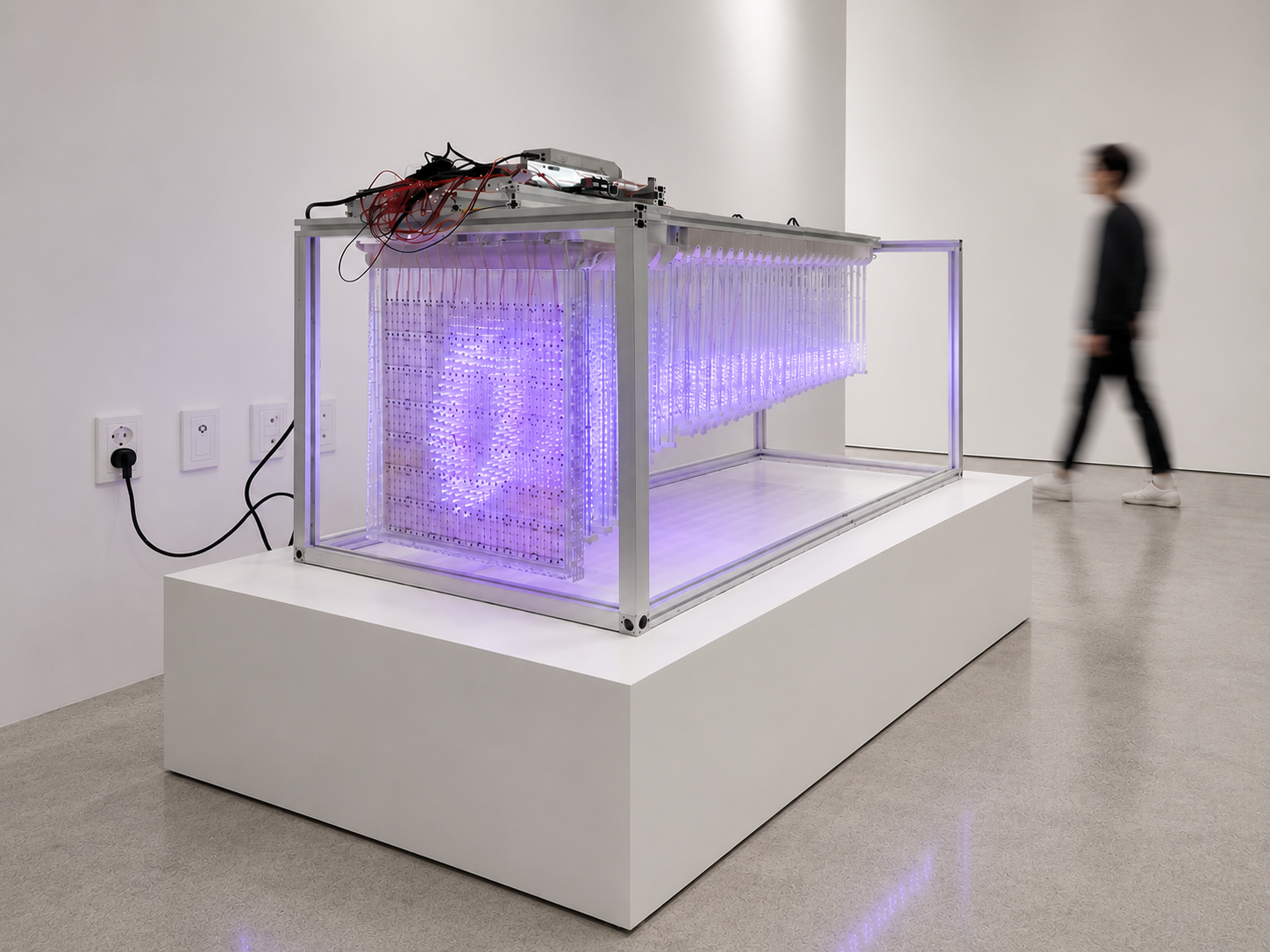
Luba Elliott: Developed by Yann LeCun and his team at Bell Labs in 1989, LeNet-1 was one of the earliest successful applications of a convolutional neural network. It is historically important but mostly invisible within contemporary AI narratives.
What drew you to this particular neural network architecture as an artistic subject?
Nick Oh: It came from reading a 2022 ICLR blog post by Andrej Karpathy, in which he sets out to reproduce LeCun's 1989 paper in PyTorch. What stayed with me was the way he positioned the paper's historical significance, as the earliest real-world application of a neural net trained end-to-end with backpropagation, and as something that, apart from the small dataset and small network, reads remarkably modern. The dataset, the architecture, the loss function, the optimization, the reported error rates—all of it is already there, recognizable as the shape of contemporary deep learning. The paper is something close to an archetypal form.
I dug deeper and found a video on YouTube titled "Convolutional Network Demo from 1989" (uploaded by Yann LeCun himself). It was a retro VHS tape clip of LeCun at a Bell Labs workstation, feeding handwritten digits into the network and watching it classify them in real time. That, for me, was the iconic primary moment of our history of AI. It was a real, working system in a room doing the thing.
Looking back, I think the unconscious pull toward LeNet-1 over a Transformer—or a GPT—had something to do with this idea of an archetypal form.
A working LeNet from 1989 is a kind of point of origin that the newer systems still resemble at the macro level, even after decades of refinement.
There is something compelling about being able to point at the original instance of a pattern rather than at one of its descendants. A Transformer would be the natural subject for a project about where AI is now. LeNet is the natural subject for a project about where it began.
Luba Elliott: There’s a tension in the work between technical precision and abstraction. How did you decide which aspects of the system to preserve faithfully and which to reinterpret artistically?
Nick Oh: The network we physicalize is the one in the video demo, described in LeCun et al.'s NeurIPS 1989 paper Handwritten Digit Recognition with a Back-Propagation Network. A 28×28 input, four hidden layers, ten output classes. It is the paper that immediately follows the one Karpathy reimplemented and the architecture our installation rebuilds in physical space.
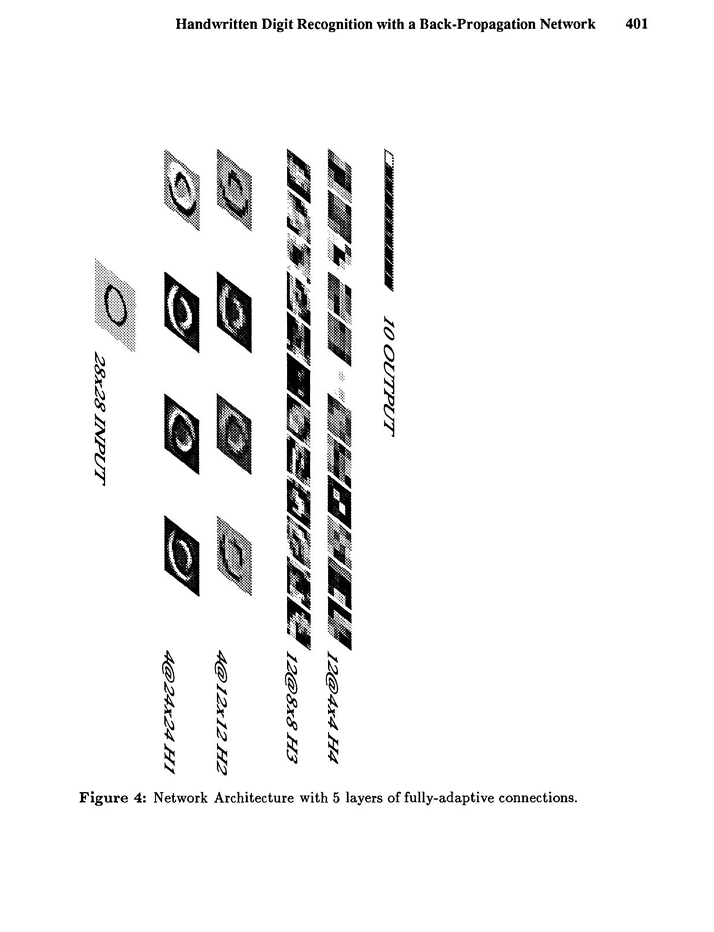
The architecture, the layer dimensions and the order of operations are all faithful to the original. To us, the installation was more interesting if what you were watching was genuinely LeNet "thinking."
The only translation we allowed ourselves was a translation of substrate, of bits to atoms. We did not want a sculpture that gestures at a neural network. We wanted a neural network that happens to be a sculpture.
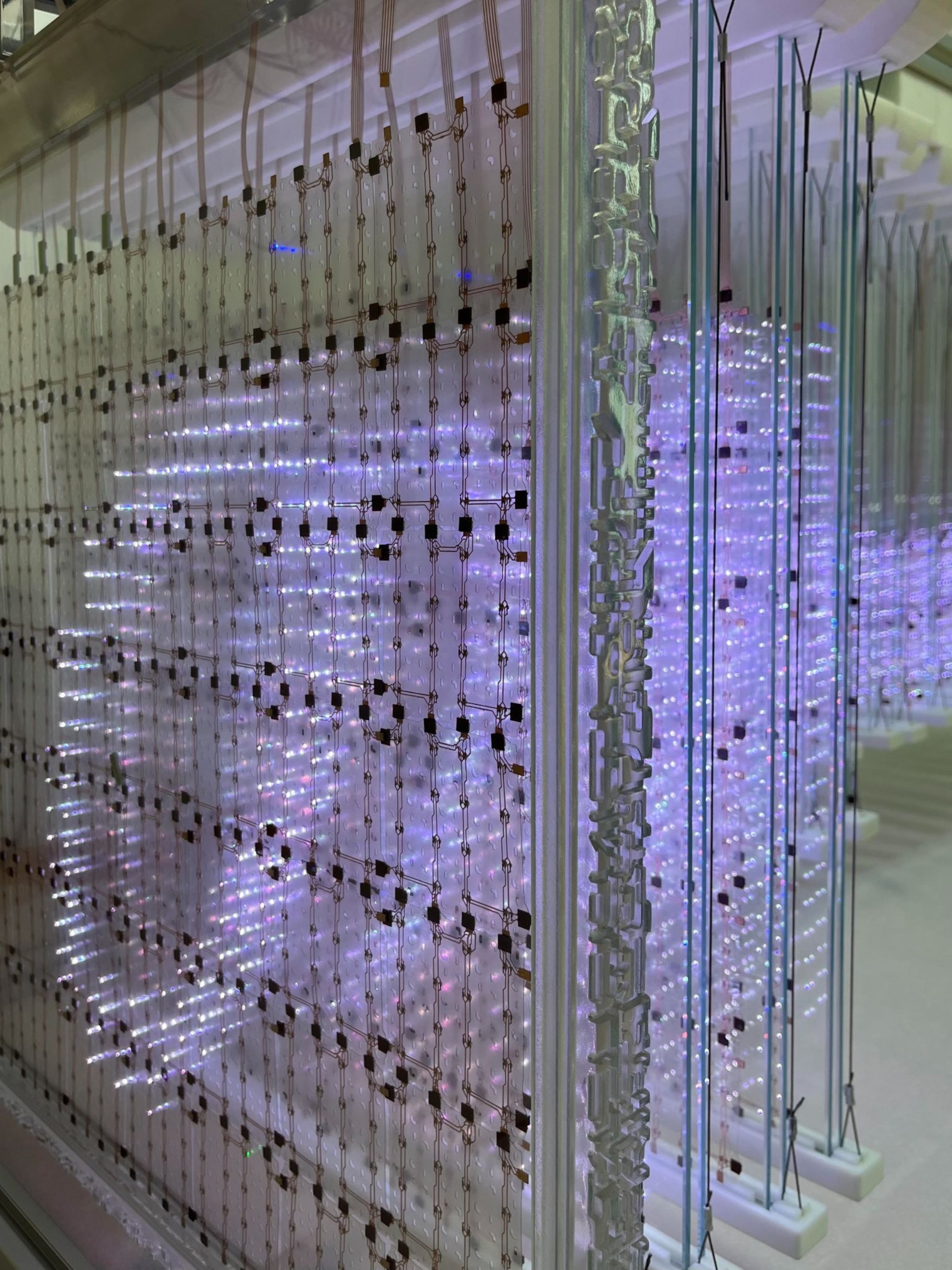
In that translation, the matrices became transparent PCBs with LEDs. Where the paper has scalar activations, we have brightness. Where it has a topology diagram, we have spatial depth, something you can walk around. The 4×4 LED matrix on each board is the network's smallest unit of seeing, the size of its most compressed feature map after the final pooling.
The motivation, in the end, was simple. We wanted to see how LeNet-1 thinks. Not to explain it, not to interpret it, only to watch it.
Alex Park: Because LeNet lives in the software realm, we could preserve the original network exactly while still having a high degree of artistic freedom in how we made it physical. The rule we agreed on early was that the computation stays exact and only the substrate gets translated. That sounds restrictive, but inside the studio the issue was the opposite of what you might expect. There were too many ways the network could be expressed visually, not too few. The constraints were time, space, and money.
This led to a wide range of experimentation, different renderings, different possible shapes, different materials for 3D printing, different approaches to epoxy potting. Each method had many parameters, each living on a continuum. Many ideas and methods didn't make it. But the core visualization (i.e., LEDs as the network's activations) never changed. That commitment was made early and never moved. Everything else around it has changed several times.
Luba Elliott: Today, AI is predominantly experienced as immaterial or cloud-based, whereas your project presents a physical interpretation of LeNet-1, foregrounding process and infrastructure.
Were you trying to rematerialize AI in some way? How important is it for technology to have a physical manifestation?
Nick Oh: Rather than physicalizing or materializing AI, we are making a specimen of an AI. There is a difference between visualizing a neural network in digital space and making one physical. I kept returning to the tradition of specimens, something like a planetarium model of the solar system in an astronomical museum. A specimen is not a depiction of a thing. It is the thing in a state arranged for looking at.
Most encounters with neural networks today are encounters with representations. For instance, TensorSpace lets you rotate the architecture and inspect each layer of different neural network architectures. These are excellent representations, but they are still representations.
A diagram of the solar system on a screen is one kind of object. A planetarium model, with the planets on their armatures slowly turning, is a different kind of object. We wanted to make something closer to the second.
The closest analogy I have found for what the installation does, as distinct from what a visualization does, is the difference between a blueprint of a building and the building itself.
The blueprint contains, in a strict sense, complete information about the building. You could reconstruct the building from it. But the blueprint and the building are not two grades of access to the same thing. They are two different kinds of thing. The building exceeds the blueprint not in information but in mode of being. The installation of LeNet is closer to the building.
The installation is an instance of a different relationship to a computational object, one where the object is in a room, drawing real current, with mass and a position. PyTorch is also a working LeNet, but it is not a thing in a room. That difference is what made us build it.
Luba Elliott: Early neural networks like LeNet-1 were relatively small and understandable compared to contemporary foundation models. Did working with an older architecture change how you think about transparency or explainability in AI systems?
Nick Oh: A few weeks before we shipped the work, we ran the network on a digit from MNIST. A clear seven, slightly slanted. LeNet classified it as a one with high confidence. I knew the architecture cold by then. I could draw every layer from memory. And I still could not tell you, standing in front of the boards, why the network had decided what it decided.
This is the thing that working with LeNet-1 has changed for me. You would expect a small, simple architecture to be the easy case for interpretability. Convolve, pool, convolve, pool, classify. Every layer has a name in plain language. Compared to a foundation model with hundreds of billions of parameters, LeNet looks like the system you can explain.
And the architecture is interpretable, up to a point. You can stand in front of the installation and loosely describe what each layer is doing. The first convolutional layer is detecting simple visual features. The pooling layers are compressing them. The next convolutional layer is combining them into more complex ones. All of this is true. The architecture is legible by inspection.
But interpretability in the harder sense goes beyond architecture legibility. When we say a model is hard to interpret, we mean something stricter. We mean we cannot explain why this particular input produced this particular output. Why that seven was read as a one. Why the network was more confident than it should have been.
None of these questions can be answered by looking at LeNet’s architecture. They can only be answered by looking at the learned weights and the learned weights in LeNet are no more legible than the learned weights in GPT. They are smaller but they are not smaller in a way that makes them readable.
What I find quietly fascinating about this is the kind of opacity it is. The installation is, almost, a glass box. The PCBs are transparent. The neuron housings are glass with translucent resin. The frame is open aluminum. Nothing is concealed behind anything else. You can see every component, every trace, every connector.
Yet the network is still, in part, unread. Standing in front of it, you still cannot see why that seven was read as a one. That reason is in the values of the trained weights, and the trained weights are visible in the same sense that everything else is visible. They are not hidden. They are present—on the boards, in the firmware, in numbers you could read off if you wanted to. They simply do not become meaningful when you look at them.
The argument the work ends up making, almost despite our intentions, is that there are kinds of opacity that hiding had nothing to do with and that unhiding cannot solve.
Luba Elliott: Do you think technological artifacts age more like scientific instruments or cultural objects?
Nick Oh: I think they have two lives. In the first, they are instruments, judged by what they do. In the second, after the function has been superseded, they become cultural objects, judged by what they meant.
LeNet-1 is interesting because it sits across the hinge between those two lives. The code still runs; the network is a functioning instrument. But the meaning has shifted under it. What was once a working system is now a precursor, a relic, an origin story. And in that way, I think LeNet-1 is now more of an iconic object in the history of AI, an artifact in the archaeological sense, rather than the software sense.
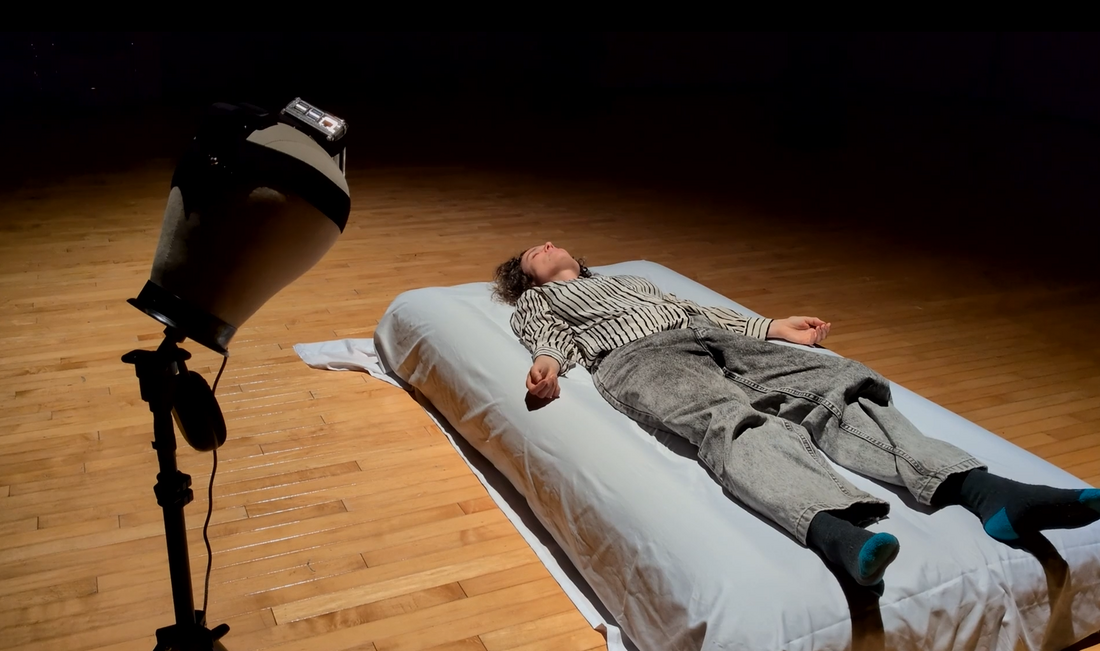
Rest! is a collaboration between artist Avital Meshi, whose work focuses on embodied AI, and Danish artist Dorte Bjerre Jensen, whose work has long engaged rest as resistance, a concept coined by Tricia Hersey.
Luba Elliott: This work frames rest as more than passive recovery; it becomes a performative or even political act. What drew you to rest as subject matter? What does rest mean to you?
Meshi & Jensen: AI is becoming mainstream at a moment when we are living not only through a climate crisis but also through a kind of “speed crisis.” We are expected to be constantly productive and to prove our worth through work.
Rest! takes inspiration from Devon Price’s book Laziness Does Not Exist, in which he argues that “most of us spend the majority of our days feeling tired, overwhelmed, and disappointed in ourselves,” convinced that no matter how much we have done, we have never done enough to deserve rest. Technology now supports a workday that can continue uninterrupted, 24/7. AI is often imagined as something that will free us from labor and give us more time but that is not necessarily what we are experiencing. We might even argue the opposite.
With Rest!, we began by asking, "How is it possible to rest in the era of AI?" Rather than using AI as a tool for productivity, we prompt it to guide us toward rest. The system offers rest-related instructions, such as “melt into the mattress” or “the earth wants you to rest.” We prepare a resting place, in this case a mattress, and attempt to rest while listening to the AI’s voice.
Through this gesture, we want to provoke questions about whether rest needs justification at all. Rest is often accompanied by guilt or shame, as if taking time to rest means failing to be productive or responsible. The AI model we use, GPT, can be turned on or off. When activated, it can generate language for hours but it will never independently say, “Let’s take a break because I am exhausted.” At the same time, it does not judge us for resting or for not prompting it. It does not call us lazy unless we ask it to. It does not require us to explain why we need to slow down.
This is where Rest! becomes interesting to us. Unlike many human social structures, which often make rest feel permissible only when we are sick, exhausted, or burned out, this nonhuman intelligence can be positioned outside grind culture.
By asking AI to guide us toward rest rather than productivity, we explore whether technology can be reoriented toward care, refusal, and slowing down. In this sense, rest becomes both a performative and political act: a way of resisting the demand to always be available, useful, and productive. At the same time, we are aware that this intervention is paradoxical.
Luba Elliott: The piece exists in the context of a durational performance. What happens when slowness or inactivity becomes the central experience for the audience? How does that contrast with our typical experience of contemporary AI technology?
Meshi & Jensen: As a durational work, Rest! foregrounds time as a central part of the experience. The piece has no clear beginning or end. Spectators may come and go, encountering only fragments of the performance. It also functions as a soundscape. People might hear the AI’s instructions from a distance before seeing the resting body, allowing the work to affect them even when they are not watching it directly.
By placing slowness and inactivity at the center, Rest! invites the audience into a different relationship with time. Spectators are invited to rest with us, whether standing, sitting, or walking. They might pause their thoughts for a moment, observe the resting body, and notice what this encounter produces in them: calm, discomfort, impatience, guilt, curiosity, relief, or even compassion.
Contemporary AI technologies are often framed around speed, efficiency, optimization and productivity. They are designed to help us do more, faster. In Rest!, we use AI in the opposite way. We prompt it to deliver a continuous stream of rest-related instructions that sound meditative and repetitive, almost like a mantra. The AI encourages the body to soften, pause, release and slow down.
This repetition is important. It feels as if the AI is trying to interrupt the habits we have internalized around rest, including those that large language models often reinforce. Instead of saying, “Get up,” “Be useful,” or “You should be doing something,” the AI makes rest feel allowed, important, and necessary.
Through this gesture, we invite spectators to consider whether AI can be used to support and even protect us from grind culture and from the accelerating technologies that sustain it. We ask whether AI might be oriented toward care, slowness, and permission rather than speed, output, and optimization.
Luba Elliott: The title Rest! carries an imperative tone as if rest itself required instructions. How does the work attempt to reclaim rest from productivity culture or critique the impossibility of doing so?
Meshi & Jensen: Rest often feels like something we have forgotten how to do on our own. The exclamation mark points to a contradiction: rest should be simple but in a culture organized around productivity, it can feel almost impossible.
In the work, we stage this difficulty. The performer lies on a mattress and attempts to follow the AI’s instructions. But the experience is not necessarily peaceful or effortless. Rest becomes a practice, something we have to negotiate with our internalized sense of obligation to do.
Resting under the watchful eye of AI was, in some ways, surprisingly liberating. The system seemed to lack expectations. It did not project guilt or shame as we might experience from family, friends, coworkers, or society more broadly, where rest can be read as laziness, irresponsibility, or failure to contribute. The AI did not ask us to justify why we needed to rest. It simply continued to encourage us.
At the same time, AI’s presence complicates the possibility of rest. We are still being observed and addressed. Can we truly surrender into rest when a machine is watching us, speaking to us, and shaping our behavior? Does being guided by AI turn rest into another task to perform correctly?
Luba Elliott: We often place our bodies into technological systems of surveillance or algorithmic influence. In Rest!, what role does human vulnerability play compared to your previous AI-related performances?
Meshi & Jensen: In Rest!, vulnerability is not only about placing the body in front of AI. It is also about placing the body into rest and doing so in the exposed setting of live performance.
Rest is usually private. We rest when we are alone, sick, exhausted or allowed to withdraw. Making the resting body visible creates a particular kind of exposure. This body is not performing strength or skill. It is trying to let go. Rest feels fragile because it reveals need. It shows that the body cannot always keep moving, which also raises a more complicated question: what does it mean to let a technological system guide us into such an intimate state?
Rest requires trust and here that trust is given to a nonhuman voice. The performer allows AI to shape the conditions of rest while remaining aware that this same technology is part of the culture of optimization and surveillance from which the work tries to withdraw.
The vulnerability of Rest! lies in insisting that resting may be the real work we need to pursue.
In For Whose Will, This Coronation, goldfish replace the human subject of divination. The artist speaks about childhood memory, the ethics of living systems, and what predictive culture reveals about our desire for meaning.
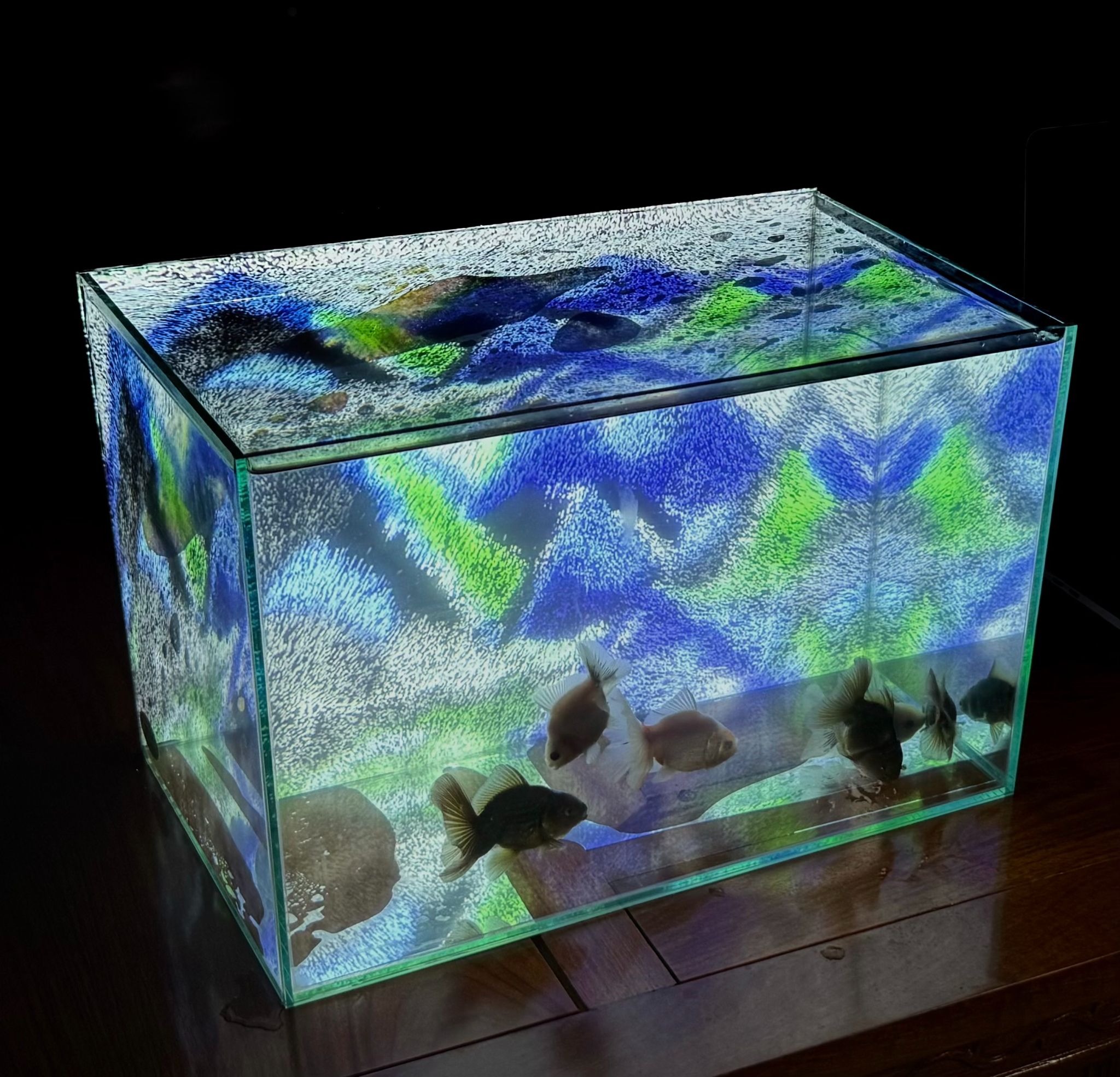
Luba Elliott: In this work, live fish unknowingly satisfy precise conditions of being certain distances away from each other to trigger a computer vision system. What inspired you to work with both living creatures, fish in particular, and technology?
Xia Liu: The starting point wasn't technology; it was a feeling of unease about prediction. We live inside systems that are constantly reading us, classifying us, converting the mess of being alive into data points that feel decisive and authoritative. I wanted to build something that made that conversion visible. To do that, I needed a subject that couldn't consent to being read.
But there's a displacement at the heart of this work that matters deeply to me because divination is traditionally a human act. There is always a person who serves as the subject, someone who picks up the yarrow stalks, tosses the coins, brings their question and their will to the ritual. In For Whose Will, This Coronation, I moved that subject position and gave it to the fish: only random swimming with no intention. The trigram is swum into existence.
That substitution is, for me, the work’s most essential gesture. It asks, when the divining subject is stripped of awareness and will, do we still believe in the meaning it produces?
Does that reveal that what we always believed in was never the subject at all, only the symbol, and our own desire to read it?
Fish came to mind almost immediately; but originally, the idea came from a childhood memory. I grew up at my grandmother's house in a village. Those years left deep impressions on me and my creative work tends to find its sources there. My grandmother kept a fish tank and I remember standing in front of it for long stretches, watching the fish move through the water, feeling close to them, yet sensing that something about them was always just out of reach. Years later, when I began thinking about how algorithmic systems read living things, that fish tank came back to me.
Goldfish in particular carry this strange double life: they are among the most domesticated creatures on Earth, shaped over centuries by human aesthetic desire. Yet even inside a tank, they are utterly indifferent to us. They don't perform. They don't respond to the camera. They simply move according to inaccessible logics. That irreducible spontaneity was what I needed, a source of contingency that no model could exhaust.
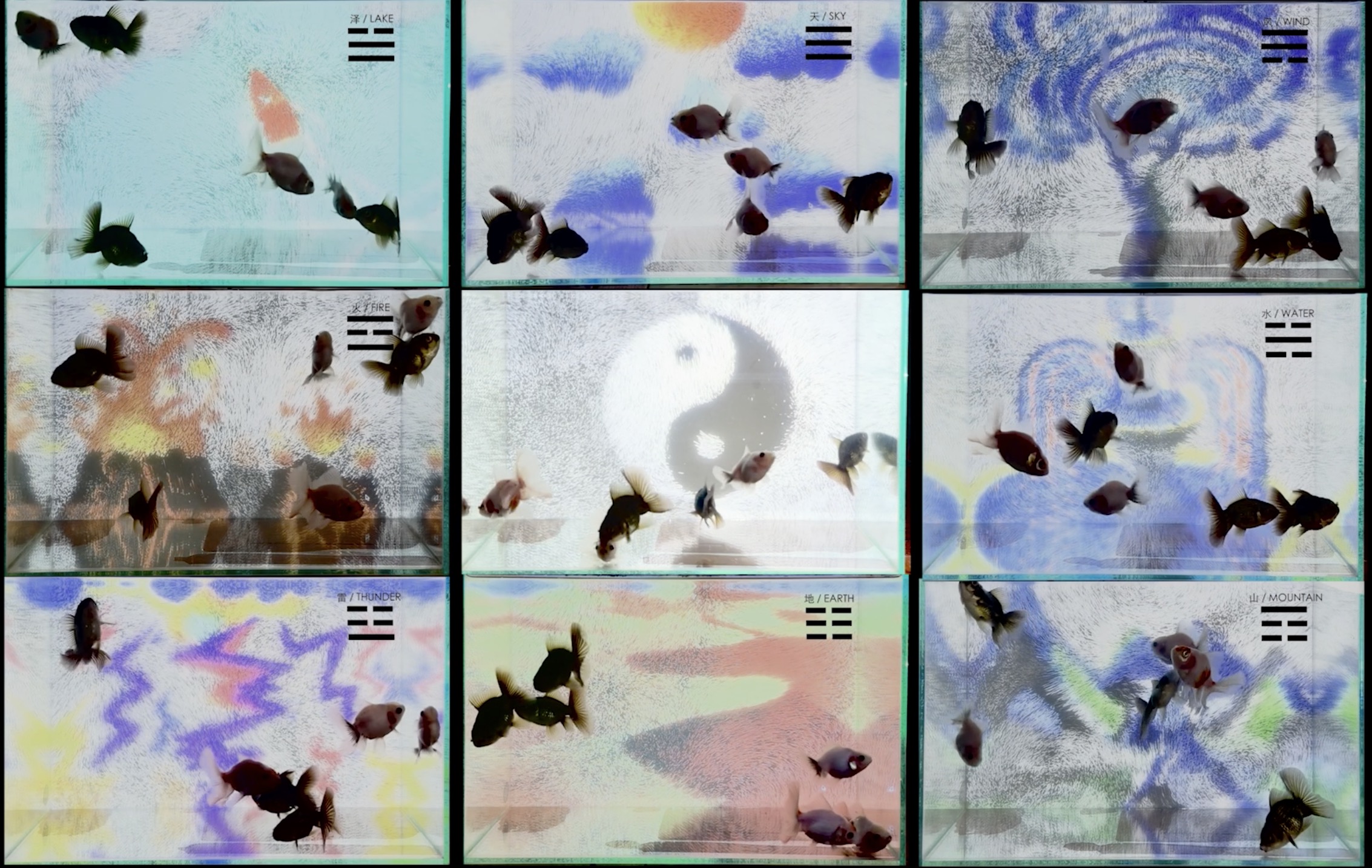
Luba Elliott: You describe the fish as “living readymades.” How did you navigate the ethical and conceptual implications of working with living organisms?
Xia Liu: The ethical tension was present from the beginning and never fully resolved, which is partly the point. With the goldfish, I kept returning to a simple question regarding what it means to use a living being as a generative input.
In most generative art, the randomness comes from a seed. Here it comes from something that breathes and can die. That changes everything about how responsible you have to be in designing the system.
That meant insisting on non-contact observation. No tagging, no marking, no behavioral conditioning. The camera watches and the fish ignore it. After the exhibition, they were transferred to long-term care. But I don't want to let that stand as a clean resolution because the work itself acknowledges the ethical asymmetry: the fish supply the contingency that drives the installation but they have no access to what it produces.
The trigram that appears on the tank surface means nothing to them. That gap between generative contribution and interpretive exclusion is something the work asks the audience to sit with, not resolve.
Unpredictability broke almost every assumption I brought from prior generative practice. A noise function does what you expect at a statistical level. A fish doesn't. There were sessions where no trio formed for ten minutes. There were moments where five fish clustered simultaneously in ways the system had to adjudicate.
The behavior of living matter introduced a kind of duration, a texture of waiting, that I hadn't anticipated.
Luba Elliott: The installation combines that living matter with ancient divinatory systems and contemporary computer vision tools like YOLOv11 and DeepSORT. What does this encounter between Daoist cosmology and machine perception reveal that neither system could express on its own?
Xia Liu: What they share is more interesting to me than what separates them. Both the Yijing and a YOLO-based detector are in the business of converting indeterminacy into a readable form. Rather than the Yijing claiming to eliminate uncertainty, it formalizes it. Yin and Yang are a minimal binary grammar for rendering flux legible, for producing a snapshot within continuous change. A computer vision model does something structurally similar by reducing the continuous motion of a body in space to a bounding box and a class label. Both are cultural techniques for making the world interpretable.
What neither system can express alone is the gap that lies between them. The Yijing operates within a cosmology where indeterminacy is generative and meaningful, treating uncertainty as a condition to be listened to as opposed to a problem to be solved. Machine perception, by contrast, treats that same indeterminacy as an error, constantly shaving off the jitter, smoothing the lines and patching up the occlusions.
Placing them together renders this friction perceptible. The trigram emerging from a fish cluster carries an ancient and resonant weight, yet the process that engineered it remains relentlessly modern and computational. This collision refuses to let either system masquerade as neutral.
I was also drawn to the fact that the Yijing has never claimed to predict the future; it claims to give you a language for thinking about change.
Algorithmic prediction and divination share the same honest limitation: they don't know what comes next. What they both do is give you a symbol that feels authoritative enough to act on.
For Whose Will, This Coronation is a diagram of that desire, exposing it.
Luba Elliott: The work suggests that machine vision can “read” nature but only through categories and frameworks designed by humans. How important was it for you to expose the limitations and biases embedded within computational perception itself?
Xia Liu: Absolutely central but I wanted to do it aesthetically rather than didactically. I didn't want to make a work that lectures you about algorithmic bias. I wanted to make a work where you feel the reduction happening in real time.
The system classifies each fish as black or white, which is the only thing it knows about them. The full complexity of a living animal, its velocity, its orientation, the slight variations in its color under shifting light, the way it moves differently when it's been fed versus when it hasn't—all of it collapses into a single binary value.
From that binary, something called a trigram is produced, and something called meaning follows. If you watch this happen long enough, you start to feel the violence of it, gently, aesthetically. The fish is more than the label. The label is what the system can hold. That gap is not a flaw I tried to fix; it is the work.
There's a specific technical moment that became unexpectedly important to me in this regard, involving the DeepSORT tracker stabilizing identities across frames. When a fish partially occludes another or swims through a specular highlight on the glass, the system can momentarily misclassify it.
The tracker steps in to correct for that, continually ironing out the jitter, forcing the identity to stay put, and ensuring the final output remains cleanly legible. From an engineering perspective, that correction is a success. But from the perspective of the work, it's a decision, a declaration that the momentary ambiguity was mere noise rather than information.
It trades the actual complexity of the animal's passage through space for a cleaner symbol. I think that trade-off is happening everywhere in computational perception, not just in fish tanks. I wanted at least one careful viewer to feel it happening here.
------
Luba Elliott is a curator and researcher specializing in creative AI. She works to engage the broader public about the developments in creative AI through talks, events and exhibitions at venues across the art, business and technology spectrum, including The Serpentine Galleries, V&A Museum, Feral File, ZKM Karlsruhe, Impakt Festival, NeurIPS and CVPR. Elliott’s Art Gallery at CVPR is exhibiting 114 works in person at the Colorado Convention Center in Denver (June 5–7, 2026) and online at thecvf-art.com.
Nick Oh is a researcher at socius labs experimenting at the intersection between every field that has ever studied "thinking" and every machine that's trying to "think." Advised by Fernand Gobet, he works across cognitive science, philosophy and neural networks, treating artistic practice as a continuous part of that thinking.
Alex Park is a theoretical physicist and a maker. Trained in theoretical and mathematical physics at King's College London, he can be found at socius labs whenever there's something to build and moves between equations and electronics with no particular hierarchy between them.
Avital Meshi is a new media and performance artist exploring the impact of AI on human identity and sociality. Meshi invites viewers to become entangled with AI algorithms, reclaim agency, and spark discussions on identity transformation. Meshi is a PhD candidate in Performance Studies and Science and Technology Studies at UC Davis. She holds an MFA from UC Santa Cruz’s Digital Arts and New Media program and a BFA from the School of the Art Institute of Chicago. She also holds an MSc and a BSc in Behavioral Biology from the Hebrew University of Jerusalem. Meshi’s work has been exhibited widely, including solo shows and performances at NYU’s Institute of Fine Arts, Duke Arts, CURRENTS New Media Festival, Inverse Performance Festival, Flux Factory Gallery, SIGGRAPH, ISEA, NeurIPS, and more.
Dorte Bjerre Jensen is a Danish artist, educator and PhD candidate in Performance Studies at UC Davis. She is currently artist in residence at The Manetti Shrem Art Museum. Her work explores multisensory relations of attention through live art installations, site-specific work, and performative scores. Jensen holds an MFA from the Danish National School of Performing Arts and has performed and taught improvisation for over 25 years. From 2019 to 2025, she participated in the art and science project Experimenting, Experiencing, Reflecting (EER) between Studio Olafur Eliasson and Aarhus University, developing Sharing Perspectives at Tate Modern London. Her recent work Excorcitium, performed at the Neue Nationalgalerie Berlin in 2025, is a participatory ritual space asking, "How can we be together differently as an act of resistance?"
Xia Liu is a media artist working across projection, sound, and installation. Born by China’s Bohai Sea, her childhood spent along industrial shorelines and rural villages shaped a practice focused on ecology, memory, and community. Xia treats darkness as a programmable medium, using a framework she calls computational darkness to sculpt human attention and space. By integrating computer vision with non-human behaviors, like animal movements, her work seeks to decenter human perspective in digital systems. Xia holds an MFA from Alfred University and is a PhD candidate at the University of Wollongong.
Special thanks to Peter Bauman (Monk Antony), Le Random's editor in chief.