

Suggested Reading
Interview
Evergreen
A. Michael Noll on When It All Started
A. Michael Noll
•
October 19, 2026
View


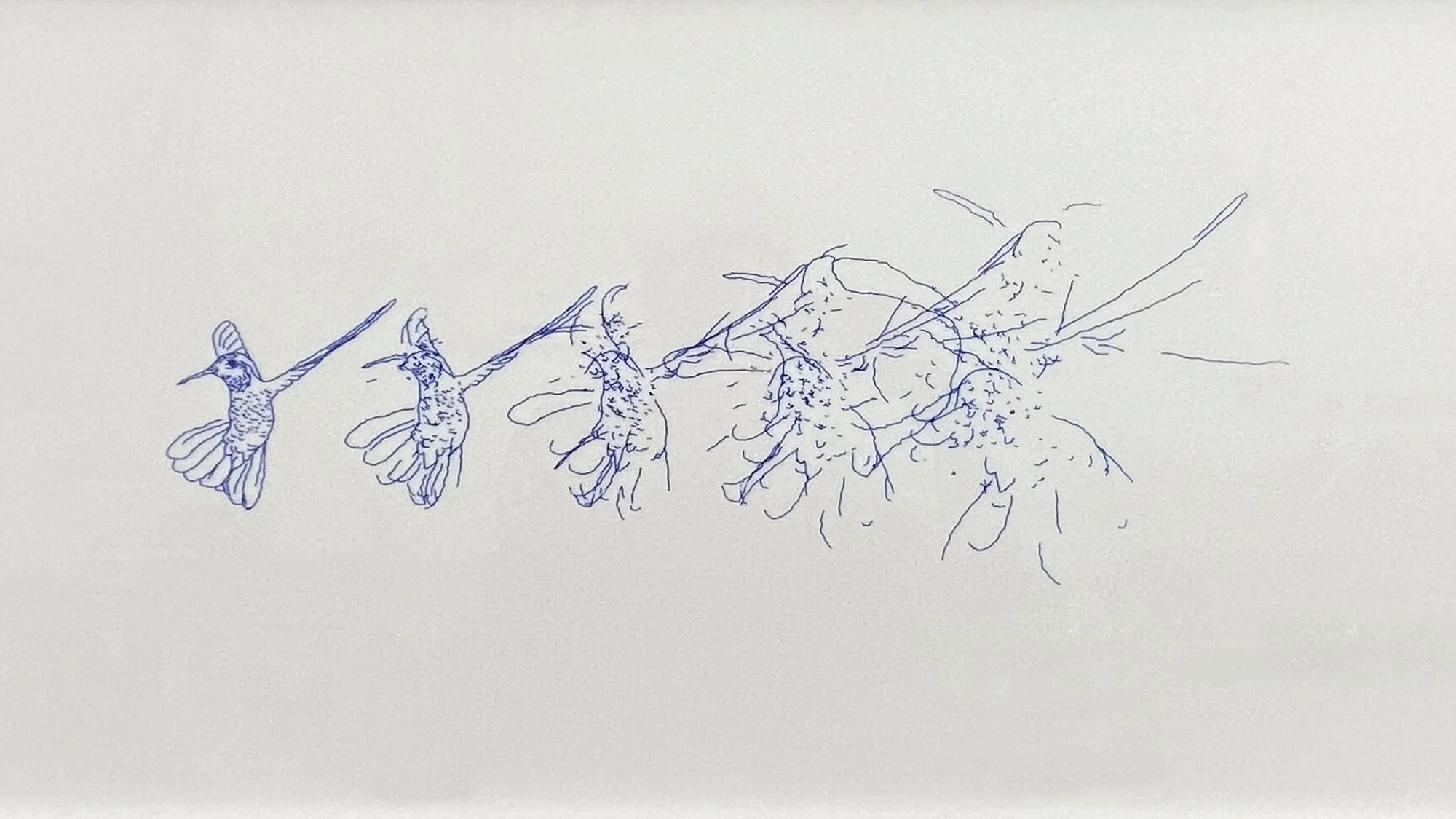
Caroline Csuri, daughter of artist Charles Csuri, speaks with Peter Bauman (Monk Antony). They discuss how the computer animation and graphics icon first discovered computers in art, the punch cards and plotters behind Hummingbird (1967), and why he called the computer his “playground” and “magic black box.”
Peter Bauman: Many associate your father Charles Csuri’s career with computer graphics and art but his practice began twenty years prior. Can you tell us about your father’s journey as an artist before his digital computer practice?
Caroline Csuri: My father, also known as Chuck, became a professor at The Ohio State University (OSU) in 1949 where he met Roy Lichtenstein who was an assistant professor; they quickly became best friends.
Because Roy didn’t receive tenure like my father, he went on to try to “make it” as an artist in New York. My father joined him a little later, going back and forth exhibiting his paintings in NYC from 1955 to 1965 while still teaching painting and drawing in Ohio.
During this period he recounted he was part of the New York scene hanging out at the old Cedar Tavern in Greenwich Village with the avant-garde writers and artists like Jackson Pollock, Roy Lichtenstein, Franz Kline and Allan Kaprow. Abstract Expressionist Clyfford Still and he had the pleasure of being the plaster-covered models for George Segal’s famous artwork The Diner.
He told me of the energy in NYC, the exchange of ideas and drive to do something revolutionary as an artist. His fine art training by Professor James R. Hopkins, who knew Degas and Renoir, coupled with a powerfully innovative group of artists had a tremendous influence on my father and his art.
Peter Bauman: What sparked your father’s interest in engaging with even analog computers in his practice? Can you describe the moment he decided to create art using computers after the conversation with engineer Jack Mitten in the 1950s?
Caroline Csuri: It’s significant that my father received an engineering degree while he served in the military so he also had a mathematical mind with a keen ability to problem solve.
During the same ten-year period that he taught in Ohio and exhibited in New York, he had a dialogue with his engineering friend Jack Mitten about computers. With cocktails flowing, my father and Mitten speculated on computerized theories of art, notions about AI and the computer’s impact on society. But in 1955 there were no plotters or output devices.
In 1963 my dad designed a drawing machine, essentially an analog computer. He was intrigued by the idea of transforming his drawings by computer. His very first computer artworks were his line drawing interpretations of works by Klee, Picasso, Goya and Dürer. As he traced the drawing, the device correspondingly with its two pens made a transformation and created another drawing.
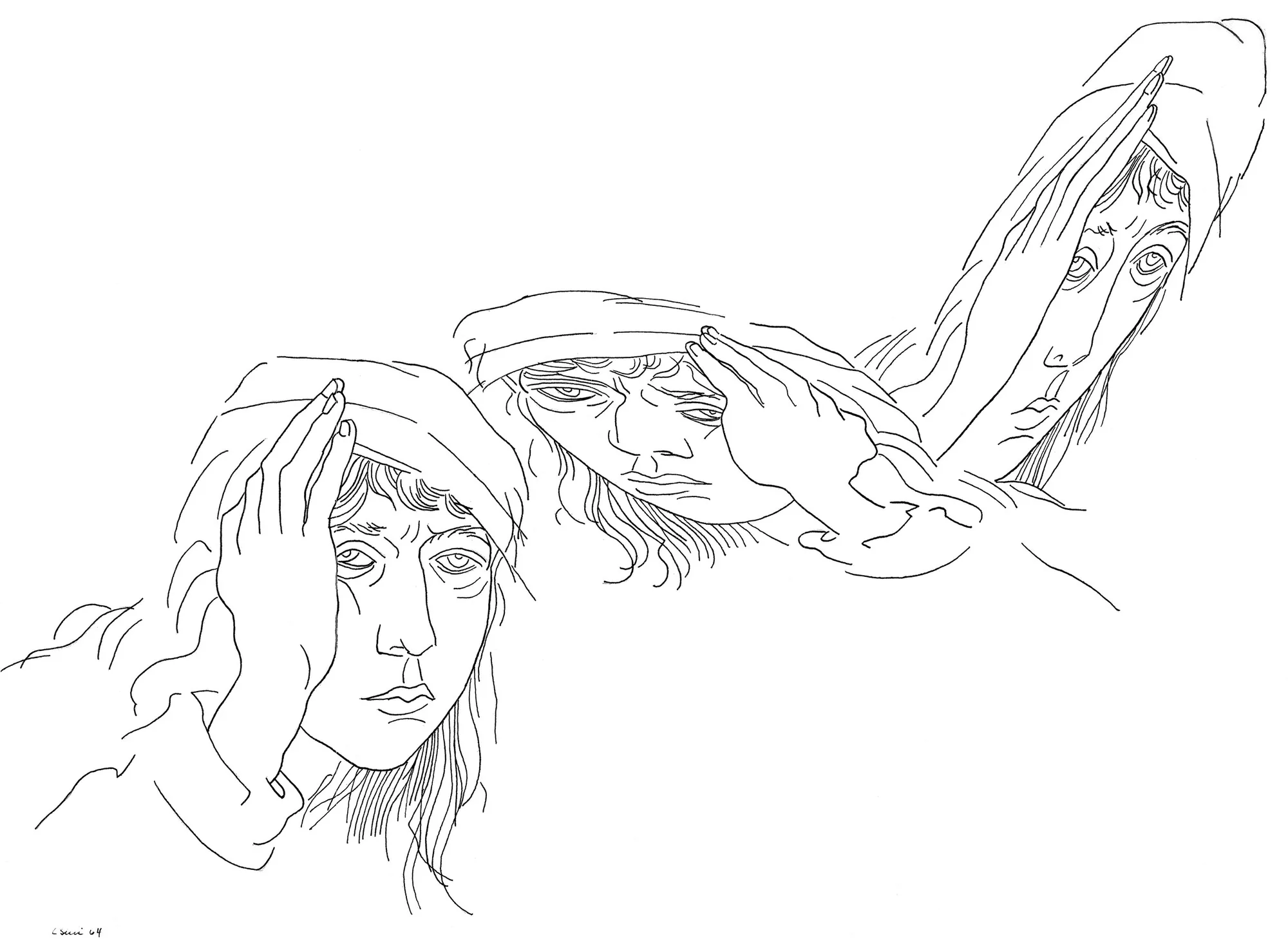
This system he devised helped him exploit variations of changes in shape, scale and rotation plus their relationships in XY coordinate space. He then combined several transformations of his drawing into a single image.
At the same time, he saw a research project at OSU demonstrating computer graphics where grid coordinates of a photo of a woman’s face were fed into a computer. Then an automatic typewriter with nine shades of gray interfaced with the computer. When Chuck saw the woman’s computerized picture, he became wild with excitement and immediately took a workshop on computer programming learning Fortran and other aspects of computer software.
I think my father envisioned even with primitive technology the benefits of the computer to create art in a revolutionary way. He continually talked about utilizing the computer as an artistic tool that had the potential beyond what he could achieve by hand.
I also think he was fascinated by the ability to artistically change parameters through programming that resulted in the random, generative outcome of the visual. He delighted in being an artistic editor of the hundreds of frames he would generate just to get the perfect combination of pictures. He was mesmerized by the magic of the computer’s generative process. He called his computer his “playground” and his “magic black box.”
Peter Bauman: How did your father navigate the challenges of using primitive technology in those early days of digital computation? What was his painstaking process of creating imagery on the computer like?
Caroline Csuri: My father had incredible patience. He ate a yellow apple every day and meticulously peeled it in one peel. He practiced mindfulness. My father endured life’s challenges with grace. It’s no surprise to me that he had the strength and perseverance to endure how incredibly difficult it was to make images by computer.
In the 1960s and early 1970s there was no such thing as interactive input devices. In his early digital work from 1967, he used a pen-like device to meticulously input his precise drawing point by point and then entered it onto hundreds of punch cards.
He would then feed the cards into a mainframe computer, where a program modified the data and put it onto continuous paper tape, which the plotter required. Images were drawn with mechanical pens, some he actually made to print on plotter paper. Programs were entered the same way using stacks of IBM punch cards. If there was a problem with the tape or just one punch card the whole thing failed.
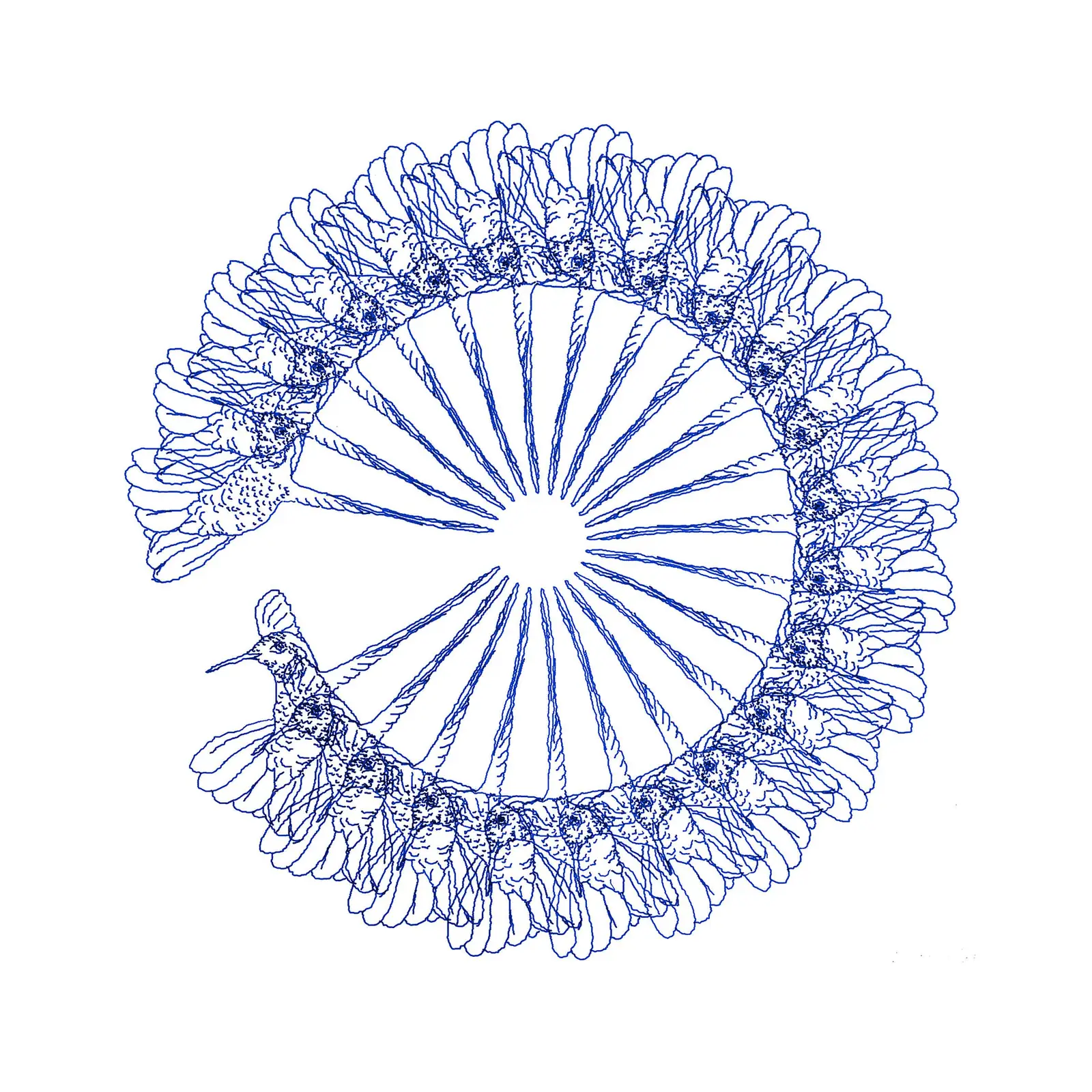
His film Hummingbird (1967), which MoMA purchased as one of the first computer-generated works in its collection, was very labor intensive. His line drawing of a hummingbird was transformed by a programmed sequence of movements. There were twenty-five motion sequences and 30,000 punch cards that had to be fed into the computer.
Peter Bauman: Can you talk about his National Science Foundation grant at OSU because it’s what he used to create his Computer Graphics Research Group, which was foundational to the field?
Caroline Csuri: Yes, the grant from the National Science Foundation (the first artist in history to attain one) was sizeable and allowed him to continue his research. In the early 1970s he developed interactive 3D art objects and real-time animation with objects movable in 3D space.
He used something called a light pen where he drew in real time; this was revolutionary. Still, it was labor intensive. He had a set of programs fed into the computer and he used dials to change them. He also had to get color by using an actual color wheel of film that was placed over the frames of animation and photographed frame by frame.
People don’t realize the hardware and software had to be custom-developed; there was nothing readily available. Dr. Wayne Carlson, who worked with Chuck, recounted to me: “Chuck’s ideas and desires were always one step beyond our existing capabilities, requiring new development efforts on a continuing basis.”
Csuri’s vision included “the computer as a doorway into a new universe of possibilities, dreams and realities.”
Peter Bauman: He had the vision but also faced skepticism and ridicule for his use of computers in art. Are you aware if it was ever difficult for him to maintain his vision despite that, considering computers were viewed even more negatively than we view AI today?
Caroline Csuri: I remember his frustration with the politics of the university trying to establish computer graphics, computer art and animation as a credible field.
But he knew in his bones what he was doing was important and ultimately going to revolutionize our culture and the art world.
In the middle of ridicule and rejection he still believed in his vision of the future. Most people would have given up with the Artforum rejection letter he received in 1967. Instead he used the rejection to motivate him.
He predicted the internet and AI; people looked at him like he was crazy. He told me tearfully at the end of his life it only took over fifty years for this art movement to be taken seriously. He wanted the fine art establishment to understand that this is a movement like any other revolutionary direction in art and every bit as important.
He was so far ahead of his time people didn’t understand and still don’t really understand the magnitude of what he accomplished. He felt it was up to the next generations of digital artists to persist in creating works that had never been done before, as this artform came to the forefront.
Peter Bauman: Where might this prescience have come from? Can you share more about your father’s background?
Caroline Csuri: He grew up poor in a Hungarian community in Cleveland, Ohio. His father was a cobbler and Chuck helped him in his shoe shop from the age of seven. His older brother, seeing he had an interest in drawing and making things, would often take him to the Cleveland Museum of Art. He was enriched by that experience. He told me he didn’t have money for art materials so he carved bars of soap and could only draw because he had no paint supplies.
He told me later when he got a football scholarship to the university he was thrilled because it gave him the advantages of culture without having to have money. He was the first in his family to go to college. In a university environment he was like a sponge. He had a tremendous drive and intellectual curiosity that he carried with him throughout his career.
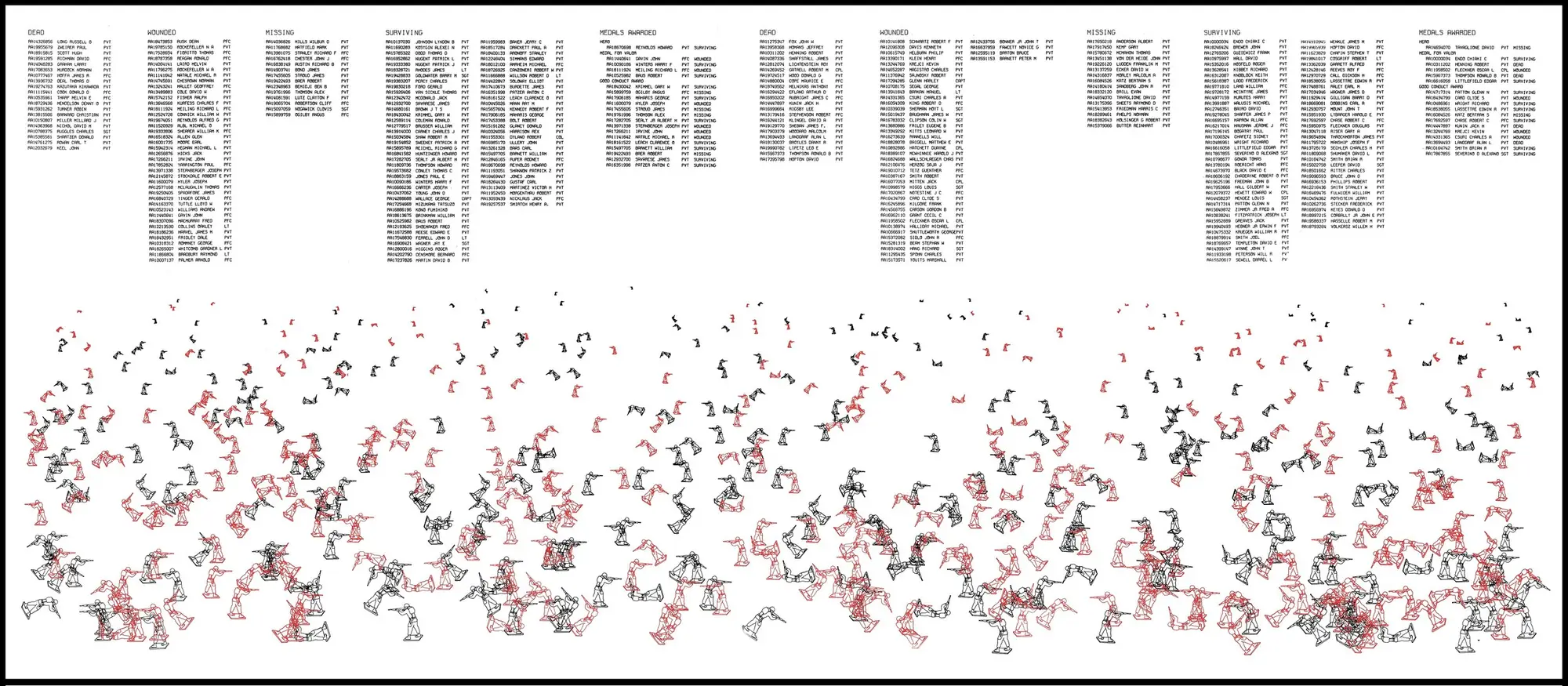
Peter Bauman: Your father was an artist but also an OSU football player and a WWII veteran with a Bronze Star. How do you think his experience with war especially shaped his art practice? I’m thinking of works like Random War.
Caroline Csuri: I think the brutality and horror of war made him want to artistically create a beautiful world to escape that harsh reality. He was impacted by that experience throughout his life starting with his iconic Random War in 1967, as you said.
In that piece, the life and death of soldiers was controlled by a random number generator. He continued exploring the theme of soldiers throughout his artistic career.
Peter Bauman: Your father is probably best known historically for his role developing the field of computer graphics and animation. Even with his late-’60s plotted work, like Hummingbird, he was clearly interested in movement. I’ve spoken to Tom DeFanti about his time as a PhD student with your father, where he developed the GRASS language.
Caroline Csuri: My father helped pioneer the field of 3D graphics and 3D computer animation while at OSU starting in the ’60s and early ’70s. He continued his research until the late 1980s. Working on developing proprietary software, he would come up with an innovative idea and then find the person who could help him. I was told that many of his collaborators thought he was crazy but he didn’t take no for an answer; he would figure out a way to solve the problem.
Steve May, CTO of Pixar, said my father came to him and said he wanted to be able to “draw” in 3D space. Steve said that can’t be done and my father replied that it could and he did. Steve said he was tough but a romantic.
Peter Bauman: Your father also built his own special tools. How does that tie into his gift for collaboration?
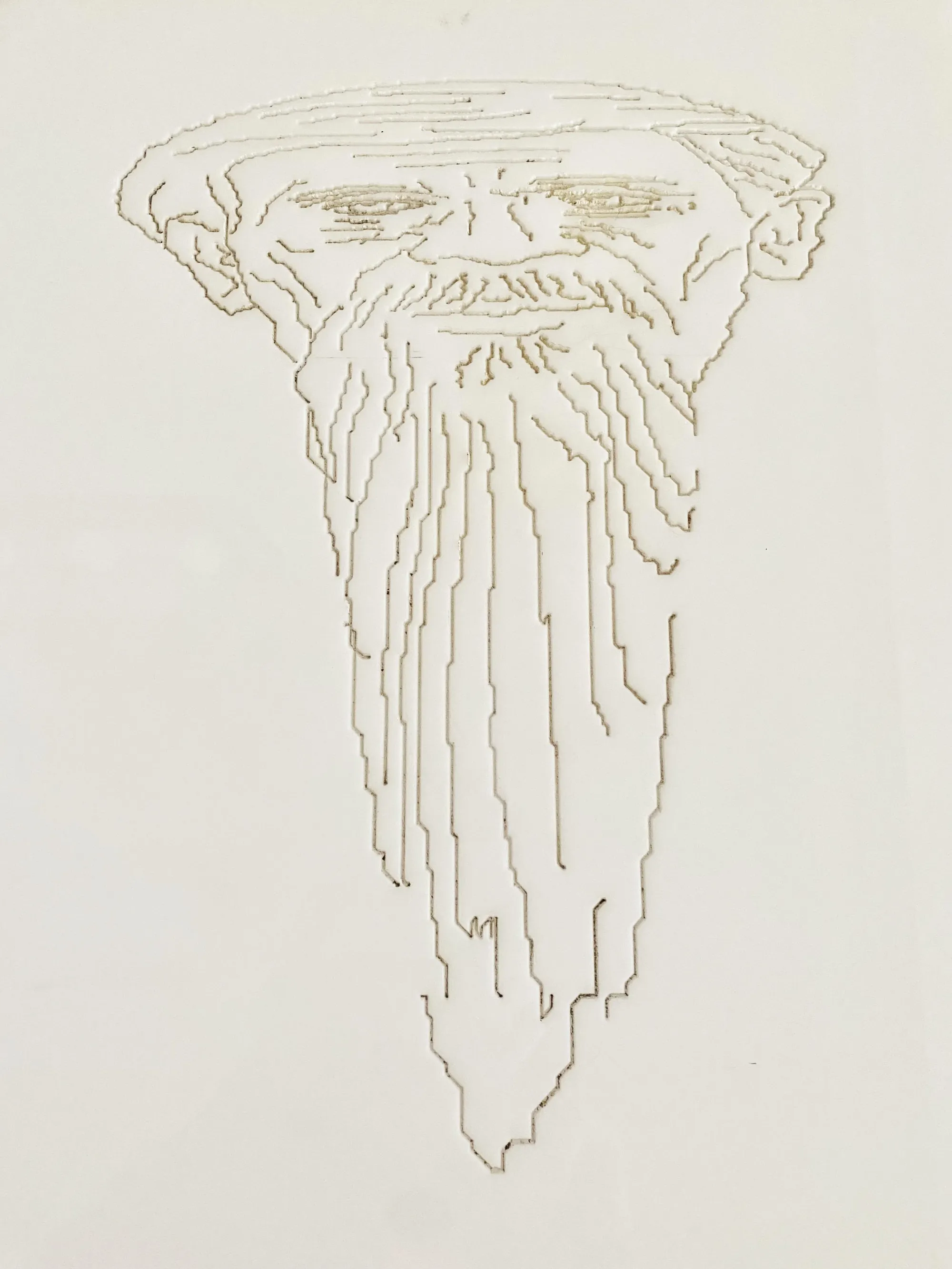
Caroline Csuri: An important proprietary tool was the ribbon tool that my father used throughout his practice with his many artistic adjustments. Another was an organic embossing technique to contrast the synthetic look of computer-generated objects and texture mapping a picture onto a 3D object.
He was always playing with light and transparency. He wanted the look of glass so he created a transparency tool so he could adjust the varying degrees of an object’s transparency. There was also the fragmentation tool where he could control the fragmentation of objects up to thousands of pieces.
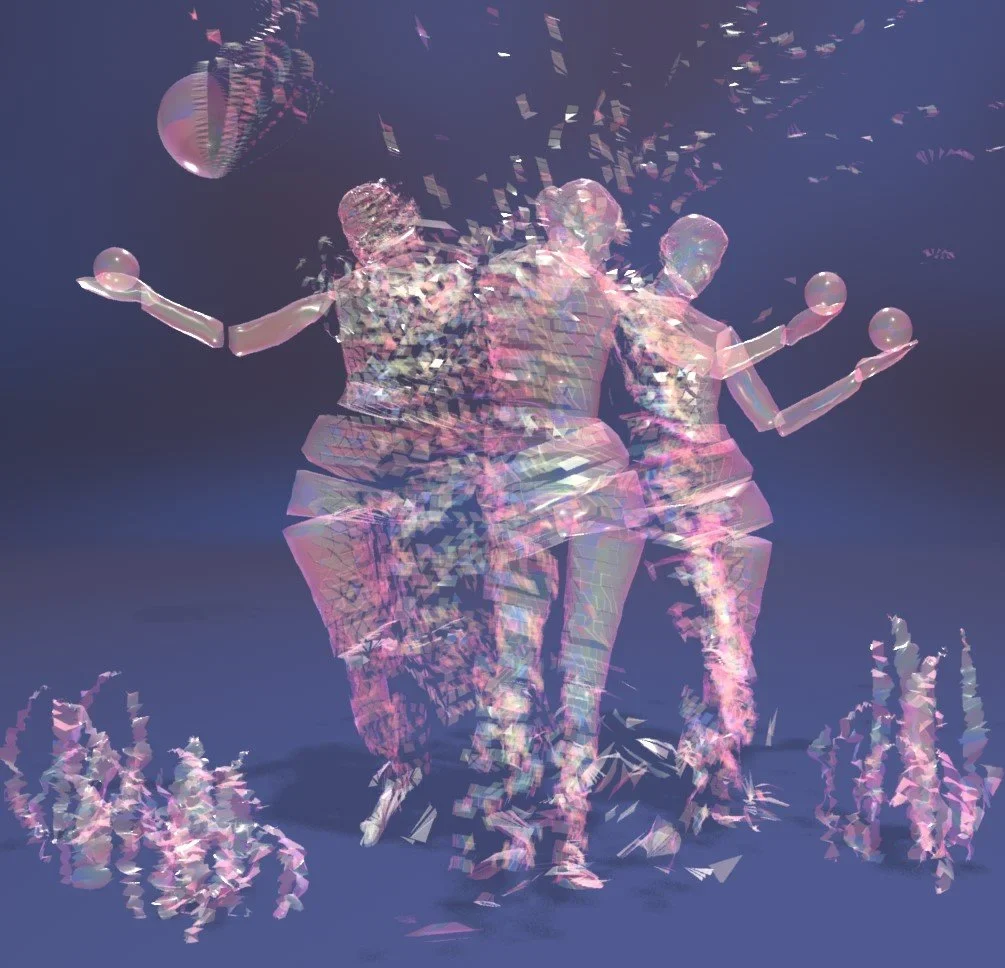
His color space was large; he used a prismatic color field where there was a relationship to the object’s position in space to the color. The important aspect of these tools is what he created with them. He didn’t use commercial software so had limited things in his toolbox but they were powerful tools and he expanded them in different artistic ways.
His research involved collaboration in almost every discipline. He drew people into projects from engineering, computer programming, aerospace, medical imaging. He even helped develop motion capture for dance. He worked with NASA and the Air Force on flight simulation. He created visual concepts to communicate with the deaf.
There’s almost no area of computer imaging he didn’t touch. He was intrigued with investigating new areas of discovery to solve problems or invent something new, better or different.
He loved collaborating with people to spearhead technology.
Peter Bauman: Speaking of his many skills, while at OSU he co-founded Cranston/Csuri Productions in 1981. It was the pipeline of his academic innovations to industry, like TV show openings and sports graphics. After this, he returned to the studio around 1989. What inspired this return to his roots as an artist?
Caroline Csuri: He wanted to get back to his own personal expression. My father experimented with so many different artforms. He was a true artist and understood art as being part of his DNA.
His drive to create was staggering and amazing to me. Even at close to one hundred, he worked prolifically, producing computer art and animation like it was his lifeline. I’m only beginning to scratch the surface of his genius and the complexity of his creativity.
In his notes I often saw “Why do I do what I do? What am I trying to do? What am I trying to say?” He thought it was so important to search for meaning in whatever he was doing.
He even had an exhibition entitled In Search of Meaning. He had a very humanistic approach to creating imagery by computer.
Peter Bauman: Your father’s view of computers as a “magic black box” takes on new meaning today as “black box” has become synonymous with AI interpretability and its unknowable inner workings. But how did he mean it and what role did the element of surprise and randomness play in his work?
Caroline Csuri: My father’s brother was a professional magician in LA. The first time I met him as a kid he pulled an egg out from behind my ear. My father was fascinated with magic and he could also do magic tricks.
He believed the computer and creating imagery with code was absolute magic.
He would always smile when he would run his scripts with the code flying through the screen, seeing this random image suddenly appear before his eyes. It was fun to watch! He totally had a sense of the absurd and playfulness in his approach to making art.
From the beginning, he created a hand series of his own hand in a glove hardened with wax that he poured inside. He put the wax fingers in a pencil sharpener.
In another, his hand held a fly swatter with a real fly encased in wax sitting on top of it. His animation of Frog to Artist in 1967 showcased his sense of humor. Most important at the end of the day, he felt the computer was a completely different approach to making art, saying:
“The idea of random events has intrigued me for a long time because I have often thought some of my best work was the consequence of accidents.”
Peter Bauman: To wrap up, can you talk about how you see your father’s legacy moving forward?
Caroline Csuri: MoMA had it right in 1968 by acquiring Hummingbird but they then forgot that pivotal moment. They were likely dazzled by the latest technology yet recognized little thereafter. Much of Csuri’s art and animation progressed quickly from that film as he pioneered the field of 3D digital art and animation, as we’ve discussed.
It’s critical to reexamine the digital art of the pioneers and the artform’s evolution. The latest technology is always seductive, like the power of AI today. But the true innovators, learning from the past, will lead the continued growth of this artform like the visionaries before them. They will have a personal point of view combined with a sense of playfulness and experimentation to discover how they can truly elevate the technology.
As for my father’s philosophy, he felt that if art became mechanized, it would remove the human element and further disconnect us from one another. It would have no real meaning.
I’m forever grateful to all Chuck’s students and collaborators who are carrying on his legacy by continuing to significantly impact digital art and animation with films like Star Wars, Star Trek, Jurassic Park, Terminator, Toy Story, Finding Nemo, Up, Monsters, Inc. etc.
I am also grateful that the foundation of this important art movement will be recognized through the critical work of the digital art curators, writers, educators and pioneering digital art institutions like Le Random and Spalter Digital, which tell the never-ending story.
------
Caroline Csuri is an artist and the head of the Charles Csuri Estate, which promotes her father’s legacy. She studied fine art, film, photography and computer graphics at The Ohio State University and spent some 30 years working with him on his art.
Peter Bauman (Monk Antony) is Le Random’s editor in chief.