

Suggested Reading
Article
History
Molnár's Paris
Peter Bauman
•
October 16, 2026
View


Degrees of Disruption: Vera Molnar and Generative Art opens Friday, October 16 at V&A South Kensington. The display brings together more than fifty works from Vera Molnár’s career, from early paintings to plotter drawings and late self-portraits. It’s a journey through a career as well as art history.
Degrees of Disruption tells a certain history of art since midcentury. It starts with painting, moves to human-executed rules, then to computer-executed rules and ends with machine-learned models.
The show also implies a position shared by our Generative Art Timeline and Editorials: that these various rules and networks are all connected, held together over time through advancements in technology; they are different expressions of systemized thought.
The V&A’s institutional juxtaposition of Molnár’s practice with contemporary algorithmic artists further questions how fundamentally different the hand and the model are. Should we stigmatize something made with deep learning tools, like we did in Molnár’s time with the computer? Or should we view it as another complex tool and be grateful for artists who inspect them?
Stigmatizing feels so right, though. Artists are delegating human work to “extractive killing machines” and it feels wrong. It’s just another example of contemporary culture degrading into dust. Right? Wait, are we talking about AI today or computers in the ’60s?
Molnár shows us artists have been confident enough to cede carefully selected parts of their artistic control for decades, by choice, Molnár herself since the late ’50s. She even invented an imaginary machine to which she gave away control. Once she encountered real machines (early computers) that could execute rules even better than her imagined one, she recognized the benefits and was off in 1968.
Rather than some new affliction thanks to AI, artists have comfortably shared control with collaborator machines and humans since the bone flutes of Paleolithic campfires. As they should. Why? Because it’s a tradeoff; it comes with comparative advantage: each doing what it’s relatively best at for shared benefit.
With machines, what they’re better at became fairly clear even from the beginning: calculating and quickly following all of those pesky rules. With that out of the way, it left people to do what they are best at: thinking up those rules in ever higher levels of abstraction.
When people mix with these systems, whether imagined, real, computerized, robotic or networked, it creates some kind of alchemy, where the result is greater than the sum of its parts. Somehow, one plus one equals almost anything.
When one plus one equals three, things break. These disruptions are what kept Molnár fascinated, regardless of hand- or computer-executed system. The artist was constantly toying with the dial of disruption, adjusting it with a glee discernible over decades of focus.
Molnár disrupted her outputs as her actions and practice were disruptive. When computers were despised and a death knell for any artist working with them, she was sneaking into university labs to access them on weekends. Fearless and unconcerned with reactionary societal approval, that is also the legacy Molnár leaves today’s generation of artists with their own dials to adjust.
“For every creator who has ever sat behind a screen wondering if their pixels, code, or digital canvasses held the same weight as paint and stone, this is the answer.
The institutional gates have been blown wide open for every digital artist, pioneer, and creator coming next.”
Michael Spalter, Spalter Digital, in a statement to Le Random
This V&A show, like the Centre Pompidou’s 2024 Molnár retrospective, Parler à l’œil, begins before any computer with Molnár’s early abstract paintings.
Upon arriving in Paris in 1947, Molnár encountered the work of Albrecht Dürer and met Sonia Delaunay in cafes, which inspired the abstract turn in her solo work. If you go to the show or have ever seen her early paintings, you can already glean an interest in geometry, restraint and systems.
Then about a decade later, Molnár’s solo career began in earnest as her collaborator-husband got a job as a researcher. Molnár’s mind was on her own now. She began systematizing her painting practice in the late 1950s with a hand-executed algorithm through her machine imaginaire. Her shift occurred as art itself was dematerializing and systematizing with concepts, instructions and scores becoming as accepted as art “objects.”
She operated her “imaginary machine” by writing out sequences of instructions, which she would then carry out by hand, rearranging and combining simple elements step by step. This demo below gives you some approximation of the process.
Understatement: our brains are truly wonderful. Yet, we can all agree machines perform certain tasks better, like strict rule following or advanced calculations, not to mention simple ones, like 34 × 56, done instantly. It’s that comparative advantage idea.
So it’s no surprise that Molnár craved a machine that could execute her machine imaginaire in reality. As computers were extremely difficult to access back then (think of trying to use a quantum computer today), it wasn’t until 1968 that Molnár was finally able to, through her friend the algorithmic composer Pierre Barbaud.
Timeline: Vera Molnár develops her machine imaginaire (1959)

Once Molnár finally swapped the imaginary machine for a real one in 1968, well, the rest is art history. What interested her was the fractal, jagged coastline between order and disorder. What would this dash of randomness add? What about this pinch of disorder? Molnár welcomed these small doses of disruption into otherwise regular compositions.
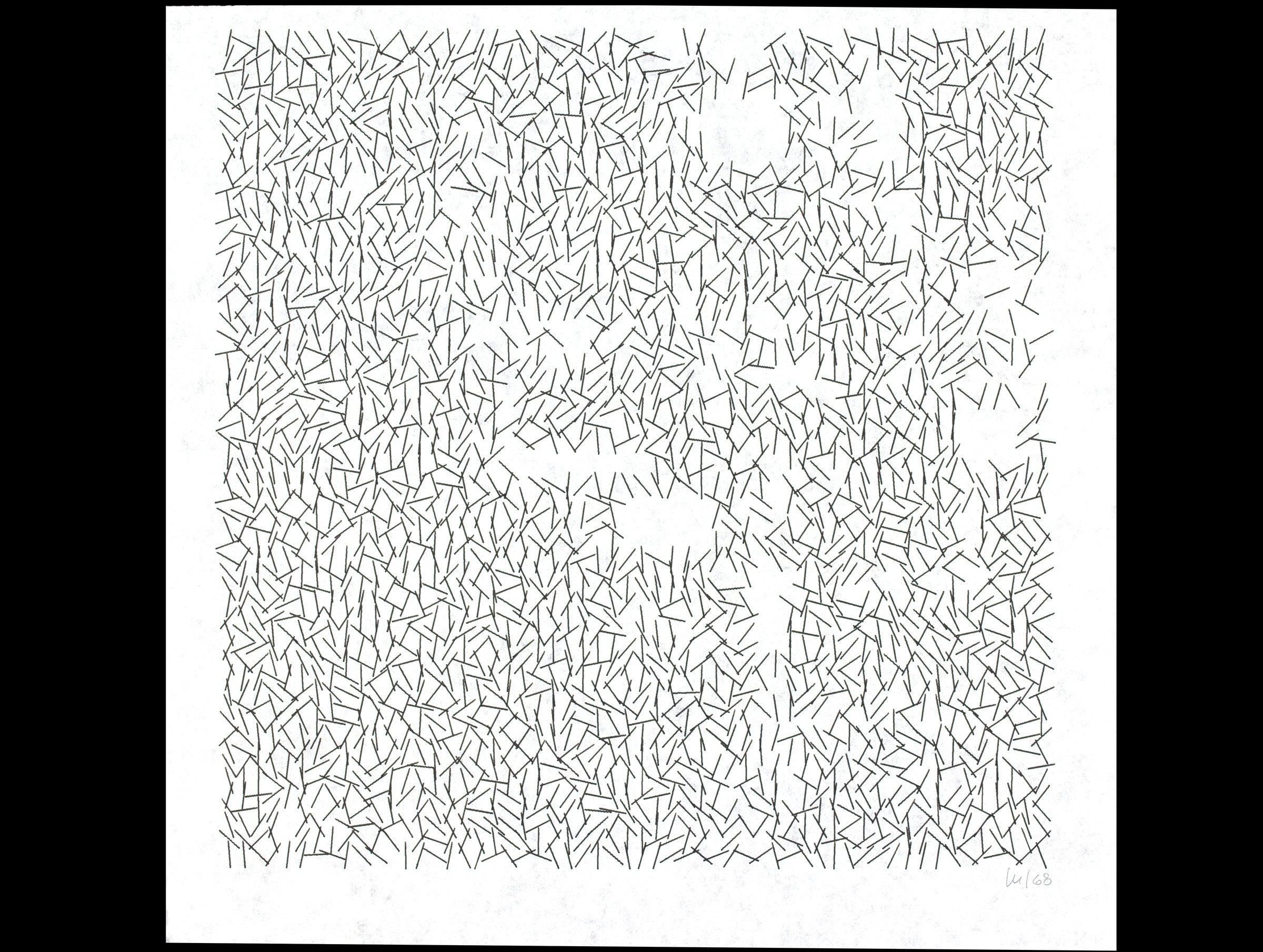
The plotter drawings on show include Interruptions (1969), In Search of Paul Klee (1970) and (Des)Ordres (1974). Each one is a grid that breaks with intentionality.
Timeline: Molnár begins her computer art phase with the Interruptions series (1968) · the (Des)Ordres series (1974)

Throughout the decade of the 1970s Molnár had regular computer access through the Sorbonne University–Orsay Computing Centre. It’s there she developed Molnart, written in FORTRAN, which she used to achieve works like (Des)Ordres (1974).
The artist was also captivated by lines and motifs. She used the line itself as a research tool. In her most moving work, Molnár drew by hand and by computer to see how far a line could vary before it became something else. My Mother’s Letters (1988) takes her mother’s strict Gothic handwriting and lets it glide, letter by letter, toward illegibility.
She also often responded to art history directly, with homages to Monet, Klee and Delaunay. The V&A display includes a self-portrait never shown before, Autoportrait à la Sainte-Victoire (2004). It consists of six collages cut from one photograph, nodding to Cézanne’s oft-painted mountain. Through rules and algorithms, Molnár systematized that motif, bringing its output space to a higher level, offering a multiplicity of views and perspectives not limited by the hand.


The last section is perhaps the most argumentative, demonstrating Molnár’s legacy by placing her work beside eight contemporary generative artists. It shows the reach of her influence, exploring and extending terrain trod by Molnár for decades around questions of control, agency and authorship, often in dialogue with technology.
Among the contemporary artists are Casey Reas, Licia He, William Mapan, Zach Lieberman, Harm van den Dorpel, Matt DesLauriers and Entangled Others, whose Sediment Nodes (2022–23) uses neural networks to imagine microscopic life.
That last example is the show’s quiet argument, fittingly using one of Molnár’s famed irregular lines to trace a path from abstract painting objects to Molnár’s person-executed rules to her automated rules and to today’s neural networks.

In a stroke of good timing, just this week the programmer Cheng Lou released Handwired, which turns ordinary JavaScript into a neural network. The network gives exactly the same output as the code it came from. If any program can be rebuilt exactly as a neural net, “rules” and “generative model” are just two ways of writing a system down.
It makes the technical connection that Molnár’s practice made conceptually for decades: systems are there to help us express more fully. Whether we use our hand, a machine in our head, a computer or a frontier agentic AI model, they all share a related lineage.
Few artists embody such a lineage so directly as Molnár.
------
Peter Bauman is Le Random’s editor in chief.