
Suggested Reading
•
October 26, 2026
View


The founders of the Electronic Visualization Laboratory talk to Peter Bauman about playing video like music, the Sandin Image Processor and giving their tools away.
Peter Bauman: I’m just really curious to hear from you two about this legendary media art laboratory that has been instrumental in the formation of new media art for decades.
Let’s begin with Tom and your foundational real-time computer graphics program GRASS. You developed it at The Ohio State University (OSU) as a PhD student with Chuck Csuri.
In the early 1970s, one of your and Csuri’s main visions for the future of computer graphics was making it real-time and responsive, incorporating user feedback. How did that experience shape you?
Tom DeFanti: It totally shaped me. In those days, the Vector General was a very responsive, real-time device. Chuck had gotten one as part of a grant to do real-time film animation, he called it, which of course is an oxymoron.
I like oxymorons. I think they make things very clear.
When I ran into Chuck, he was working with an IBM system, spending all his time doing demos of punch cards. And I said, “You really need a programming language.”
He goes, “Yeah, okay, fine, who’s going to do that?”
I said, “I’ll do it.” And so I did it.
Because of his grant he actually hired me as the first research assistant that OSU had ever had in the art department in its hundred-year history. I worked on the GRASS language, GRAphics Symbiosis System.
They happened to have an old black-and-white TV camera in the OSU lab. So we pointed it at the screen, not knowing anything about video really until I met Dan. It did a pretty good job of capturing the video, which is surprising considering one is random scan and the other is interlace.
Then I kind of knew it was going to work.
Then I graduated and got the job to work with Dan and another fellow by the name of Ted Nelson at what was then called the Circle Campus of the University of Illinois [at Chicago (UIC)]. That’s where I met Dan. I saw that he had this colorizing IP [Sandin Image Processor] with many effects. And I have to tell you, that completely blew my mind.
I really realized that we could make this thing do interesting things together in real time, developing really a synthesizer when you get down to it, something that you could play in real time like musicians do.
With the programming behind GRASS and the programming possible in the IP with its patch programming, we could now do the equivalent of composing music as well. So we did both.
Peter Bauman: Tom, you’re referring to the heart of why we’re talking today, which was that magical combination of your GRASS software and Dan’s IP hardware at the Electronic Visualization Laboratory (EVL) at UIC.
That brings us to Dan and his legendary Image Processor. You started working on it in 1969 when you were already at UIC.
How did it begin for you? What were your inspirations after studying physics to create the video version of a Moog synthesizer?
Dan Sandin: So one thing I’d like to mention is that, of course, I have a master’s degree in physics. And how did I get a job in an art department? Because they don’t normally hire physicists for the job.
The reason is that the design component of the art department at UIC, I would argue, is the third-generation Bauhaus.
Most of the staff in the design areas came from IIT [Illinois Institute of Technology, whose Institute of Design was founded by László Moholy-Nagy] to start the program at UIC. They hired me specifically to combine industrial production with computers to be able to do cybernetic design, which was the jargon of the time.
It was a very unique circumstance. I don’t think any other art department would have hired me. I was supposed to bring design components into the cybernetic age.
The concept of the IP, I developed when I was still at the University of Wisconsin’s physics department. I had done an interactive exhibition which had a computer-controlled Moog synthesizer and a bunch of lights in a room. It could do music and the sound was responsive to the people in the room.
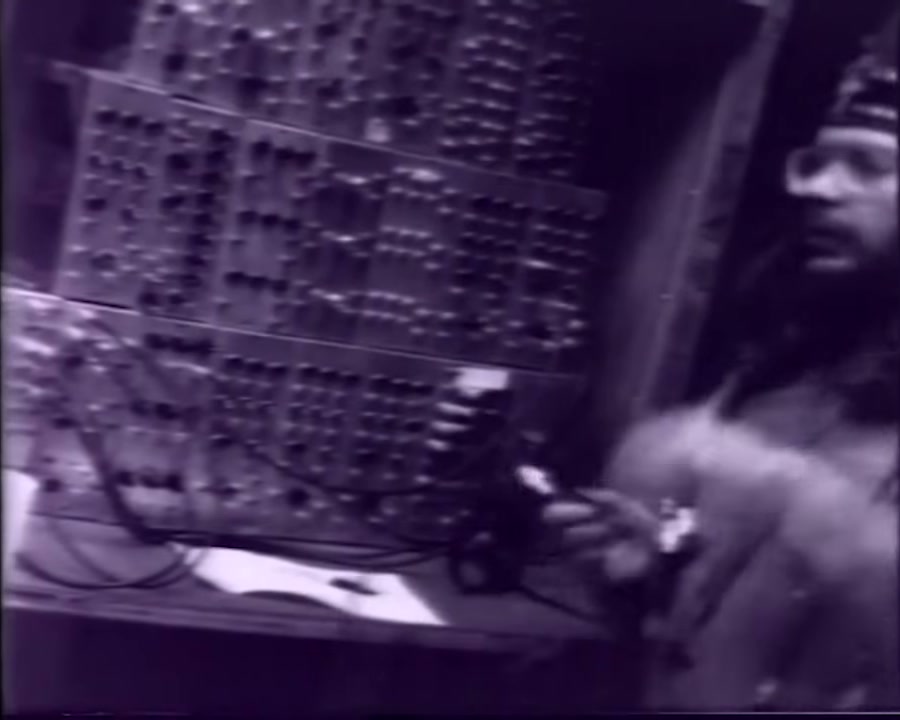
At that point, I started to think about a visual processing instrument. Because it was very clear to me that color TV had this red, green, blue component. It was signals; you could process them like audio signals.
Russell Dobson, a long, long friend from when I was an undergraduate at Shimer College, was a manager at the Computer Center in Urbana. We spent a lot of time together thinking about what would be the visual equivalent of a Moog synthesizer. It fell into place fairly quickly, conceptually.
The only real difference between the IP and the Moog synthesizer is the bandwidth: instead of being limited at 20 kilohertz or so, the IP goes up to 5 megahertz or so. Otherwise, it’s the same kind of structure.
A structural difference between programming the IP and the Moog synthesizer is that in the Moog, the control voltages are a different standard from the audio voltages. That’s kind of necessary, because pitch has to be controlled so precisely.
It was a 12-volt signal, while the audio signal was DC coupled so that you could use it to control things. Then the audio channels were all kind of like AC coupled, not DC coupled, and kind of standard audio input and output impedances.
With the IP, the control voltages are exactly the same standard as images. So the images can control the IP, in a sense, too.
So for me, music is the inspiration for the way I think about the IP and real-time computer graphics.
After my physics master’s, I set the curve on the qualifying exam for the PhD program, and presumably in something like three or four years I’d have had a PhD in nuclear physics. But I saw OffOn (1968), which was an abstract film by Scott Bartlett.
I realized that one could structure film like music instead of structuring it like narrative.
I just fell in love with it and I decided that’s what I wanted to do. The goal of being able to create visuals in time inside of a musical tradition rather than inside of a literary tradition is just, I just couldn’t do anything else.
Peter Bauman: What was so new about GRASS and the IP at the time? I think it’s hard for us in 2026 to understand why these were so radical.
Tom DeFanti: The Vector General had a bunch of analog controls. You could actually turn dials and slide sliders and push buttons to start things up and stop them. And this is unusual for computer graphics.
It was a fundamental part of the design of GRASS that things were moving.
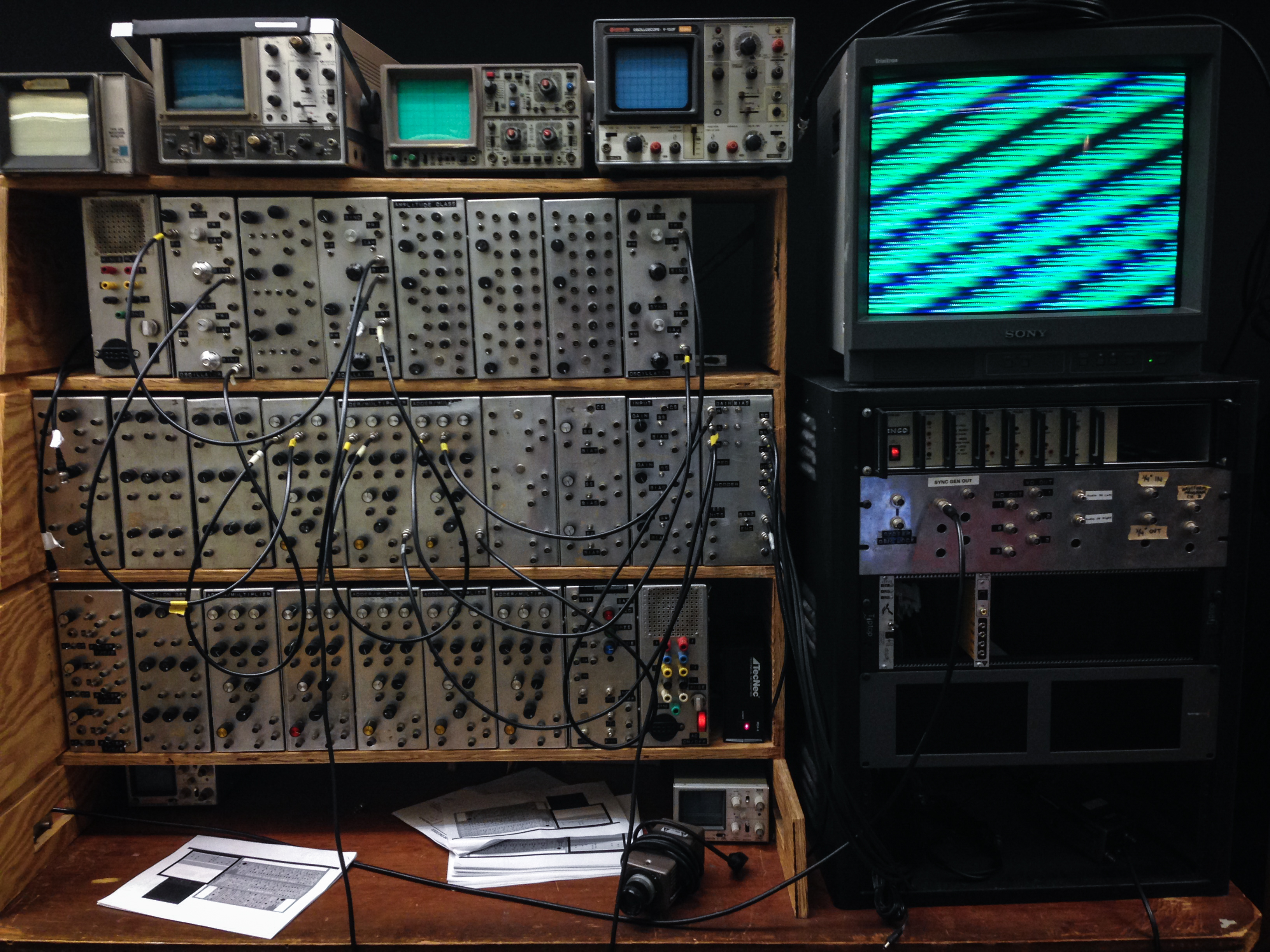
Similarly with the IP, stuff moves, video’s on all the time, right? And of course you’ve seen pictures of the IP, [it] is like a wall of dials, right? And so we were able to play things.
Peter Bauman: How did the artists you worked with take advantage of what you were doing with real-time graphics and sound?
Tom DeFanti: Barbara Sykes was very, very talented in playing the IP. She even invented her own language for capturing the patches. Some people, like Dan and me and Barbara and a few other people, used the combination of devices to create these very fluid color experiences.
Sometimes we even did performances with live sound that were sort of like jams.
The real time is a great teacher. I mean, you do something and you make a mistake and you know about it, right? Phil Morton used to say, “Well, gee, if you’re doing a performance, you make a mistake, do it two or three times in a row and people think it’s part of the composition.”
One of the nice parts about the GRASS system is you could construct strings that were executable programs on the fly, something you couldn’t do in BASIC. There’s a bunch of weird things the Vector General would do if you gave it intentionally wrong things. Like the Circle 9 Sunrise piece all had to do with essentially abusing its capability of drawing circles.

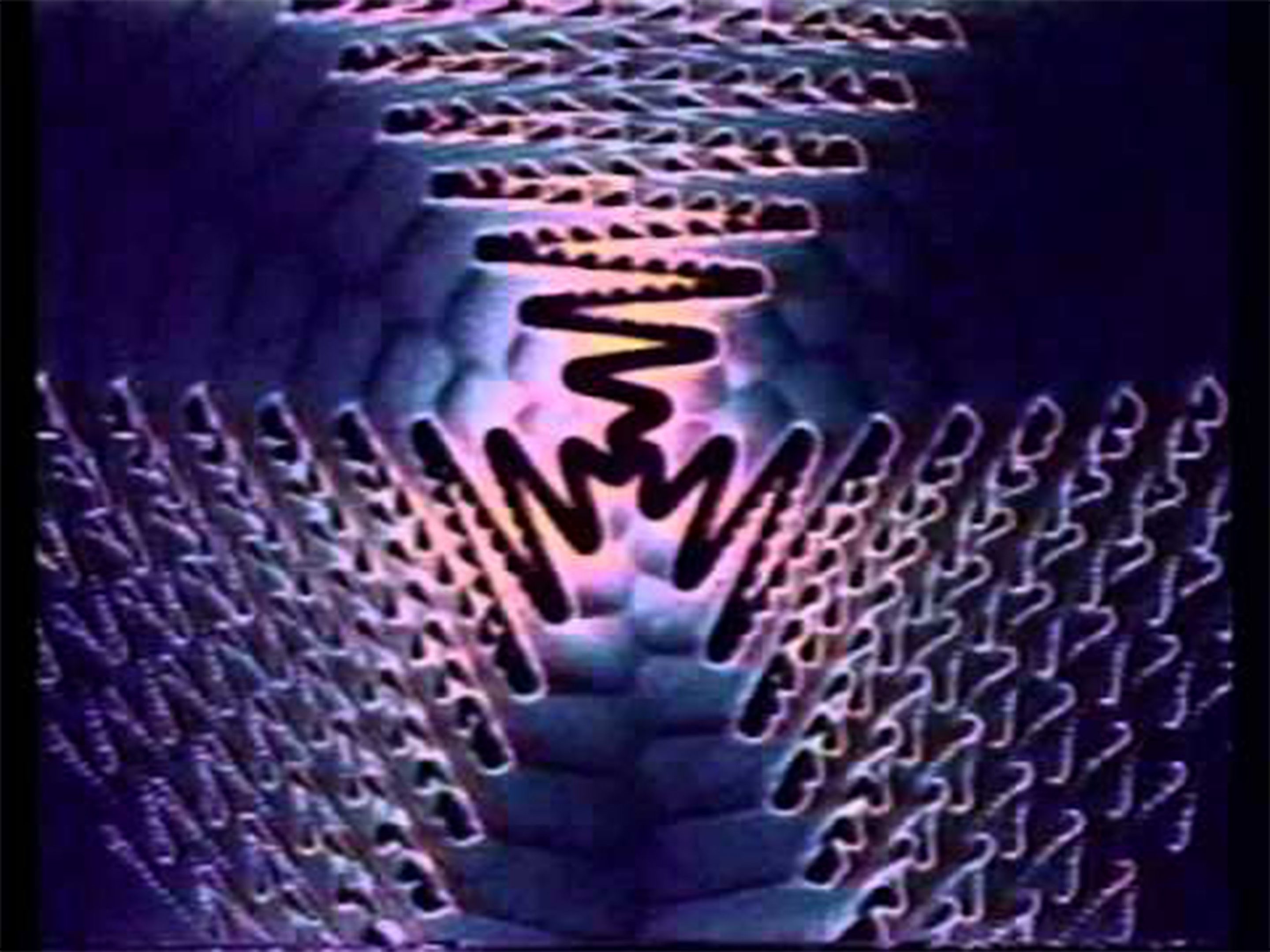
The Spiral PTL piece was essentially the exact opposite of what everybody else is trying to do in computer graphics, which is anti-aliasing. The piece is completely temporal aliasing. This had to do with creating visuals by doing a low-frequency sampling of high-frequency events. You get these aliases, which turned out to be very attractive.
So there were all sorts of things we could do in real time that I don’t think you would have figured out if we had to program. At least I never would have.
Dan Sandin: Real time is a very different form of discovery.
Tom DeFanti: And remember, Dan and I were both teaching full-time. We had a lot of students and Dan’s IP classes were a central part of what he was teaching. I had much larger programming classes and I was using punch cards still.
I got people on PDP-11s and so on but I had only a few students to work with me on the GRASS language and then ZGRASS later on. So the GRASS system was not so much part of my curriculum. It was the center of my lab but I think Dan brought many more students into it.
Remember, at Ohio State, I was in an art department as a computer scientist and Dan was in an art department as a physicist at UIC. So we brought different talents to it.
Peter Bauman: It really highlights the multidisciplinary work of the lab. But before it was EVL, it was the Circle Graphics Habitat. What was that and how did it become EVL?
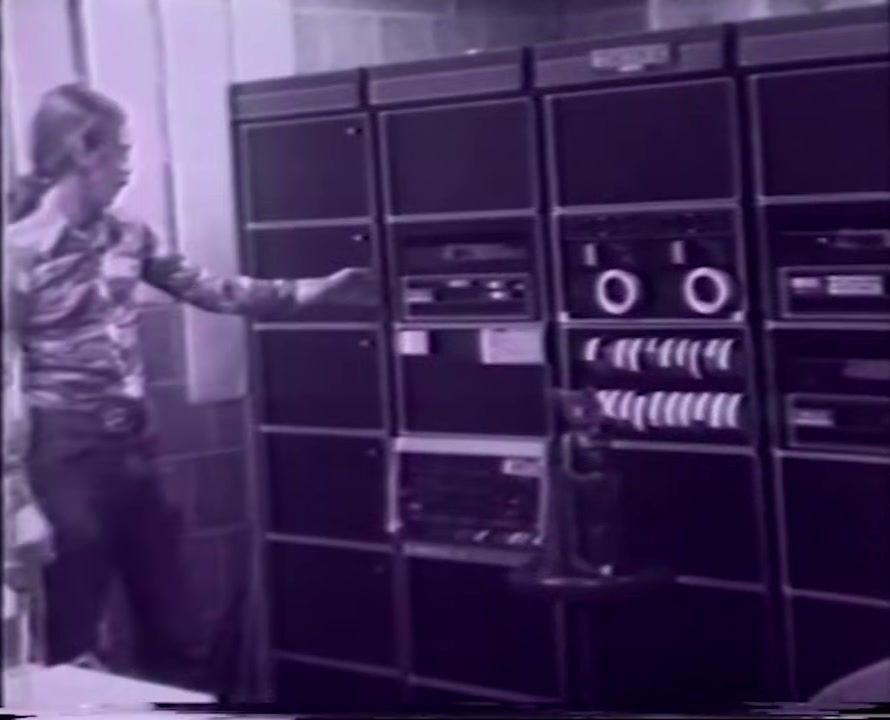
Tom DeFanti: Circle Graphics Habitat was a room, 4114 SES [Science and Engineering South]. It had the Vector General, the PDP-11, a big air conditioner to keep it all cool and the IP. I was hired at UIC in a program that involved teaching grad students how to use media to teach. As a matter of fact, my first course was teaching teachers how to teach teachers how to teach.
After a year or so, the dean of the Graduate College called me and Dan into his office, a very wonderful man, a guy named Jan Roček. He said, “Why don’t you guys start a program?” And since we’d already had the Electronic Visualization Event, we decided to call it the EV Lab.
I hate bureaucracy so I kept paperwork from ever being filed about it. But Dan did have a formal EV program in the art department, a formal master’s program. Copper Giloth was the first graduate of that.
Later on, the term visualization took off. This is a term that Alvy Ray Smith first started using to describe voxels. We co-opted it at SIGGRAPH and used it to describe something that was a combination of computer graphics, image processing and science. And then we were able to say that visualization was our middle name, which we always kind of thought was cute.
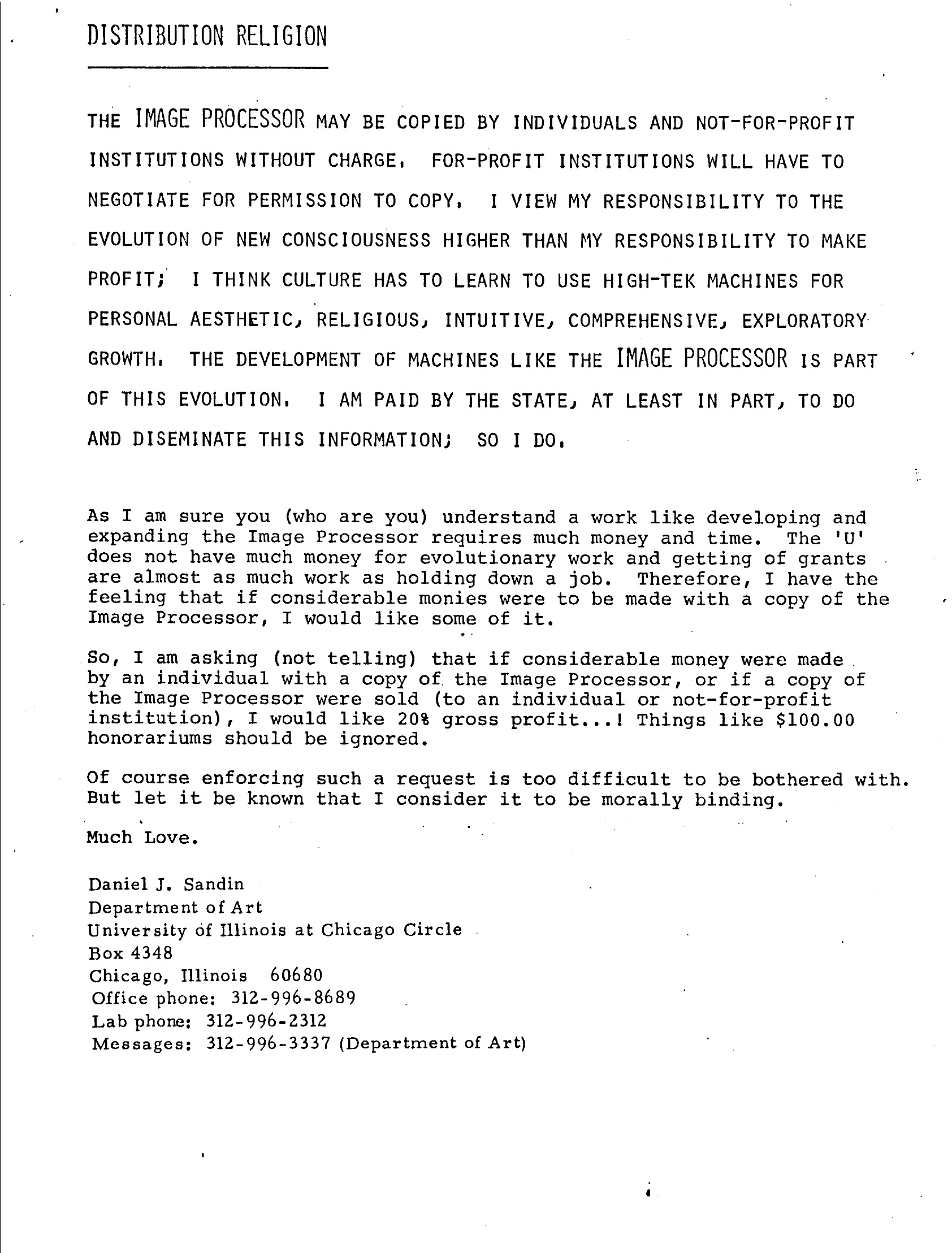
Peter Bauman: Something really interesting is how you’ve described the IP as the system that can be copied. Others can use or instantiate the system themselves. It aligns with a lot of thinking today about protocols as art. Do you see the IP as an artwork itself or more as a tool?
Dan Sandin: I see it as an instrument in the musical instrument tradition.
That’s my view of it, that I designed and built and allowed to be copied a new instrument that people would personally own and enjoy.
Phil Morton was an artist who basically asked me, “Could I copy the IP?” And I said, “I’d certainly give you permission, but I actually don’t know if you can copy the IP, because I hadn’t given the matter much thought.” Then we together developed the documentation for the IP, which was necessary for it to be copied. And he was the first copier.
The documentation was very thorough. It included essentially sheets of paper that you could send to an electronics supply place like Newark. And they would ship you the parts. At that time, Heathkits were big in the home-built electronics realm.
The first thing that anybody who copied the IP would have to do, or I suggested they do, is build the Heathkit test instruments that they were going to need to be able to debug and evaluate and actually build the IP. So, Heathkit was an incredibly important multiplier in the game. In the Chicago area, there were probably about ten IPs at least, even fairly early in the game.
Some people built some lovely cabinets for their IPs. One person, because the IP was made out of aluminum, spent a lot of time highly polishing the aluminum, like people do now with antique mobile homes. People loved the thing.
Tom DeFanti: This is not the case with the Vector General. You really couldn’t embrace it.
Peter Bauman: And these systems were central to the events. The Electronic Visualization Events (EVEs) anticipated a lot of things, from video game art and the demoscene to even things like rave culture and live-coding events.
The first two took place in Dan’s inflatable rooms?
Tom DeFanti: So the first two EVEs were real-time concert experiences in the inflato that Dan built in the atrium. Dan got really into building inflatos because he was hired partially as a sculpture instructor. He built these giant plastic things out of Visqueen and tape and we turned some of them into display environments for the very first projector TVs that consumers could buy. That was kind of a riot.
Dan Sandin: Make your own buildings to make your own rules was my thing about the inflatables. You could do stuff in there that nobody would allow you to do in a building. You didn’t have to get permission from anybody who had rooms, like galleries and stuff. You could just do it.
Peter Bauman: What was it like to produce and experience these legendary events?
Tom DeFanti: In Dan’s inflatos, we had to have wires strung up to where the Vector General was, which Larry Leske actually did. Another fellow named Greg Dawe, who was a longtime friend of ours, built the inflato, including a revolving door to get in and out of it, which was very clever.
We had that rotunda. There were probably a hundred people there. We highly publicized it and we put posters up all over the place.

By the time we did the third one, we had gotten enough money to actually buy video editing equipment so we could actually create edited pieces on video. We put it in a reasonably big auditorium, like a 500-seat auditorium in downtown Chicago that had a huge GE light valve projector. After that, it all turned into SIGGRAPH.
Dan Sandin: Some of the pieces were done where the soundtrack existed first. So I just remember doing one piece to the Grateful Dead’s “Truckin’” soundtrack. Then there were some where we actually created a click track with the video recording so that the person doing the audio could synchronize to it. That’s how Mimi Shevitz did the soundtrack to Spiral PTL.
There was just this spirit of getting together to play. The first two events, we really did have kind of these jam sessions going on. They were brief but they were extremely energetic. That was, to me, the most exciting part.
Tom DeFanti: We were at a conference and somebody asked Dan, how do you tell the difference between the computer science students and the art students? And he goes,
“The computer science students are better musicians.”
Peter Bauman: To you, who are both these incredible multidisciplinary artists, what’s the difference between being an artist, an engineer-artist and a scientist?
Tom DeFanti: Well, in that moment, we were artists. By the time we got to Spiral PTL, or Spiral 5, what changed was that I created a script that essentially had to do with transitions. They were at the touch of lighted buttons on the control panel.
So I was essentially experimenting back then with the idea of programs writing programs.
Then it was just a question of, with rehearsals with Dan, when I was going to do the transitions, when he was doing transitions and when they were in lockstep. We’d gotten to a rather exquisite place of being able to control, and repeat the control of, what we were doing with essentially a very analog system, but putting the digital controls on it.
One of the important things that comes from the musical tradition and the art tradition is the concept of formal rehearsals. We also adapted that when we were doing performances for the National Science Foundation. They would show up to decide whether we did good or they were going to give us more money or whatever. That’s straight out of the art tradition, certainly not out of the computer science tradition.
The artist Phil Morton came up with the concept of copy-it-right as opposed to copyright. We asked people, if they’re going to copy it, do a nice job of it, or ask us for a copy.
I was at a party in New York City one time and they were showing one of our spiral works, and it was all breaking up and tearing and everything. And I walked up to the person who was running the party, who, if I remember correctly, was Mickey Hart [from the Grateful Dead]. I handed that person a copy that I had with me, and I said, “Here, take this one and show this one instead, and keep it.” Because I wanted our work to be copied well.
Dan and I are very lucky in that we were supported by the state of Illinois to do this kind of thing, too. To be able to give away what we were doing. A lot of other people in the field were trying to bootstrap a career of companies and other kinds of things and they had to protect their intellectual property.
Dan Sandin: There was still a big ivory-tower hangover from the previous time periods, where I felt, for instance, I was being paid by the state to create and disseminate information. So that’s what I do. It felt very natural to give away the copying of the IP and all the other knowledge about that I could, because that’s what I viewed my job to be.
Tom DeFanti: And generally speaking, nowadays at universities, copyright belongs to the creator, but patents belong to the university. We skirted around all of that by not patenting anything. Our philosophy was to not impede giving it away.
This is the end of Part 1 of this conversation. Part 2, on ZGRASS, the Pixel Machine and the CAVE, will be released in the future.
------
Tom DeFanti is a computer graphics researcher who wrote the GRASS language at The Ohio State University. In 1973 he cofounded the Electronic Visualization Laboratory (EVL) at the University of Illinois Chicago with Dan Sandin, where they later developed the CAVE virtual reality environment with Carolina Cruz-Neira. He chaired ACM SIGGRAPH from 1981 to 1985 and is a research scientist at the University of California San Diego.
Dan Sandin is a video and computer graphics artist who designed the Sandin Image Processor, an analog video synthesizer he made free for others to copy. In 1973 he cofounded the Electronic Visualization Laboratory (EVL) at the University of Illinois Chicago with Tom DeFanti, where they later developed the CAVE virtual reality environment with Carolina Cruz-Neira. He is professor emeritus at UIC’s School of Art and Design.