


Suggested Reading
Interview
Evergreen
A. Michael Noll on When It All Started
A. Michael Noll
•
November 25, 2026
View


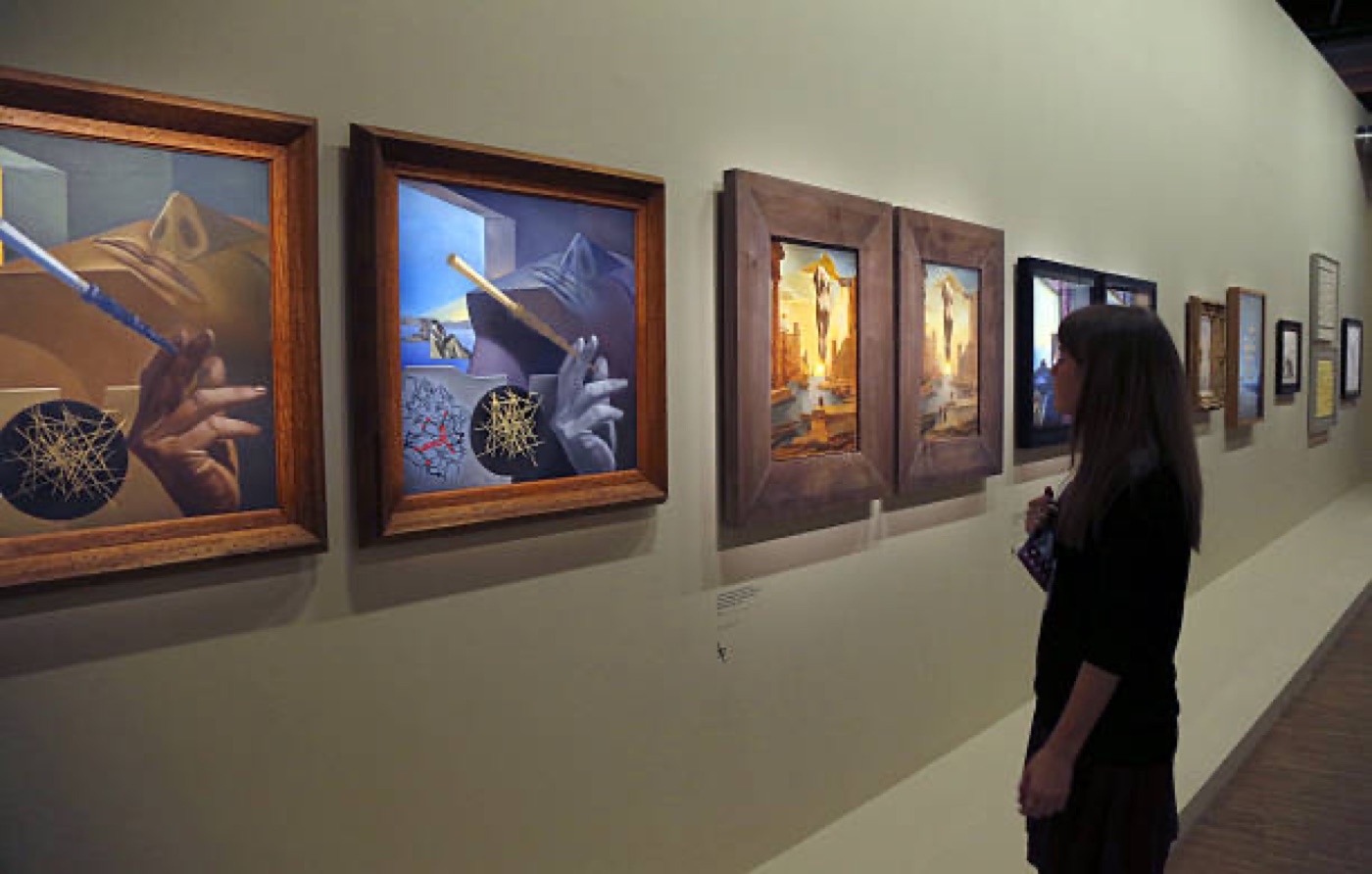
How did computer drawings from Bell Labs appear in Salvador Dalí’s paintings? While researching A. Michael Noll, Noah Bolanowski spotted Noll’s 1960s “random structures” in Dalí’s The Sleeping Smoker (c. 1973) and Perspective filaire (c. 1972–74). Bolanowski describes how they reached Dalí, through Jasia Reichardt’s Cybernetics, Art and Ideas (1971), and how they helped Dalí achieve the stereoscopic painting he had chased since at least 1950.
“Today, it is indisputable that masterpieces cannot be produced without computers and cybernetics. This is the future of painting.”
– Salvador Dalí, 198111
This story began while researching A. Michael Noll, a celebrated early practitioner who sought to convey the computer’s appeal to art from 1962 to 1968. My work led to Béla Julesz, who mentioned his relationship with Salvador Dalí in Dialogues on Perception (1994),1 the first clue. I then remembered Dalí’s appropriation of computer-generated work by Leon D. Harmon.2 All three were employed by Bell Telephone Laboratories throughout the 1960s, each making core contributions to the genre.
Julesz and Noll even went on to exhibit their computer-generated work to the public at Howard Wise Gallery in 1965, in one of the earliest exhibitions of the art form.3 Making this connection, I began to wonder about the full extent of Dalí’s appropriation of computer art.
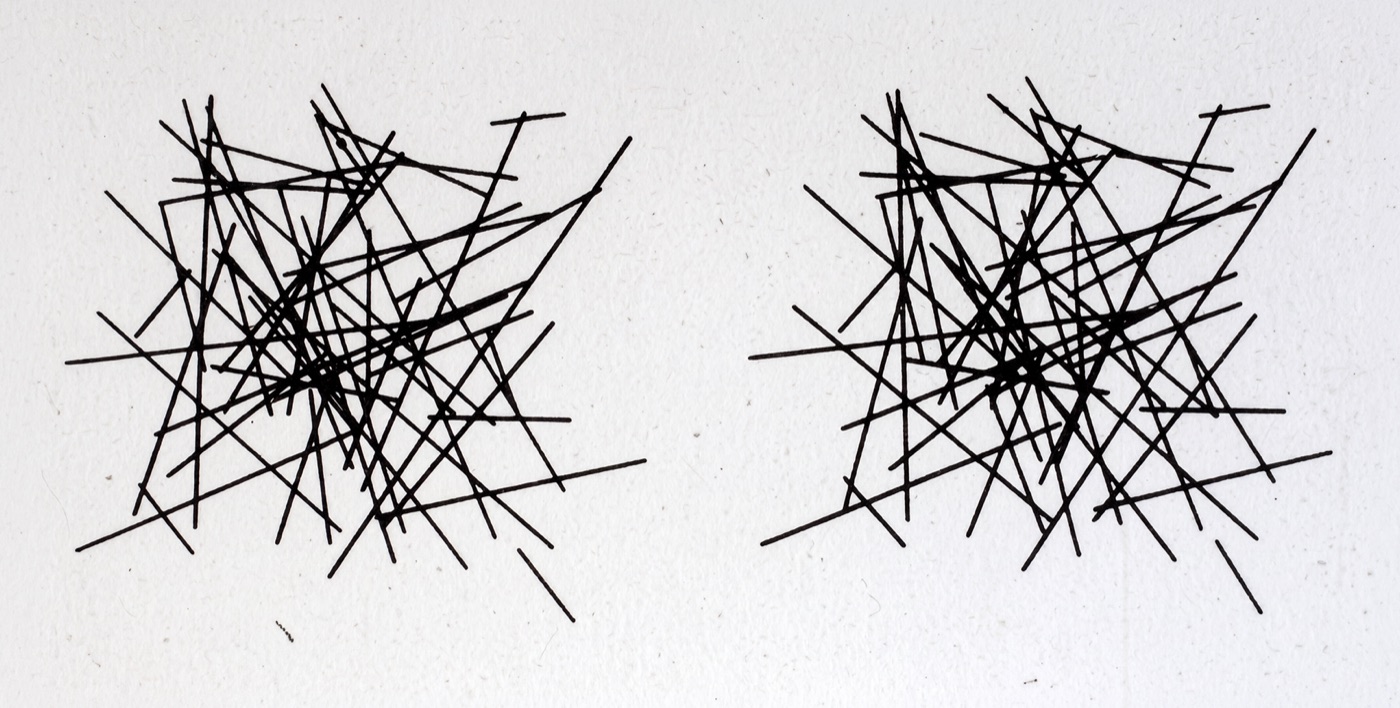
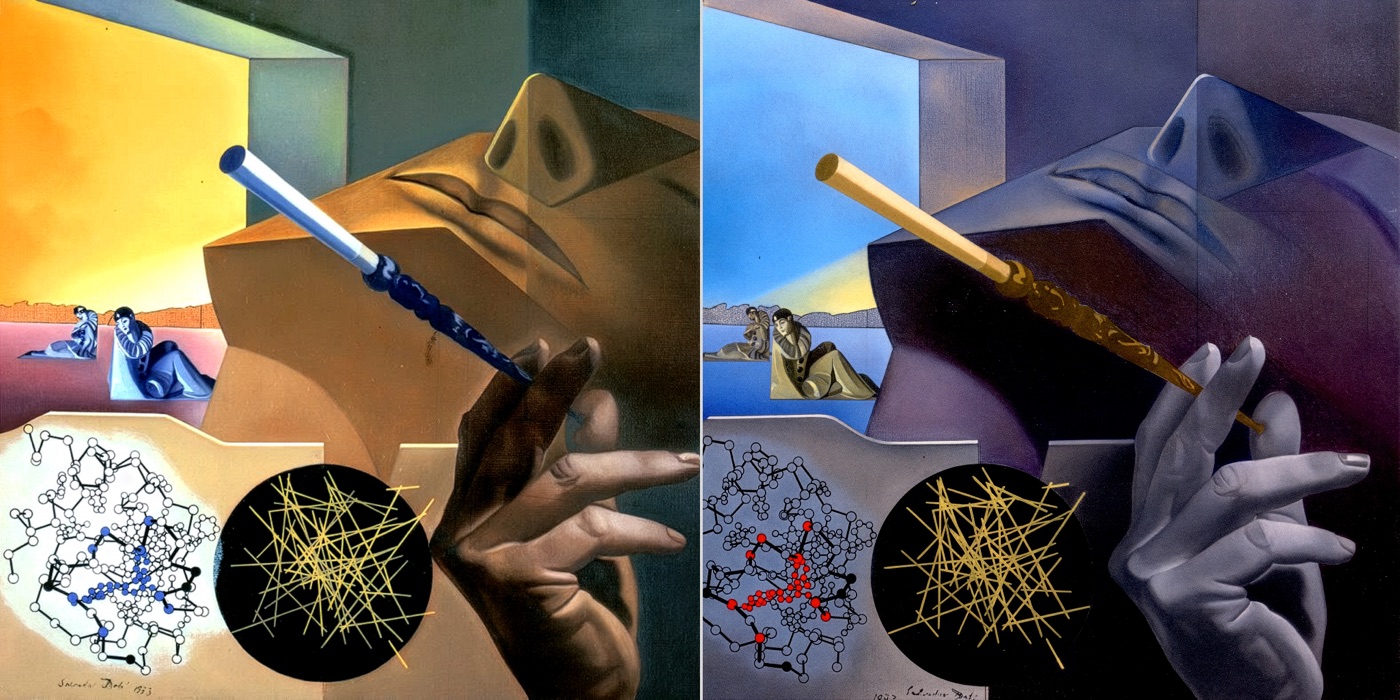
Scrolling year by year through Fundació Gala-Salvador Dalí’s online catalogue raisonné, my attention was drawn to The Sleeping Smoker (c. 1973).4 As if piercing through the painting, I instantly recognized Noll’s Random Structure Consisting of 50 Lines Falling at Random Within a Cube (c. 1963).
This discovery prompted several questions, beginning with how an early computer-generated artwork came to the attention of one of the foremost figures in twentieth-century art.
Further investigation illuminated Dalí’s prolonged interest in stereoscopy, the illusion of three-dimensional depth on a flat surface, from as early as 1950.5 Yet he only successfully implemented the technique in the early 1970s. The turning point, as his former assistant Louis Markoya recounted, occurred when Dalí was “introduced [to it] through computer drawings that were in early… books for computer generation[. He] saw them with a viewer, and started to want to incorporate them into his art…”6
But what was there to find? Noll’s 50 Lines was one of several “random structures” he created at Bell Labs demonstrating the computer’s capacity for three-dimensional stereoscopic expression. Noll executed the work of randomly scattered lines with an IBM 7094 and outputted the image to film with the Stromberg-Carlson 4020.7
This work might have remained in Bell Labs technical obscurity without Jasia Reichardt publishing the technique in Cybernetics, Art and Ideas in 1971. Reichardt’s corresponding text even sought to teach creatives how to achieve their own computer-generated stereoscopic images. For Dalí, who had two copies of the book in his personal library,8 it provided the “missing link” to achieving stereoscopic painting.
After more digging, I realized Dalí drew on the book more than once. To my great surprise, I encountered another Dalí work with another of Noll’s unmistakable “random structures.” Gifted to Markoya in 1974, Dalí created Perspective filaire (c. 1972–74)9 to conceptualize his method of stereoscopic collage. This work incorporated Noll’s 85 Mutually Perpendicular Connected Line Segments (c. 1963–64), from Reichardt’s Cybernetics, Art and Ideas, as well as William Fetter’s Computer Generated Perspective Transformations (c. 1960s) from Reichardt’s The Computer in Art (1971).

Dalí’s interests were famously wide-ranging, as was his penchant for appropriation. The artist incorporated visual motifs across a broad array of artistic and scientific disciplines, including the other computer artists mentioned previously. Yet few held his attention as long as Noll’s work and writing, with Dalí’s interest in stereoscopy persisting through the 1970s and into the 1980s.
In 1974 the artist proclaimed: “At the moment, I am painting stereoscopic paintings, using two mirrors that reflect two photographs, like the old masters, Vermeer for example. I obtain unique visions and colors. To sum it up, formerly I painted the fantasy of reality. Today I paint the reality of fantasy…”35
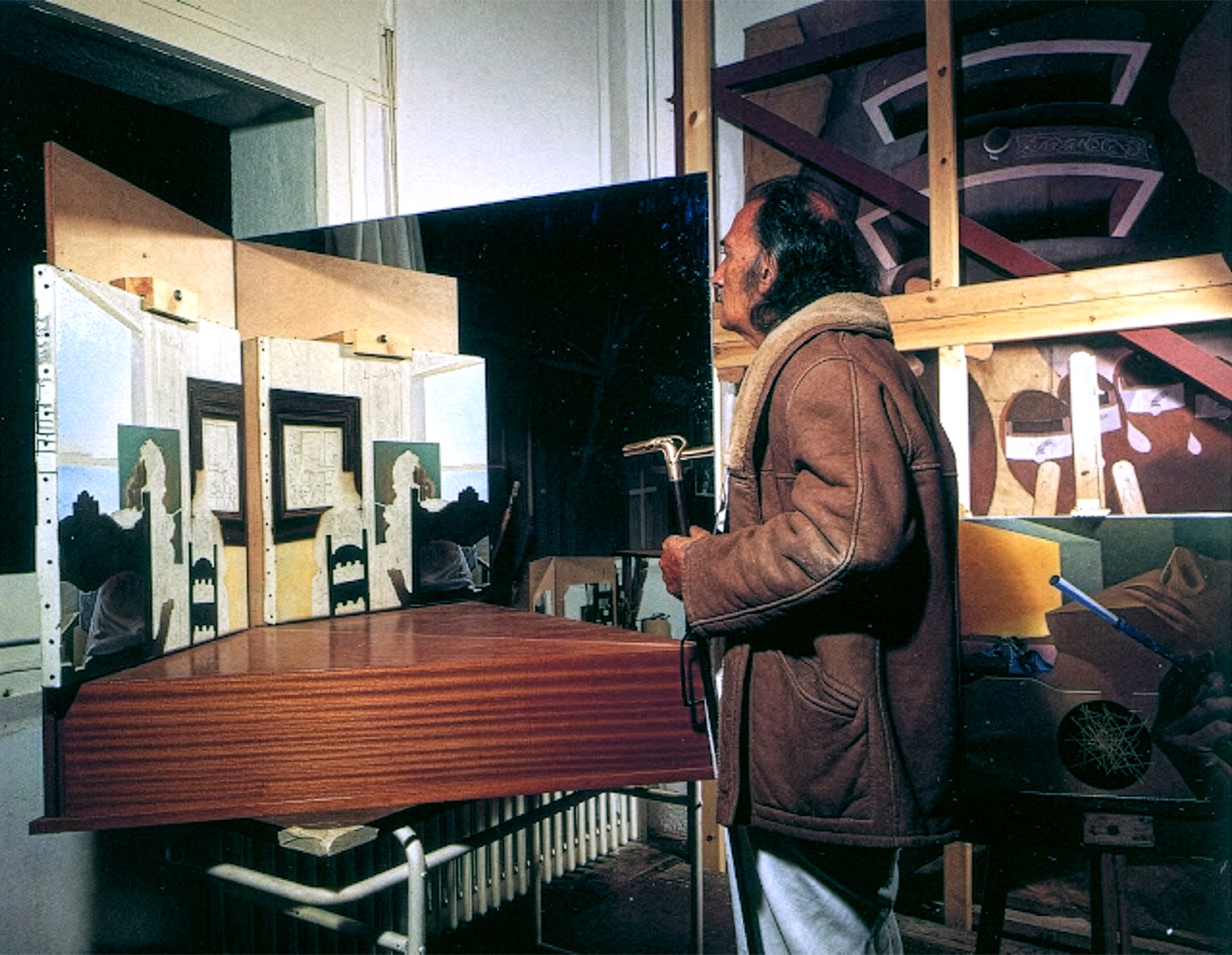
In 1976, Dalí’s secretary, Robert Descharnes, reflected on stereoscopy’s profound impact: “All the painter’s work turned toward the study of the variations of colors, values, and the rendering of the lights and shadows from one canvas to the other, in order to achieve a three-dimensional effect and to offer a new stereoscopic, binocular vision, thanks to the optical superimposing of his two paintings.”36
Dalí was not finished. The artist continued expanding pointedly toward computation, declaring in 1981: “One must paint on the basis of cybernetics. At the height of Surrealism, I had defined painting as ‘color photography, by hand, of superfine images of concrete irrationality.’ At the height of abstract art I continued with the same definition, adding stereoscopy and holography, which gave rise to hyperrealism.”
“Painting will be cybernetic and by hand or it will not be.”10
In August of the same year, he compounded the sentiment with his cybernetic prediction of the future of painting, which began this text.
Thus, one of the most prominent painters of the twentieth century presciently anticipated the enduring role of computers on his form. He also joined today’s ongoing debate on copying, copyright and appropriation in art. With help from Noll and Reichardt, Dalí embraced the challenge cybernetically, through responsiveness, adaptation and feedback.
------
Noah Bolanowski is a researcher and advisor, specializing in early computer art.
------
1In Dialogues on Perception (1994), Julesz recounts visiting Dalí’s studio, likely in the mid-1970s, where he discovered that the artist had incorporated a computer-generated random-dot stereogram of a torus, reproduced in Julesz’s 1965 Scientific American article, into a depiction of Christ crucified upon a DNA double helix. Dalí sought Julesz’s advice on stereo-pointillist painting techniques and requested additional stereograms to modify for his own compositions.
2Leon D. Harmon’s Block Portrait of Abraham Lincoln (c. 1970) was appropriated into the first version (1974–75) and the second version (1976) of Gala Contemplating the Mediterranean Sea which at Twenty Metres Becomes the Portrait of Abraham Lincoln – Homage to Rothko, also referred to as Lincoln in Dalivision. Harmon expressed considerable frustration over Dalí’s unauthorized reproduction, particularly the commercial success of the resulting painting and prints. By 1981, Harmon had publicly declared his intention to pursue legal action, characterizing Dalí’s use of the image as an appropriation of his intellectual property.
3Computer-Generated Pictures opened at the Howard Wise Gallery in New York on 6 April 1965 and ran through 24 April. It was among the earliest public exhibitions of digital computer art in the United States. Nam June Paik attended the exhibition and became highly influenced by A. Michael Noll’s use of the computer, inspiring him to visit and learn FORTRAN at Bell Telephone Laboratories in the following years.
Noll, A. Michael. “The Howard Wise Gallery Show of Computer-Generated Pictures (1965): A 50th-Anniversary Memoir.” Leonardo, vol. 49, no. 3, 2016, pp. 232–39.
https://doi.org/10.1162/LEON_a_01158
4Fundació Gala-Salvador Dalí. Untitled (The Sleeping Smoker. Stereoscopic Work). 1973. Salvador Dalí: Catalogue Raisonné of Paintings, cat. no. P 855, https://catalogues.salvador-dali.org/catalogues/en/heritageobject/1081/
5Fundació Gala-Salvador Dalí. Sense títol (Untitled. Interior of a Church With Appearing Skulls). Fundació Gala-Salvador Dalí, ca. 1950, https://www.salvador-dali.org/en/heritageobject/1058/
6Markoya, Louis. “An Interview with Dalí’s Protégé, Louis Markoya.” NYSA Presents!, season 3, episode 9, NYSA, 3 Apr. 2021. Vimeo.
7Noll, A. Michael. “Computers and the Visual Arts.” Design and Planning 2: Computers in Design and Communication, edited by Martin Krampen and Peter Seitz, Hastings House, 1967, pp. 65–79, http://noll.uscannenberg.org/Art%20Papers/Computers%20Visual%20Arts.pdf
8In a conversation between A. Michael Noll and scholar Anna Pou Van Den Bossche dated August 15, 2026, Pou confirms Reichardt’s Cybernetics, Art and Ideas (1971) is held in Dalí’s library, “I have had it [in] my own hands!”
9Christie’s. “Salvador Dalí (1904–1989), Perspective filaire, œuvre stéréoscopique.” 1974. Christie’s, lot 5037184, https://www.christies.com/en/lot/lot-5037184
10AFP. “Dalí proyecta en París un gigantesco homenaje al filósofo Spinoza.” El País, 14 Jan. 1981.
11Quinta, Alfons. “Dalí: ‘Tengo tantas ideas que me vienen a la cabeza...’” El País, 27 Aug. 1981.
12Bosquet, Alain. Conversations with Dali. Interview conducted in 1965. Translated by Joachim Neugroschel, E. P. Dutton & Co., 1969, pp. 52–54.
13Howard Wise Gallery. “Computer-Generated Pictures by Bela Julesz and Michael Noll (New York, April 6–24, 1965).” 1965. Howard Wise Gallery Records, 1943–1969, Series 3: Exhibition Files, box 6, folder 98, Archives of American Art, Smithsonian Institution, https://www.si.edu/object/archives/components/sova-aaa-howawisg-ref456
14“Salvador Dalí Comments on Dr. Gerald Oster’s ‘Jagged Log Major.’” Photograph. Edmund Scientific Catalog No. 671, Edmund Scientific Co., 1966, p. 140.
15Fundació Gala-Salvador Dalí. Gala Looking at Dalí in a State of Anti-gravitation in His Work of Art ‘Pop-Op-Yes-Yes-Pompier’ in Which One Can Contemplate the Two Anguishing Characters from Millet’s Angelus in the State of Atavic Hibernation Standing out of a Sky Which Can Suddenly Burst into a Gigantic Maltese Cross Right in the Heart of the Perpignan Railway Station Where the Whole Universe Must Converge (Perpignan Railway Station). Salvador Dalí: Catalogue Raisonné of Paintings, ca. 1965, cat. no. P 809, https://catalogues.salvador-dali.org/catalogues/en/heritageobject/549/
16Winship, Frederick M. “‘The Divine Dali’ Discourses on His ‘3-Dimensional’ Art.” The Record, 14 Dec. 1965, p. 14. United Press International.
35Michel, Jacques. “Salvador Dali et son musée.” Le Monde, 3 Oct. 1974.
36Descharnes, Robert. Salvador Dali. Translated by Eleanor R. Morse, Harry N. Abrams, 1976, p. 124.