About us
Stay in touch
Peter Bauman: Welcome here and thank you for joining us. Kevin we've spoken before, but, Jenn, it's such a pleasure to speak to you both together, especially here at GLITCH. We can start by how did you even get into GLITCH? How did you hear about it or how did you end up here this year?
Jennifer McCoy: Yeah, that's a Kevin relationship question, I think.
Kevin McCoy: I've known Primavera for a long time from early blockchain stuff on panels together and interviews and publications, too, probably 2018, something like that. And GLITCH started, I think, in 2021. She let me know most years that it was happening and asked us to come. It just never quite worked out till this year. So it was just the stars aligned.
Peter Bauman: Nice.
Jennifer McCoy: Yeah, we figured it was an interesting year to come with all the sea changes in technology over the past 18 months that this would be a great time to check in with other people who are reading the same news and thinking about similar tools and strategies.
Peter Bauman: Yeah, last year was my first year, and I felt like it was a really transformative experience for myself. I was really happy to get to come back this year. And maybe we can also talk about was there anything in particular that you were working on that you wanted to workshop here? Or what are you working on now? And then maybe how has GLITCH in any way impacted that work?
Jennifer McCoy: We have some projects going in the studio, a new iteration of plotter and painter and machine drawing technologies. And it's been always, well, what are they? Are they coming from photographs? Is it live portraiture? Is it site-specific? But as AI has been coming online, Kevin's been sampling art history and really thinking about how to evaluate an image through our historical texts and thinking about literature and how literature describes images. So that feels like a very new part of the studio practice.

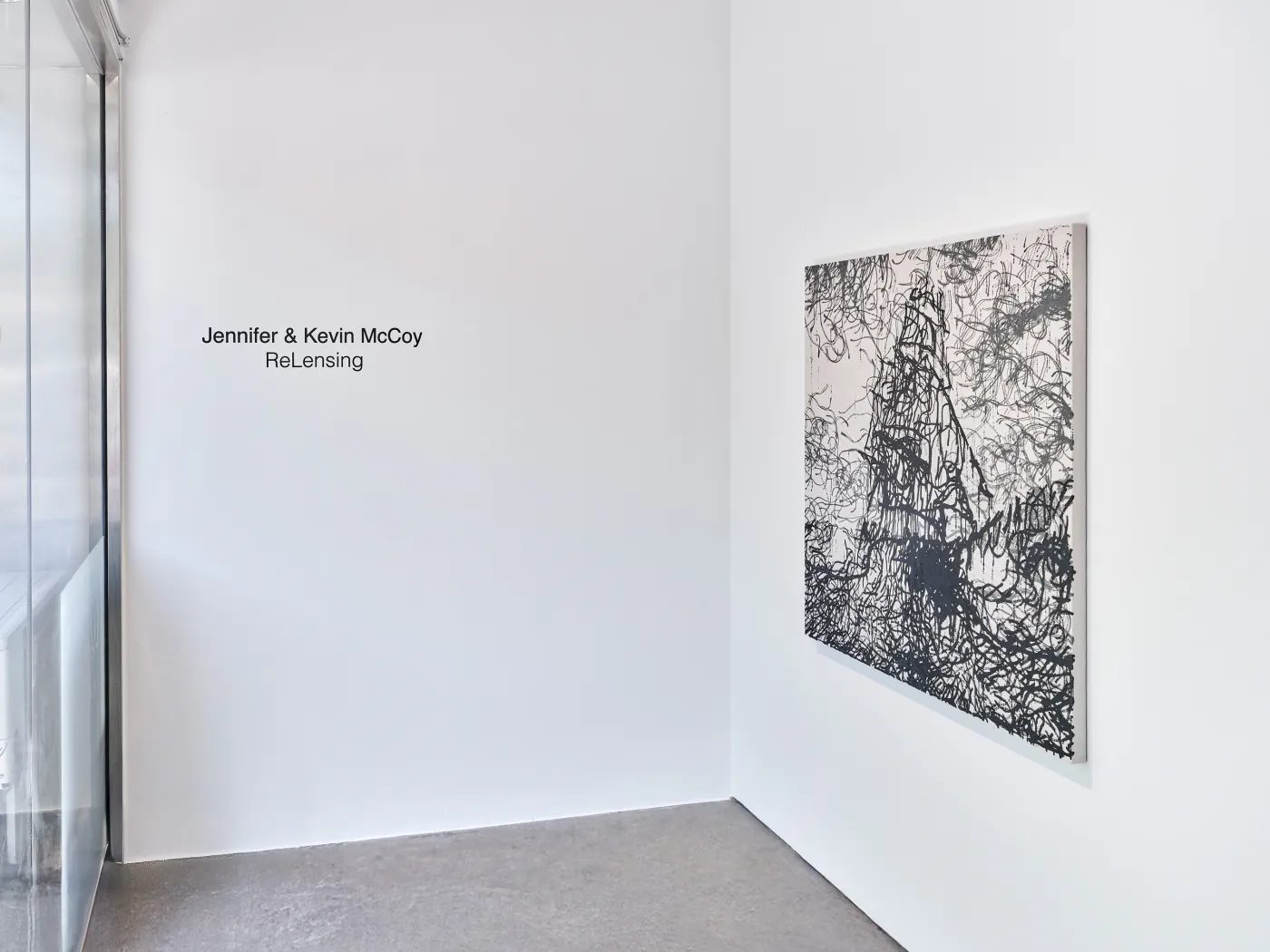
Kevin McCoy: It draws from our background, even our art background. This idea that we've been slowly unfolding in the studio, not so much in public, but just with tools and things, that was about trying to bridge this gap between prose and code, and between historical critical language and actual machine. And that's just felt like that's just become possible in a new way in the last 12, 18 months with the generation of AI models. So we were excited to come here and present those ideas in this sort of public, but it's sort of semi-public, you know, it's certainly a, really the perfect audience to bring these things to.

Peter Bauman: Yeah, it's a good testing ground for different things. And so that's a pretty big leap from you in the past 18 months, like how you've engaged with these more agentic reasoning models? Were you using them Chat and stuff that much before?
Kevin McCoy: I've been following along with the developments for a long time. I mean, since the GAN era and even before that, with word2vec and things like that. But we were never really, they were just kind of like interesting things to look at, to be aware of, and kind of check out, you know. But it never was a super central part of our project, of our work. But although we did do...
Jennifer McCoy: When people are coming online with this, they're seeing, oh, AI can make a whole project. And I don't think that will ever be where we go with it, maybe. But it seems to me, it's bad at ideating, it's good for diversifying from those ideas. It's bad at creating art, but it's good for creating databases of things that you might need. So it's sort of a weaving in and out of that space that I think will be moving forward. And certainly, as people who have just sort of rolled our own code for, you know, huge kinetic sculptures and all those things, now I feel it's really great to have an in-house expert to just make some clean code that works and move along because we're not going to hire MIT labs or a research scientist to collaborate with.
“But it seems to me, it's bad at ideating, it's good for diversifying from those ideas. It's bad at creating art, but it's good for creating databases of things that you might need.” — Jennifer McCoy 4:39
Kevin McCoy: If people went to our website and looked at our body of work. It's really diverse. There's all kinds of different things. We say that it's project-based, which is true, but how something emerges as a project is sort of undefined. The reality of it is there's just all these continuous research, investigation, inspection, looking, all these sort of different things. And so you're always trying little things out. And so experiments, there's a million things that are in this kind of little experiment stage, little fragment stage, and sometimes they aggregate bigger and bigger into each other, cross some invisible threshold to become project that we're doing.

Jennifer McCoy: How we've worked for a long time is you develop a weird tool in the studio that you just enjoy: look at it, can do this, and what could this mean? And then there's a moment in which you're like, well, are we making a tool or are we making art? And then when you can find the conceptual strategy that makes something about that process clearer or interactive with the audience, that's kind of when you're like, oh, this is something that will be a project. So it's an interesting dialogue between what the possibilities are, which are endless, to what actually do you want to make?
“Are we making a tool or are we making art?” — Jennifer McCoy 6:24
Kevin McCoy: And one other thing that felt appropriate for GLITCH is with this kind of new era of agentic models and code “being solved” by AI, which it certainly seems to be, certainly for the level that we are dealing with. I wanted to explore tools and tool making in a more intentional way, and so started releasing things on GitHub that really represented snapshots, ideas, and things like that. And so we had a good four, five projects that were kind of living on GitHub and circulating in that context, being kind of announced and discussed on X. But it's been great to bring that body of work and that way of thinking to this environment because some of the people here can kind of clip right into it.
Peter Bauman: Yeah, coming to GLITCH, it really hits home the human element of all this technology because it's such a personal experience here and you're engaging with all these different people. And then when you hear something about like, oh, you know, machines are taking over creativity from people, and you just know that that isn't true. I mean, there's always somebody behind these machines. That's what's also so rewarding about getting to come to a place like this, is you get to interact with those people and in real life.
The interactions here are very human-centered, even though the ideas are centered around technology and how they can complement our own skills in general. But I think this really brings home the centrality of, like, the humanness of this technology, these IRL events. Did you have anything coming up or did you want to say anything about any work that's time-sensitive? I think this will come out at middle of November.
Jennifer McCoy: By then, the artport show is a big one that a lot of our friends and fellow travelers are going to be associated with, so we're really excited about that. And we have a very, it's one of our more esoteric projects, so it was great to really explain that here, from 2018, where we were trying to use blockchain to create an idea about shared ownership of artwork for an institution.

Jennifer McCoy: And then here we've proposed this idea of what would be an AI road movie, and we've reeled in some fellow travelers to hopefully figure that out. These were not fully cooked things so it's just great to talk about them with people. And it's very interesting how there's sort of a crossfade from blockchain to AI that's happening with the GLITCH set, so people are in different places on that continuum. And for me, it was really great to think about those two very new structures that have possibilities for creativity but aren't for creativity necessarily, and how those can be reappropriated and recombined just through what you're saying: the very personal projects and personal interests.
Kevin McCoy: I'd say the overarching themes that are here right now seem to be looking at the latent space of AI models and trying to explore them or use them, be it as a mode of kind of inspiration or its own kind of dark forest or what have you. That's one big thing that I've seen. Then the other is this idea of judgment, machine judgment, automating judgment, and that kind of goes into curation, human curators, machine curators. And these two big pillars of the full multi-dimensional space of the model, and then this role of judgment, which is a kind of navigator within that. Those sync up with things that we're thinking about actively in terms of code projects and ultimately video software projects.
“I'd say the overarching themes that are here right now seem to be looking at the latent space of AI models and trying to explore them or use them, be it as a mode of kind of inspiration or its own kind of dark forest or what have you.” — Kevin McCoy 10:16
Peter Bauman: Yeah, amazing. Thank you so much. And yeah, definitely look forward to the Whitney show. And congratulations on that. I'm very excited that will be opening right around the time that this comes out.
Jennifer McCoy: Yeah, opening November 21st.

Peter Bauman: Yeah, thank you both so much.
Jennifer McCoy: Thank you.