Suggested Reading
Interview
Evergreen
AA Cavia on Summoning Worlds
Peter Bauman
•
March 16, 2026
View



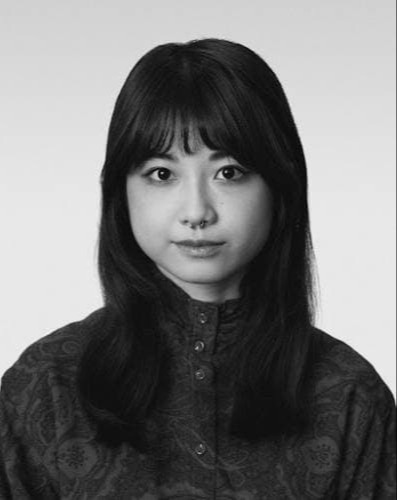
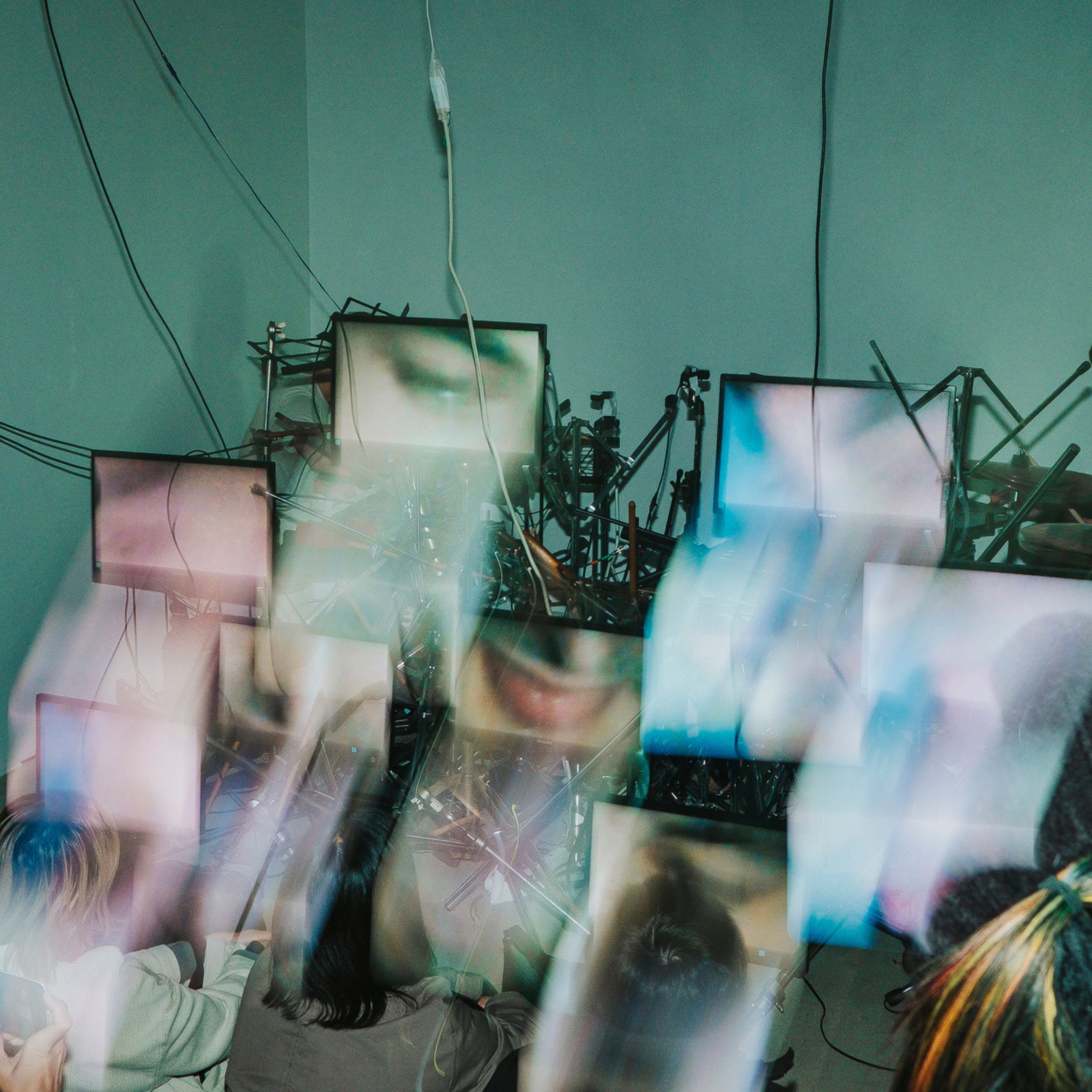
Wendi Yan and Karyn Nakamura are artists, technologists—and friends. In the following conversation, a glimpse into their everyday “joint psychoanalysis,” Yan and Nakamura discuss the origins of their practices, which circle the same questions from different angles. They cover the inseparability of image- and knowledge-making, knowledge as an artificial construction, and the tools that make them feel like gods.
Wendi Yan: I recently started reading Image and Logic and I felt, “Oh, I think Peter Galison is the clue. This is what brought us together.”
Karyn Nakamura: This is what's going to explain to us why we're friends.
Wendi Yan: That book unraveled so much for me about the relation between image-making and knowledge-making. They implicate each other. Our society privileges words in communicating and representing information but images—whether still, moving or interactive—convey information at several depths at the same time. In James Elkins’ words: “how to capture, in images, the maximum amount of useful information about objects that cannot be naturalistically represented at all.”
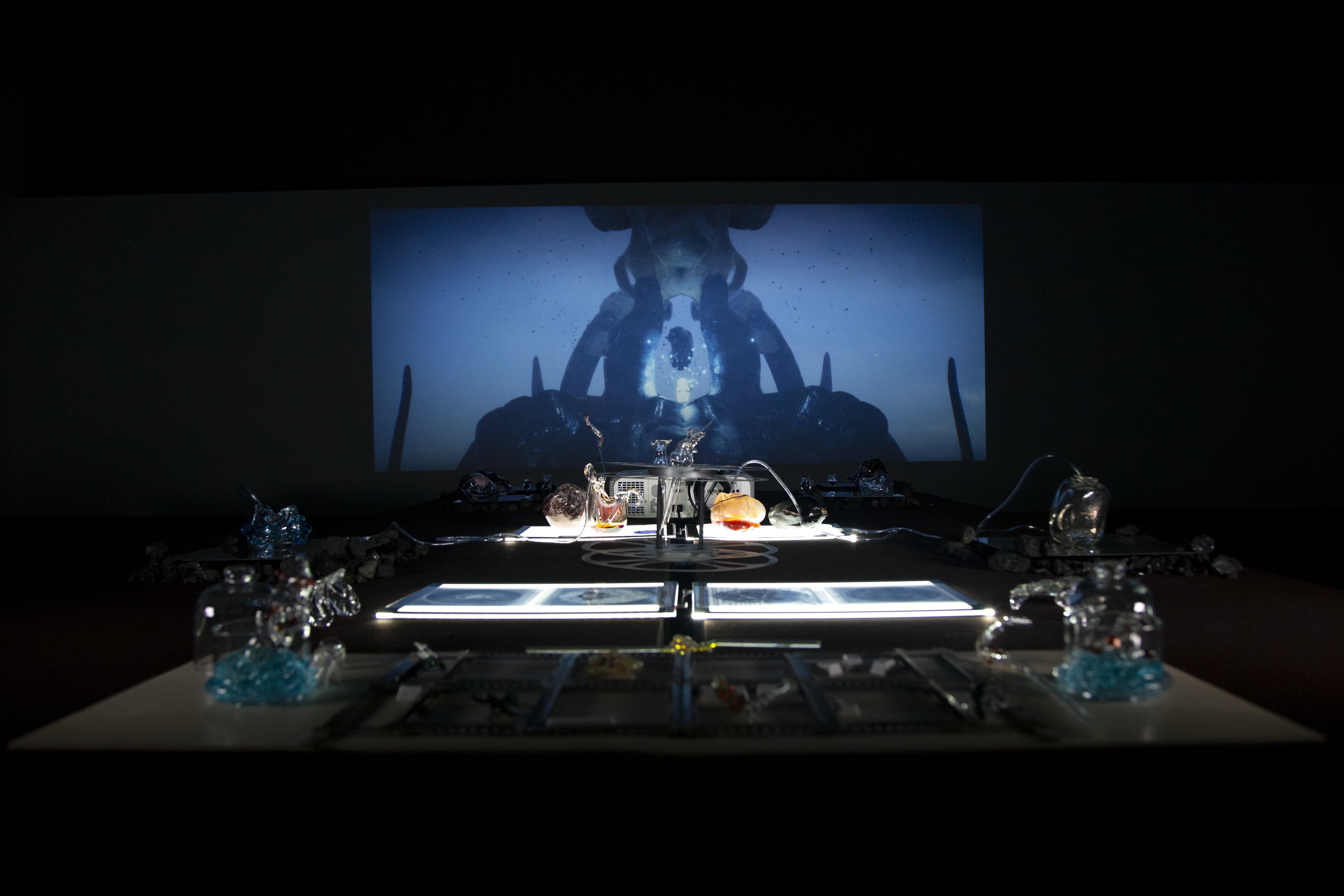
Wendi Yan: I remember the first work I saw of yours was your Frankensteinian installation-performance online, and—not knowing you personally at the time—I felt a sense of affinity already. I was thinking about fictitious knowledge in my own thesis show.
I wanted my show to feel like going into a science museum, except nothing scientific was there at all.
I was playing with how I could present a convincing facade of "there is very serious knowledge-making happening in this gallery.” And it was so satisfying for me to overhear people walking into the gallery space and saying to themselves, "Oh, this is a science show.”
Karyn Nakamura: I'm curious how you came to that because, for me, this is all a pretty direct result of having a bad relationship with academia throughout its different stages. I went through fifteen years of all-girls Catholic school with a flat-earther physics teacher, followed by curmudgeon professors at MIT who insisted there was only one right way to do things.
How I ended up making my own things was mostly because I was 18 and rebellious and could not stand the rigidity of knowledge that was being forced onto me and would do literally everything to prove them wrong.
But you had a better relationship with academia, right?
Wendi Yan: I did. History training grounded me in how I asked my questions. But the unfortunate truth about a historian is you never represent the real thing in your writing. You strive for the truth but the nonfiction you put together, in the end, is still a series of facts handpicked and strung together to form a narrative.
Somewhere in this research process, the artist part of me comes out and says, "Why don’t I straight up make up something fun that pretends to be real?" In that pretense, constructing the facade of legitimacy breaks the whole seriousness of knowledge and science.
Once I read the book Objectivity in college, which tells the semantic history of “objectivity” through the evolution of scientific images and image-making tools, I could never go back. Our use of “objectivity” and “subjectivity” literally swapped a few centuries ago. So when I saw your thesis show online, I felt you were intuitively interfering with the seriousness of how we see images in science.
Karyn Nakamura: I really never set out to become an artist and I think why I ended up making my own things was that there was always something a bit unconventional that I wanted to try that wasn’t necessarily going to be relevant in academic research. It wasn't useful enough to be legible in industry. But it was still a valid question or something that nobody’s really tried yet and the only space to share an experiment like that was in this blank space of art.
Karyn Nakamura: One of the things that frustrates me about working with technology and science in public spaces is the tendency to put science on a pedestal. People are often satisfied with appreciating technology for its mysteriousness and what they don’t fully understand. There’s a complacency with the paths that innovation ended up taking. I’m sure that also happens with history, like treating the dominant narrative as the only narrative.
Wendi Yan: In Graham Burnett's class in my senior year at Princeton, Graham asked us why we study history. Many people said they wanted to have a better understanding of what could happen in the future. But I felt studying history only made me see things with a looser grasp on concepts.
It freed me because I could see how every idea had its own formation process over an arc in history. Something about that deepens my experience as a human.
Karyn Nakamura: I feel like that's exactly what motivates me to continue expanding the range of technologies that I’m familiar with.
Knowing about all the decisions that progress and innovation are built on frees me; it makes me realize that things don’t have to be like this.
There are, like, a million paths that weren’t taken and a million other ways to make a piece of technology. It's not at all simply an optimization problem like they make it seem.
Wendi Yan: I wrote a “Mammoth Technology manifesto” for a virtual gathering I organized two years ago for X Museum. I looked back on the mammoth show and thought, "Okay, why?" Why did I want to make a show of fake science and call it a technology museum? There’s something that feels very generative about deliberately being, "This is not science.” It's kind of like playing with the boundaries of what counts as knowledge, what counts as information.
People who have really deep-seated conspiracy beliefs don't call them conspiracies. They call it science. If you're really serious about your beliefs, you don't say you have a conspiracy. Using “conspiracy” means you’re entertaining the fact that you might not be right.
Our research makes us see a lot of possibilities. Your investigation into technologies, mine into history.
Karyn Nakamura: I remember you shared a quote about this from a Berliner interview with Cabinet’s editors Sina Najafi and Hunter Dukes. It was about how learning new things is a way to unravel them:
"Curiosity as a political tool, curiosity as something that disregards all the lines that police the world and that makes it come into being the way it is. Curiosity would be the thing that, if Unbound, would completely disregard those lines and make you understand that the world was made to come into being this way so it can also be unmade."
Wendi Yan: The way we learn things is we realize that there are a lot of alternatives that become possibilities for artmaking.
Karyn Nakamura: I don't know why I'm thinking about fans right now.
Wendi Yan: What do you mean?
Karyn Nakamura: Well, your computer's really loud so I'm thinking about your computer fans. There's a really specific goal that this fan has to serve, which is to cool your big processing needs but also be as compact as possible. That's why it's designed like this but there are many other ways of using something like a fan and it could look so different if it didn’t have to serve this specific purpose.
I think growing up in a creatively starved environment really trained me in imagining how to play with things. Now I have these crazy fantasies about something as mundane as a laptop fan.
Wendi Yan: I had a call with [artist and director] Andy Thomas Huang recently. He intuited that I was interested in an “origami of knowledge," which I think is also what's happening here: we play with the physical architecture of information. In that process, we show the arbitrary, absurd and elusive qualities of the artifice of knowledge.
When I read history and come across certain ideas that people don't remember anymore, or they misunderstood, I find these ideas adorable. I’m just like, "Let me resurrect you,” and turn you into a character that moves. When we see something that moves with legs, arms and heads, they become emoting subjects. One of my intentions for 2026 is exploring characters more.
Karyn Nakamura: I actually feel the same when I take something apart. I’ll find something that I’d say is similarly a little forgotten or not really relevant, something that makes me go, "Oh, it's so cute that they, like, thought about this thing and made something so specific for it.” That compels me to just have to make work with it because that finding is such an adorable artifact that I need more people to see.
Wendi Yan: I grew up with this superficial understanding that knowledge is a very hardened thing, like building blocks. Every generation of humans builds on top of each brick. It's always very steady, basically linear and you never relapse or go back and swap the bricks. But I increasingly realized every aspect of that assumption was false, which is the fun of reading about the history of science.
A lot of the major leaps of human knowledge came from dreams, accidents or even hallucinations.
.jpg)
Karyn Nakamura: Even the experiments are super fragile.
Wendi Yan: The history of science is almost like a history of errors. You were never going to be completely right. Scientific findings are super, super short. Most of the time they will become wrong within a few decades.
Karyn Nakamura: Ok, this joint psychoanalysis is working; this makes a lot of sense now. When I was at MIT, I would be walking down the hallway and some lab would have a super expensive crazy gadget they were building. Then their cooling equipment was literally a box fan. And just seeing the fragility of these labs at the frontiers of knowledge was maybe what led me to a more intuition-based, hands-on practice.
For you it’s reading history. For me it's tinkering; they're just two different sticks to tap things with. Then we rely on the power of images to represent these adventures and share these narratives with other kinds of communities and environments.
Wendi Yan: At the Steve Jobs Archive Fellowship retreat last fall, you integrated, as part of your talk, how an image, in its physical form, reaches an audience. There was a whole invisible architecture in the auditorium, a shield you broke by doing your weird things.
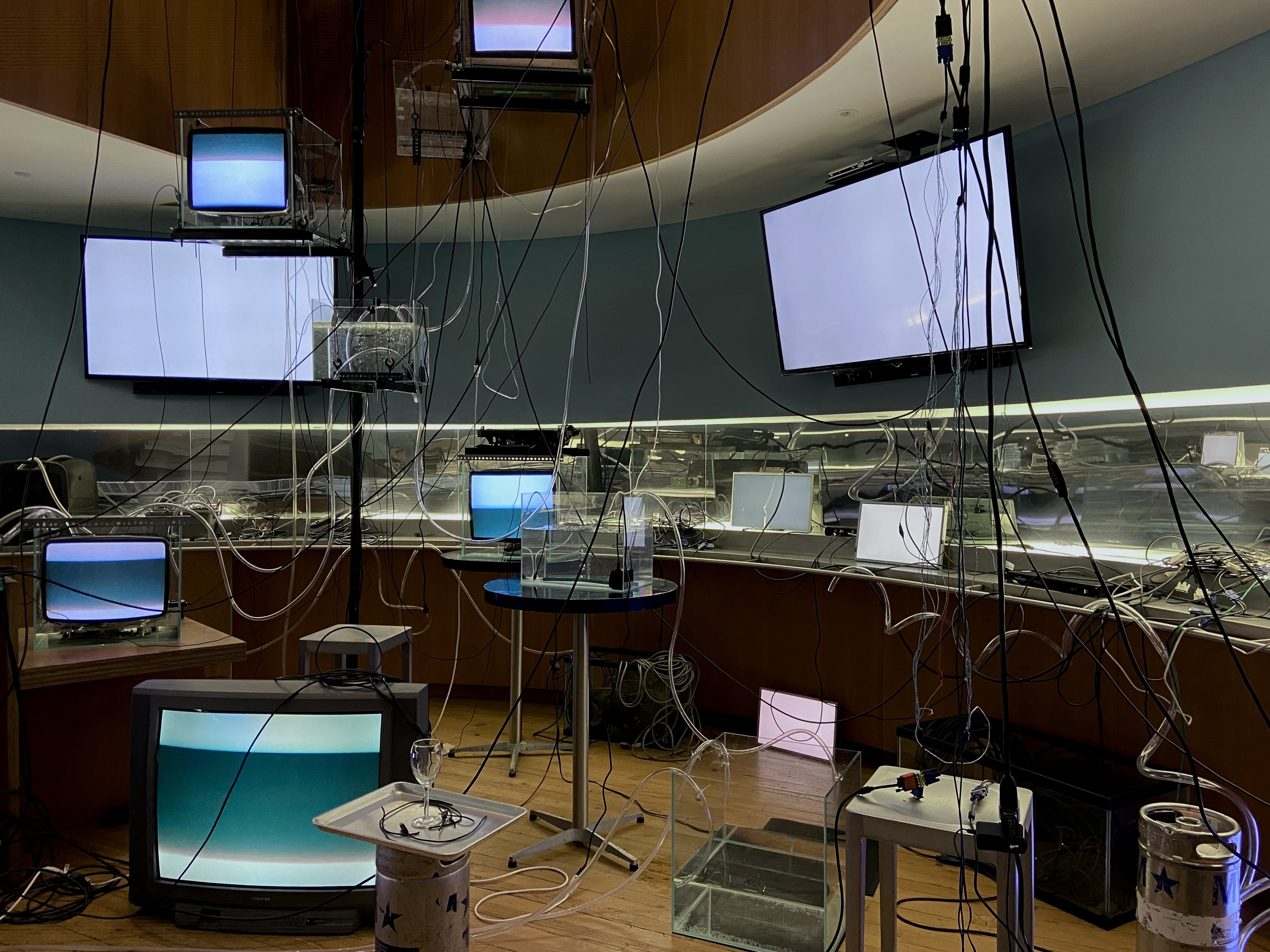
Karyn Nakamura: By bringing in my Frankenstein table—with a little bit of resistance from the AV people.
This is the medium I use. The prevalence and commonness of AV equipment makes it kind of disappear to most people but it’s simply really fun for me to pick apart all the decisions that go into even the type of signal that you're using to show your image on the projector.
At the end of the day you're not going to be able to see if a signal on the screen is HDMI or SDI or my favorite, VGA. Many of these decisions never end up in tangible differences but they're all pieces and artifacts of knowledge and innovation. That part's always really interesting to me.
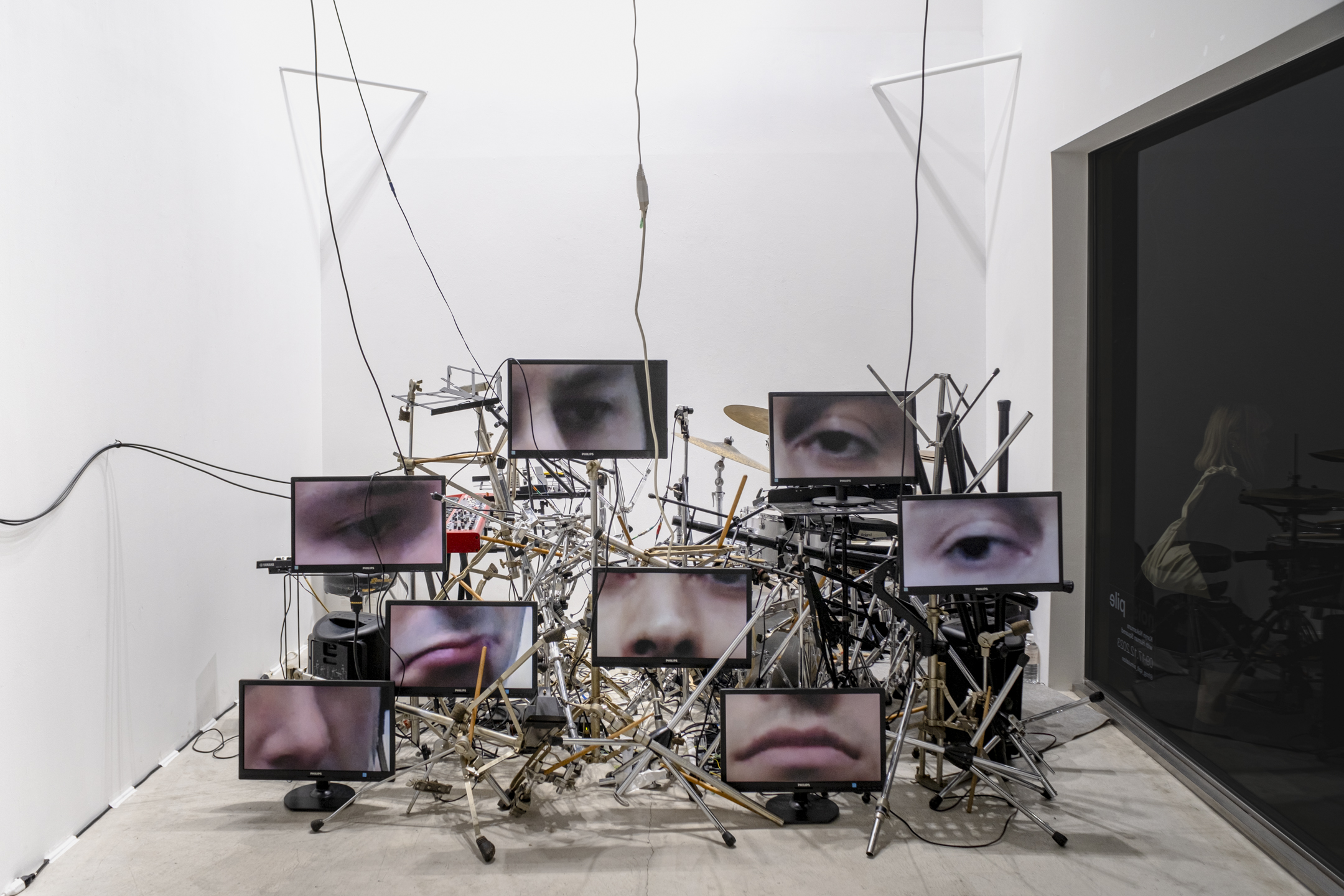
Wendi Yan: You must get this a lot: people looking at your work, seeing CRTs and saying, "Oh, do you know Nam June Paik?" Except you actually worked on restoring his work?
Karyn Nakamura: Yeah, at MIT I worked with a lot of CRTs that I would pick up from the dumpsters. I would take them apart. So when I first got to New York, I ended up working for this TV repair shop in Soho that always worked closely with Paik.
Every now and then these pieces stop working because they're old and composed of CRTs that are no longer produced. They would have me come in and take them apart mostly to replace them with LCDs.
I love old video hardware. I love feeling how stiff the buttons are, how the knobs let you set the channel, how neatly the circuit boards bend around the tube in Panasonic CRTs.
There’s an assumption that technology has only progressed but there’s so much to learn from the ways that old gear makes you interact with it. The work was special but always very heartbreaking because the physicality of the CRTs is so much of the work. Replacing them with LCDs definitely takes away from that. There just isn’t really an ecosystem to sustain this kind of obscure repair work. But fragility is part of technology.
Wendi Yan: Art is very material. And “art and technology” has a history now. It's not just about envisioning the future but also about “resurrecting the dead.” In order to visit a work again, there are a few people with very specific technical knowledge that the art institutions rely upon for the resurrection.
Karyn Nakamura: I think where I sit between art and technology is in the infrastructure of mediation. A lot of my work is providing specific technical knowledge for other people, whether it's helping to restore early media art or building calibration systems for projection mapping or tooling for analyzing video evidence. My own work is just using that specific technical knowledge in slightly crazier ways, but they’re all similar problems and similar experiments. I personally don’t care about whether some are more art or some are more backend engineering work. But I really fight against casting away experiments as aesthetic just because they don’t immediately serve utility.
Why do we have to separate the two worlds of things that are useful and productive and things that are not, when really they’re all just different ways of working with knowledge?
I think it's important to be contending with your questions and your tools across different environments. I try to stay moving, carving out different side quests to experiment with the same tools, thinking about the same questions in artistic, commercial and academic contexts. I’m slightly addicted to being an imposter.
Wendi Yan: When I started learning animation software and game engines, I had a very simple desire to imagine crazy worlds in my own way. But two years ago, I started seeing other fascinating dimensions of the software itself: the power it has historically wielded in spectacle creation.
My collaborator Darren Zhu, a synthetic biologist and creative technologist, sent me a paper a couple of years ago by Stanford researcher Muyuan Chen about rendering full protein structures inside Unreal Engine. That was a major moment in my intellectual life. I realized that scientists could now use game engines to process their data in qualitatively, even ontologically, different ways.
Somebody could make a whole game that runs on the accurate, full-resolution representation of a protein structure inside a game engine. That’s also related to Image and Logic, which talks about the introduction of Monte Carlo simulation in the history of microphysics and how computers became an integral part of science-making.
Simulation methods and software have influenced how scientific images are rendered and a lot of that will converge with the entertainment technologies in the future.
I think world building will be a part of scientific methods of the future.
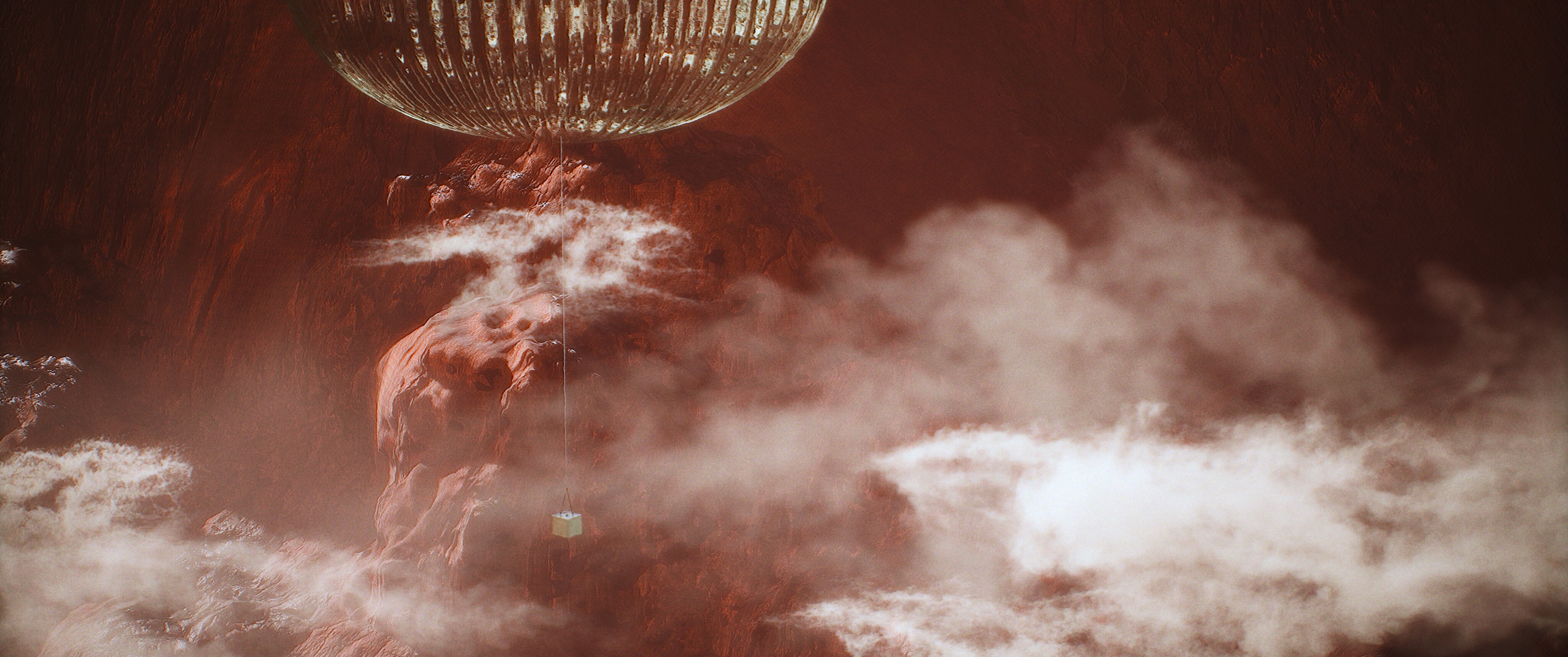
Wendi Yan: Unreal Engine almost feels like the closest you can be to a god. As if I am making my world. I'm sculpting my mud humans and literally drawing them landscapes. It's not procedural.
Karyn Nakamura: I am kind of obsessed with Houdini. I love how masochistic it is. I love hitting tab and opening up the menu and seeing the five hundred nodes laid out, imagining all the possible ways you could solve your problems to make an image in your mind more tangible.
Although TouchDesigner is where I feel closest to God because I can make software that controls things in the real world in real time. And I can connect everything and make them talk to each other.
When you work in VFX software, you know how many little decisions you have to make to be able to produce all the details that come out in a single scene. What’s frustrating about so many AI interfaces is how little appreciation they have for that detail. As a user, you don’t get to access all the levers afforded to you by traditional VFX software; you just get handed whatever internet average of the idea in your mind that you can conjure within the limits of language.
It skips over so much of the creation process that’s delightfully crafty and creative in its own way. This applies to the creation process of anything. Even when I’m making projection calibration software for a big corporate office, there are all these little crafty decisions I’m baking in.
Wendi Yan: I learned Unreal Engine by slowly discovering it through every project. You can’t really just systematically learn it.
Wendi Yan: That leads us to POND, our research-sharing tool that maps connections between ideas visually. We've been building it together and you made the first prototype in April 2025.
Karyn Nakamura: POND initially was motivated by being tired of sitting in the backseat. I was worried and upset about the current climate of increasingly offloading agency to technology, both consensually and not.
It was a step forward for me to try to imagine and manifest a technology that would empower cognitive agency.
When we started working on this, we talked in depth about the Graham Burnett New Yorker article, “Will the Humanities Survive Artificial Intelligence?”
Wendi Yan: We discussed how the thinking process will become the quintessential part of verifying authenticity to a created work.
Karyn Nakamura: It’s incredibly fascinating that people have different thought processes. You can start at the same place and end at the same place, but the path in between can be completely different.
Wendi Yan: The prototype had a trail feature, a thread of thinking that the user highlights and shares with others. It feels very intimate because it reveals the connections your brain makes. It’s a trail of attention. You’re inviting others to walk down a path your attention walked before.
Something about spatially laying out information encourages new categories of ideas to grow. That was my initial intuition. I realized only recently that Unreal Engine has been my knowledge tool: I arrange information in a 3D space and I metabolize research through making fictions.
Karyn Nakamura: I think it comes naturally for us because we spend so much time working fluidly with knowledge and trying to package that in a more shareable form through visualizing it in images and video and physical spaces.
But I was interested in diving more into POND because those things take a really long time and that’s valuable in its own way but there are so many things that we dive into every day. Our conversations always make me think about how fun it would be if there was a more casual way to share little bits of research and little bits of knowledge.
Wendi Yan: Totally. I read a dozen academic books and looked through hundreds of historical images in order to write and make the ten-minute film in CG. Almost every shot included references to historical ideas, thinkers or scientific instruments I read about. The only way I’ve been able to share this with people is a massive PDF I put together on a delirious morning after an all-nighter before the big deadline.
Karyn Nakamura: We love animating ideas from research in our own ways and physics provides some intuitive constraints.
Wendi Yan: We essentially construct narratives out of our personal paths of research and we ended up calling this wayfinding “object-oriented knowledge.”
Karyn Nakamura: At the end of the day, we also just really wanted a fun bibliography. I think it’s our way to stay grounded, to keep ourselves connected to the vast lineage of our thoughts and ideas, especially the old artifacts we love and adore.
------
Karyn Nakamura is an artist and engineer originally from Tokyo and now based in New York. She is obsessed with the technical infrastructure of systems that shape communication and perception. She began her career dumpster diving at MIT and works for academic labs and research studios in parallel to her artistic practice.
Wendi Yan is an artist, writer and technologist. She uses CGI software to simulate alternative scientific progress through videos and games. Yan also writes about the history and future of scientific discovery. Yan was an inaugural Steve Jobs Archive Fellow and the Grand Prix recipient of the 6th VH Award by Hyundai Motor Group.
Edited by Peter Bauman (Monk Antony), Le Random's editor in chief.