Suggested Reading
Interview
Event
Micky Malka & Becky Kleiner on the Birth of NODE
Peter Bauman
•
June 22, 2026
View


The Carl & Marilynn Thoma Foundation’s Carl Thoma (President) and Kathleen Forde (Director and Curator, Media Arts) joined Peter Bauman on the occasion of Interference: The Interactive Art of Daniel Rozin at The Museum of Art + Light (MoA+L).
They cover the origin and evolution of Carl Thoma's collecting instincts as well as Thoma Foundation's collecting thesis and loan philosophy for Digital & Media Art. They close by discussing the art-historical framing of Rozin's Interference.
The Carl & Marilynn Thoma Art Foundation stewards a 1,700+ work collection spanning Art of the Spanish Americas, Digital & Media Art, Japanese Bamboo and Post-war Painting & Sculpture. It supports the field through loans, research, exhibitions, conservation and over $26 million in grants since its founding in 2014.
Peter Bauman: Carl, can you talk about the beginnings of your art collecting? How did you come to love art and art collecting in 1975? What got you interested in the Taos Society of Artists and the California Impressionists?
Carl Thoma: My interest in collecting is rooted in curiosity. Early on, I was drawn to works that captured a strong sense of place and atmosphere. The Taos Society artists and California Impressionists reflected a vision of landscape that resonated with me personally, being from rural Oklahoma. Over time, that grew into a broader interest.
Peter Bauman: Is there an intentional connection between your post-war abstract and geometric collection and your later digital and new media? For example, Vasarely, Cruz-Diez and Le Parc to Daniel Rozin?
Carl Thoma: I’m drawn to artists like Victor Vasarely, Carlos Cruz Diez and Julio Le Parc because of their focus on optical experience. These post-war artworks naturally connect to my interest in digital and media art practices.
Technology and materials have changed, but many of the themes around perception and participation have remained consistent.
Peter Bauman: In 2009, the collection’s focus on Digital & Media Art sharpened. Carl, were there any artists or pieces that drew you in?
Carl Thoma: Leo Villareal’s Big Bang was one of the first pieces that drew me into media art. I was interested in how he used elements and operations like pixels, binary code, addition, and subtraction to develop complex, custom generative software with chance and variation as core components.
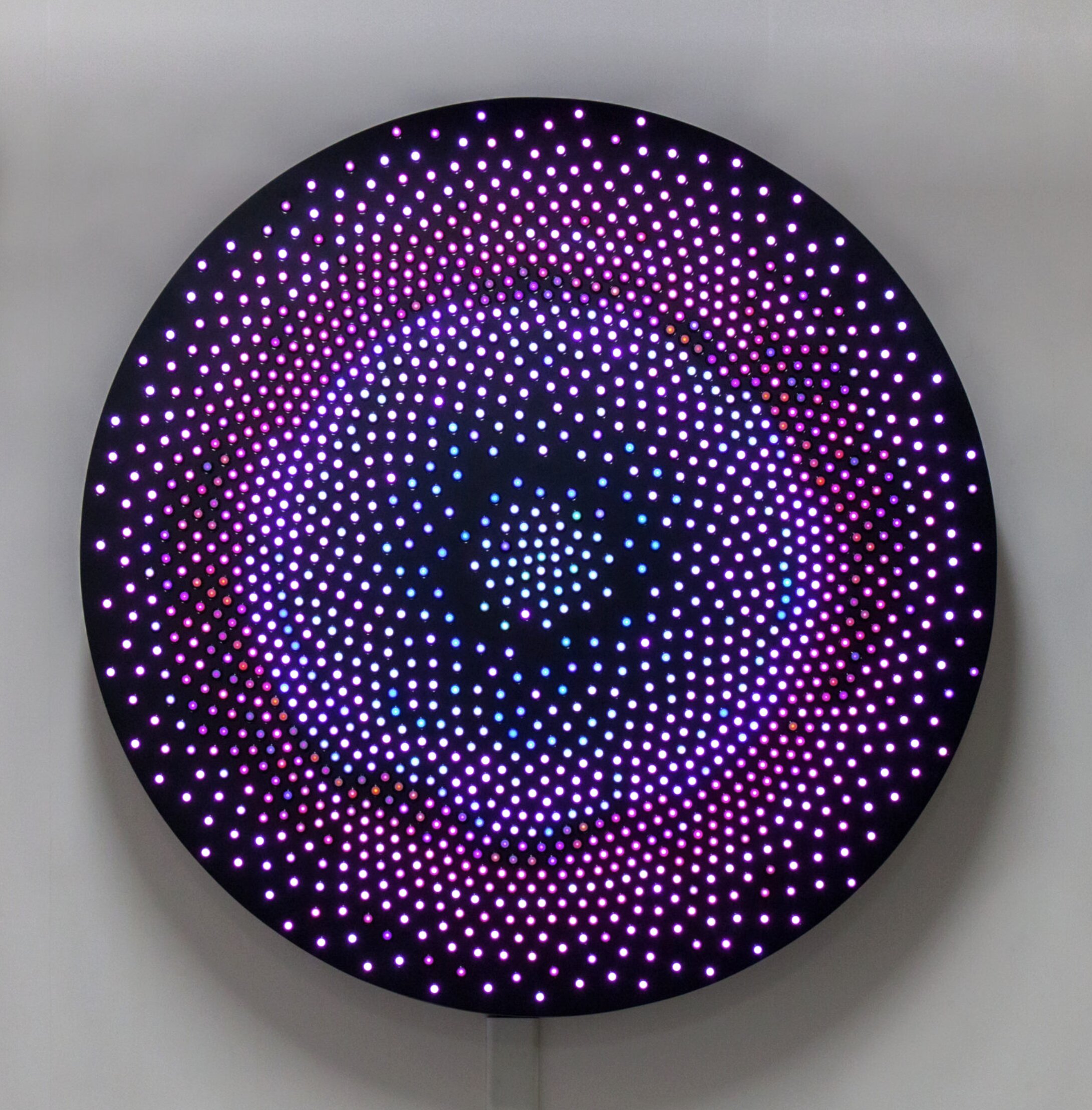
Big Bang made me want to learn more about the history of digital and media art.
Peter Bauman: Kathleen, what is your collecting thesis for Digital & Media Art work?
Kathleen Forde: One thing that is unique about the media arts collection is that it is defined by a comprehensive cross-section of generations of artists from early pioneers of the 1950s to the emerging talents of today.
There’s also a strong emphasis on works that challenge the ways images are reconstructed and experienced, whether through kinetic art, video, software, interactivity or sculpture.
The works in the collection transcend the bells and whistles of innovation. They encourage us to think about some of the most important issues of our time and of the human condition.
Peter Bauman: There is also a strong emphasis on materiality. Even screen-based works like Pfeiffer’s tend to have a significant hardware presence.
Kathleen Forde: That’s very true. There is an intentional consideration that time-based media artworks exist physically too and involve embodied experiences.
Many of the artists in the Thoma Foundation’s Media Art collection are deeply attentive to how technology occupies the real world through light, sound, architecture, hardware and viewer interaction.
%20Recto%201%20Galerie%20Perrotin%20Claire%20Dorn%20(Hi%20Res)%20(2018.10.22)%20(1).jpg)
Peter Bauman: Carl, five years after beginning your digital and media art collection, you founded the Carl & Marilynn Thoma Foundation in 2014. What motivated the transition from private collection to public foundation? What gaps did you see in the existing art world infrastructure that you positioned the Foundation to address?
Carl Thoma: Marilynn and I saw an opportunity to support areas of scholarship and artistic practice that were historically under-supported. The foundation was created to actively support research, exhibitions, conservation and public access.
Our collection now includes over 1,700 works of art in four broad fields: Art of the Spanish Americas, Digital & Media Art, Japanese Bamboo and Post-war Painting & Sculpture. We’ve made over a hundred grants to nonprofit organizations totaling more than $26 million and awarded funding to over twenty individuals for scholarly research.
Peter Bauman: As mentioned, the Digital & Media Art collection has a strong through-line across periods and media. How do you describe the unifying sensibility? What does a work need to have for it to feel right to you?
Kathleen Forde: The unifying thread is artists who challenge conventional ways of seeing. Across different generations and technologies, the artists in the collection explore perception, systems, participation and the instability of images.
There’s also important art historical continuity within the collection. Many contemporary media artists are extending conversations that began with Op Art, Kinetic Art, conceptual systems-based practices and early video art.
Carl Thoma: Ultimately, the work feels right to me when it stays with you or reveals something new each time you encounter it.
Peter Bauman: The Foundation has contributed to major media exhibitions through its loan program for over a decade. Have you noticed any patterns in what resonates with audiences?
Kathleen Forde: Time-based art often creates a very immediate point of entry for viewers while still supporting a deeper conceptual, philosophical and personal engagement. That balance is part of what makes the field so compelling.
Peter Bauman: Carl, your background in software investment might seem like an obvious path to collecting digital art. But with all the tech capital in the United States, you’re an outlier in the depth of your commitment to this field. Why do you think more tech leaders haven’t followed a similar path?
Carl Thoma: Technology and art operate very differently. The tech world often prioritizes speed and utility, while art asks for sustained attention and reflection.
Collecting digital and new media art also requires long-term commitment. It involves complex conservation, infrastructure and ongoing collaboration with artists and institutions.
I think that level of engagement can feel unfamiliar compared to more traditional forms of collecting but it’s also what makes the field rewarding and important to support.
Peter Bauman: What are your thoughts on the creative potential of emerging technologies like AI for creativity? Do you see more upside and opportunities for artists or threats?
Carl Thoma: Like many technologies, AI is a tool. The most interesting artists will use it critically and creatively. Every technological shift expands artistic possibilities while also raising new questions around authorship, labor and originality.
Peter Bauman: How does your collecting process work today? What are you interested in right now?
Carl Thoma: The process is still driven by curiosity and conversation. Building the largest collection we can is not our ultimate goal.
I spend a great deal of time looking, reading, visiting exhibitions, speaking with artists and consulting with our collections and curatorial team when considering new acquisitions.
Peter Bauman: Kathleen, what are the Foundation’s longer-term plans for digital art and how do you see the field evolving?
Kathleen Forde: We will continue to thoughtfully build the collection to represent a comprehensive cross-section of the field from early experiments to more recent artworks. For example, last year, we prioritized filling in the collection in the video art pioneers category. This year, the research focus is primarily looking at the holdings and related story of early computer art from 1965 to 1975.
Likewise, there is a concerted effort to identify gaps in the field with respect to a potential new grant initiative in the coming year(s).
Above all, the priority is to loan work and tour curated exhibitions from the media and digital arts collections to museums free of loan fees and with shipping at least fifty percent covered.
%20(1).jpg)
Peter Bauman: Speaking of your loan program, you’re supporting Daniel Rozin's first career-spanning exhibition, Interference, at MoA+L. How does Rozin represent what interests you in art?
Carl Thoma: Rozin’s work embodies many of the ideas that first drew me to digital and new media art. His works are responsive and deeply participatory.
He’s created situations where viewers become conscious of themselves, their movements and their relationship to the image in real time.
Peter Bauman: The Foundation’s loan program is quite active for a private collection. What’s the thinking behind that? Is it about building the field, building the artists’ careers, getting the work seen by audiences who wouldn’t otherwise encounter it? Something else? How do you measure whether a loan was successful?
Kathleen Forde: With media art, in-person visibility matters. Loans help support scholarship, institutional access and audience engagement while allowing the works to continue generating new interpretations by way of that expanded geographic viewership.
Carl Thoma: Loans are a core part of the Foundation’s mission. The artwork in our collection is meant to be experienced publicly and to be placed in new curatorial contexts. Our goal is to reach as many viewers as possible.
Peter Bauman: Interference frames Rozin’s work within the lineage of Op Art, specifically Soto. Does that art-historical framing resonate with how you came to Rozin’s work?
Carl Thoma: Absolutely. Rozin’s work extends conversations about perception, movement and participation that artists like Soto, Cruz-Diez and Le Parc explored decades earlier.
What changes is technology. The underlying perceptual questions remain remarkably connected across generations.
.jpg)
Peter Bauman: What does this retrospective format reveal about Rozin’s practice?
Carl Thoma: Having followed his work across different periods, what stands out is the continuity of his thinking. The retrospective shows how ideas that first emerged in early mechanical works continue to resonate in later digital and interactive pieces, creating a clear throughline across his career.
Kathleen Forde: This retrospective allows for a consideration of how deeply his work is rooted in questions of participation and human behavior while also recognizing how influential his practice has been to the field more broadly.
Peter Bauman: Carl, the show’s press release quotes you saying the collection focuses on artists who expand “how images are formed, processed, and experienced.” What are you hoping this work communicates to more general museum audiences?
Carl Thoma: Rozin’s work is accessible and engaging. It also encourages viewers to slow down and become more conscious observers of their own participation.
I hope audiences come away with a greater awareness of how images and technologies influence us.
------
Carl Thoma is an art collector, philanthropist and entrepreneur. Carl is co-founder and president of the Carl & Marilynn Thoma Art Foundation and managing partner and founder of Thoma Bravo, LLC. An early player in the field of venture capital with Golder, Thoma in 1980, Carl has applied his eye for entrepreneurial talent to collecting Modern and Contemporary paintings. Most recently, his collecting includes the fields of Digital Art and Light & Space.
Kathleen Forde is the director and curator of the Thoma Foundation's Digital & Media collection. Forde is a time-based arts curator whose career encompasses the spheres of exhibition, technology and performance. In addition to her work rooted in exhibition curation, she has a specific focus on projects in which she works with artists on ambitious new commissions.
Peter Bauman (Monk Antony) is Le Random's editor in chief.
Special thanks to Erin Dragotto, Executive Director, MoA+L.