.jpg)
.jpg)
Suggested Reading
Article
Evergreen
Post(human)-AI Art
Peter Bauman
•
April 20, 2026
View


Artist Ed Fornieles spoke with Peter Bauman (Monk Antony), exploring how ecosystems and emergent systems underpin his practice. They cover the post-internet generation's legacy, models of human-AI collaboration and art as human sacrifice, a person dedicating their life to what they make.
Peter Bauman: You use systems extensively in your work. But instead of numbers and generated programs responding to rules, your work is usually about how people respond to societal rules and conventions.
Was there a shift in your career when you went from thinking about individual works to ecosystems? What does systems thinking unlock for your practice?
Ed Fornieles: Artists, at least those I'm interested in, often build ecosystems, odd self-contained worlds with their own logics, their own aesthetics, personalities, interests, gravity and laws. To get to know an artist, director or musician is to knowingly enter one of these landscapes. When you step in, an object is never just an object. The images, gestures, props, people all belong to a larger ecology. This way of thinking helped me.
I often begin making work from this idea of systems building. I set up a bunch of parameters; then people, images or algorithms play themselves out however they play themselves out.
At its best it's terrifyingly emergent. Roleplay is a good example of this. You can set up several rules, stories and characters but you never know how things are going to develop.

I’m not so interested in the artist as a sovereign figure imposing meaning from above. I’m more interested in building a situation that can think a little for itself, or at least produce meanings I didn’t fully plan.
That means accepting instability. The system can misfire. People can misunderstand it. It can drift somewhere darker, funnier or more revealing than you intended. But that isn’t a failure to me. Often that is where the work actually begins.
Systems become legible when they’re stressed, when they exceed your control, when they start revealing the pressures inside them.
Peter Bauman: This is one of the most interesting directions in art for me and you neatly summed it up: the stacking of systems to create ecosystems and worlds that blend site-specific spaces with the digital.
You could see this interest in yours from the beginning of your career. In the early 2010s, you were part of London’s post-internet scene with Ben Vickers and Dean Kissick. How did that post-internet generation impact today’s conversations around art and technology?
Ed Fornieles: We came up within the moment of Web 2.0, where suddenly there was a new paradigm to make sense of. It came with a lot of hidden nasties as well as many new tools and possibilities to play with.
I don’t know what to make of the post-internet categorization, what it was or became. I do remember first hearing the term through Hans Ulrich Obrist and I liked how he described it.
He compared the technological moment around 2012 to video and the ‘60s. He talked about how when people first started using video, they made artwork about using video, about the materiality of video. But after a while, video was so much a part of reality that people stopped seeing it as separate. They started living through or within it. To me, that's what this “post” moment is.
Separate from that thought, it was really just a group of friends and friends of friends on Facebook.
Peter Bauman: How did this disparate group of Facebook friends, specifically your London crew, meet Hans Ulrich Obrist and, as he told me, convince him to seriously incorporate technology into Serpentine?
Ed Fornieles: He’s an interesting character. He has a capacity for consuming the moment, people, things and ideas in a way that is impressive.
Hans Ulrich has a sense that as technology changes so does art. Through conversations with people like Ben Vickers and Jon Nash, this idea of a group of artists characterized by the internet began to make sense.
Peter Bauman: One of those changes was the merging of online and “real worlds,” a tension your practice centers. You talk about it in terms of performativity, identity and masks. These ideas of masks in private versus public life go back to Goffman’s The Presentation of Self in Everyday Life in 1956.
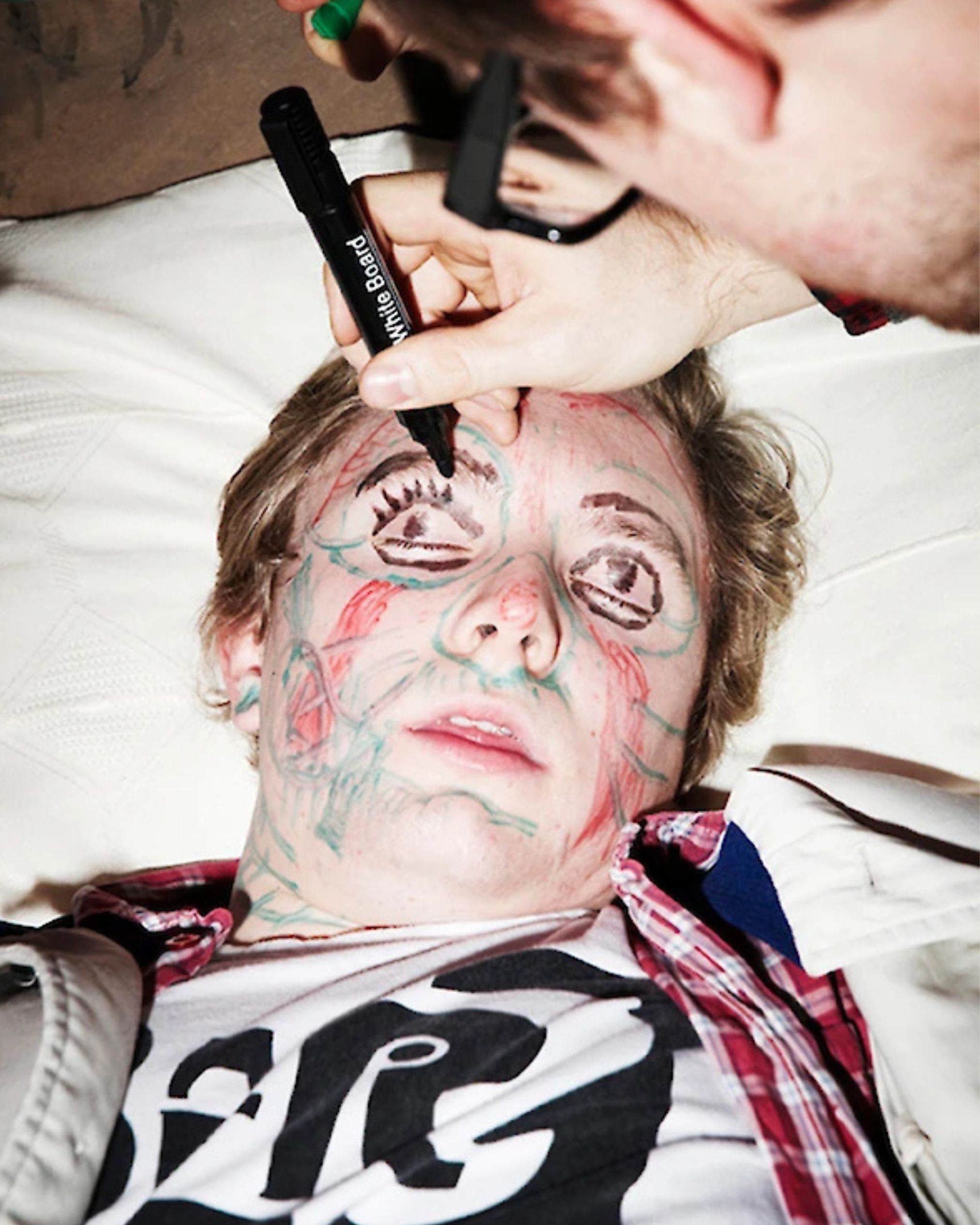
Ed Fornieles: It felt as though in the 2000s, social media became a new substrate for masks and identities to play themselves out. MySpace, Facebook and Tumblr marked the first push into our forever doomscroll.
It’s strange looking back at those spaces, which have since grown into these nightmare environments, because at the time they felt hopeful and emergent. They were strange public spaces with new possibilities. Suddenly, I could host performances in which disparate people could participate over many months rather than hours, all using this shared fluency with image and text.
What interested me was how digital culture made identity both more plastic and more fractured.
Online, you could perform yourself differently in different spaces. At the same time, there was a growing pressure to treat identity as fixed and definitive. That tension between total fluidity and hard-coded position still feels central to me.
Peter Bauman: What happens if the digital continues fracturing our sense of self? What’s the end point? Do you think that with things like AR and VR we’re heading towards full eradication or might there possibly be some way to reverse this?
Ed Fornieles: I don't think the Ready Player One version of the future is coming any time soon. What feels more immediate is the effects of AI and automation on how people understand themselves. The next possible fracturing I think won’t come only from our interactions with it. It will come from AI changing our relationship to our work, our sense of value and meaning.
We are about to enter a period of radical disorientation that has occurred with other technologies, although this time it feels like the stakes are somewhat higher.

Peter Bauman: Do you also think about post-AI in the same artistic way as post-video and internet, where these technologies have become ubiquitous?
Ed Fornieles: Totally. I think one of the biggest questions now is what it means to live and to make art in a post-AI condition. We’re still working that out.
There’s a useful model from chess sometimes called "centaur" or "advanced chess." The terms come from play popularized by Garry Kasparov in which a human works with a chess engine, using the machine for calculation while still making the final strategic decisions.
The point isn’t that the computer simply replaces the human but that a hybrid intelligence emerges through collaboration. This is perhaps a naively optimistic way of looking at things but it's my current cope.
Peter Bauman: Do you see a meaningful difference between human and AI creativity or is that the wrong question entirely?
Ed Fornieles: I think that can be the wrong question. If you walk around an art school, you see people absorbing, borrowing and mutating what came before. Creativity has always involved imitation, recombination and divergence.
What matters to me is less whether AI is “creative” in some pure sense and more what happens when it becomes part of a larger system of making.
The most interesting practices won’t treat it simply as a tool or a medium but as something embedded in a wider world of social, technical and aesthetic relations.
That’s part of why it still feels difficult to talk about. The outputs are here but the vocabulary isn’t.
Peter Bauman: You mentioned earlier that artists build worlds and video games used to be one of the great spaces for that. It could take years of coding and development to construct an entire reality.
But with AI, those worlds are increasingly buildable with natural language in minutes. What does that kind of frictionlessness do to the value and validity of these worlds?
Ed Fornieles: Reality is getting a little more plug and play. Barriers to making certain works are falling away. That’s exciting because it shifts the emphasis from the grind of logistics onto the idea itself: its force, its coherence, the sensibility behind it.
At the same time, I worry that it blocks a certain kind of immersion during the process, where you zone into making and discover things along the way. The sensation I sometimes get from making work or researching with AI is being on the outside looking in, that my thinking process is being cucked.
I often think art has something to do with human sacrifice: that work in part takes on significance because someone gives years of their life to an idea, to a way of thinking and, through that commitment, that bleeding, something meaningful might get made.
------
Ed Fornieles is an artist using film, social media, sculpture, installation and performance to express the interaction of family, relationships, memes, language and the subcultures of the 21st century.
Peter Bauman (Monk Antony) is Le Random's editor in chief.