Suggested Reading
Article
Evergreen
The Cerebral Samba: Protocol Art, Worldbuilding & Our Two Brains
Peter Bauman
•
May 18, 2026
View


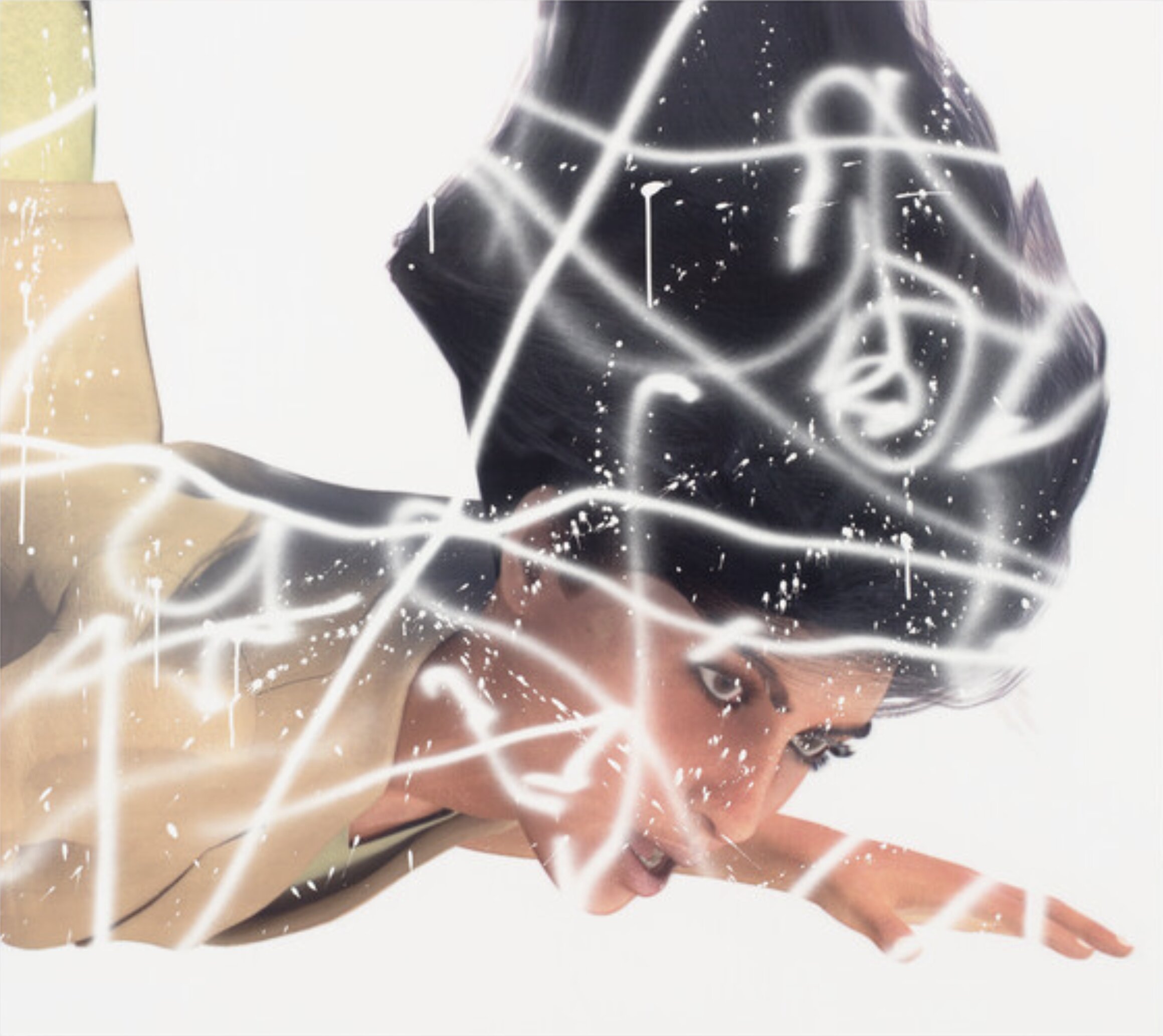
Painter Avery Singer is exhibiting a new canvas, Vanessa (2026), at the Protocol Art show, Strange Rules, in Venice. The artist spoke with Peter Bauman (Monk Antony) about her accidental path to painting and the recent integration of custom AI workflows into her practice. They discuss slop aesthetics, the dopamine blowout of contemporary image consumption, and how Baudrillard's theories of spectacle inform Singer’s long use of technology to interrogate the changing nature of image production.
Peter Bauman: In Venice you're participating with a new canvas, Vanessa, in Strange Rules, a Protocol Art exhibition. How do you see your work situated within that framework of practices engaging "with the underlying rules that dictate how culture is produced, distributed, and perceived in a digital age"?
Avery Singer: Recently, with digital imagery, I shifted away from content that I generated in character modeling software and moved into training my own AI models. I've been working with a software engineer to develop my own custom workflows in ComfyUI. I'm going back and forth between ChatGPT, Claude and ComfyUI.
I felt like that body of work would fit in with the thematics of Strange Rules. So I gave them one of the first large-scale paintings that I've made utilizing this new technique for me.
My interest is really in how we’re engaging with a new type of image production in our everyday lives. We are seeing AI-generated content everywhere and it's becoming normalized very quickly.
My work really addresses changing technology. I look at what I see around me and what I recognize as the primary model of generating imagery digitally, since I'm working with digital tools as a painter. It was like, “Okay, we've moved into this new type of image generation.”
.jpg)
Prior to that, I was using character modeling software, which felt pertinent to CGI imagery and animation, the type of imagery that I felt I saw everywhere and viewed as more cutting edge. Then it quickly changed into AI. So I became super interested in it and that's why I started using it.
I'm still applying the paint in the same way. I'm just generating some of the digital imagery with AI. I'm still also generating some of the digital imagery myself in SketchUp, where I actually sit at the computer and sort of click around a model and change things myself.
I just saw that Claude released a SketchUp plugin so I want to familiarize myself with that. But it's really just me doing the SketchUp and then there's layered imagery, which is AI-generated.
Peter Bauman: How has that technological shift impacted the aesthetics of the painted, final object?
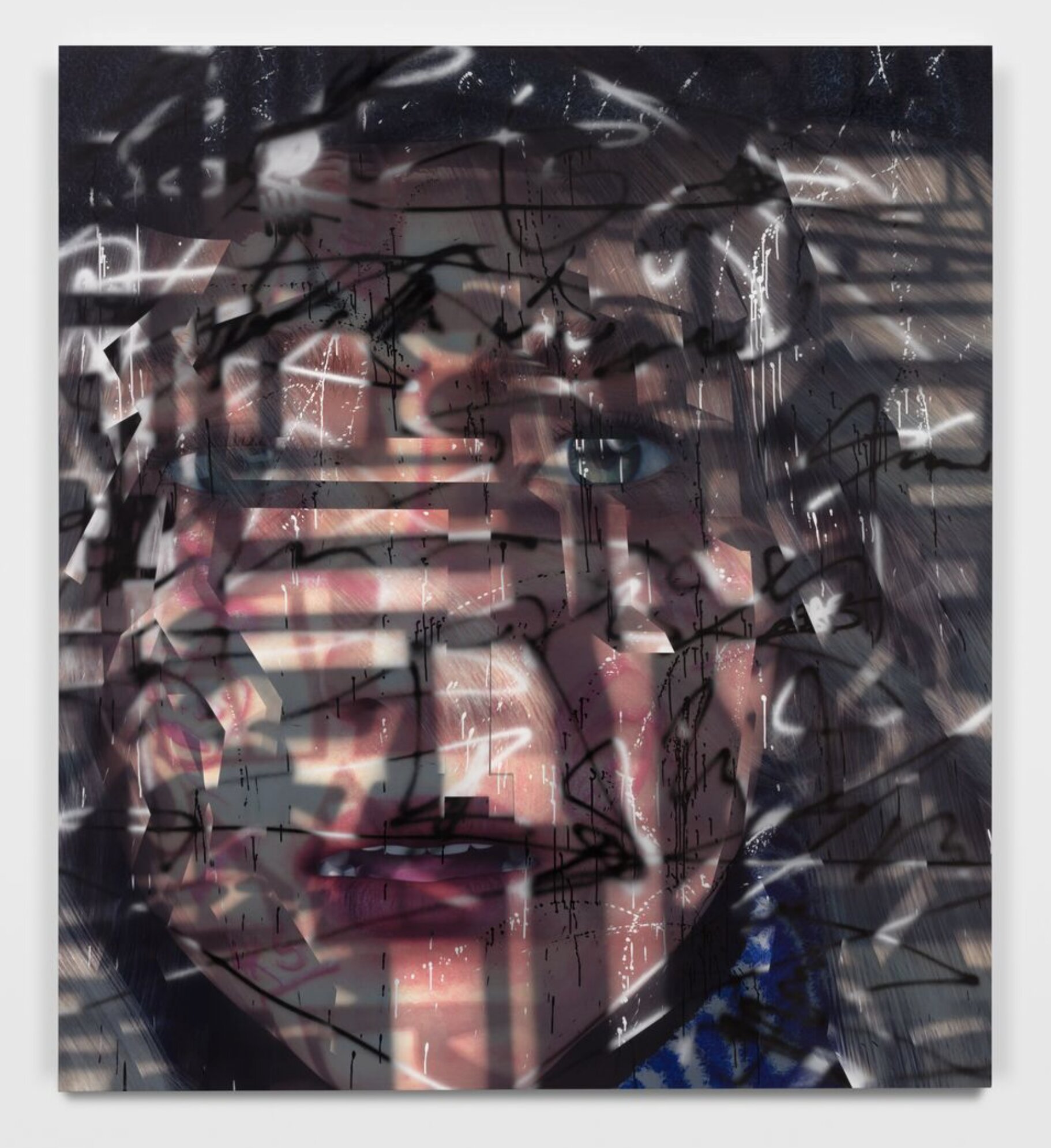
Avery Singer: The trick that I try to use is that there is a breakdown in the high-fidelity nature of the technology. With the character modeling software, you would see something called "poke-through," where polygons collide and disappear into each other. In AI, it's the slop aesthetic. So I trained the model to produce very sloppy imagery, very recognizable, low-fidelity AI aesthetics.
Peter Bauman: Is that like early GAN aesthetics?
Avery Singer: More AI from a year or two ago, where a face has eyes that aren't aligned, it's blurring out some stuff and it can’t really do text correctly yet at all. So it's that sloppy, very obvious AI look.
Peter Bauman: It seems like you have a very practical relationship with technology. You’ve talked about how in college you thought you might become “a conceptual artist or have a performance-based practice, or maybe something involving video art.”
You then described becoming a painter as “unexpected,” saying, “I never in my life thought I’d be a painter.” Yet you grew up around parent painters and you were named after a painter and clearly know its history. How is that internal struggle reflected in your practice's ongoing negotiation between digital and analog media?
Avery Singer: My early interests, as a child, were really computers and mathematics. I became interested in making art maybe when I was eleven because otherwise I’d have to, like, play on the softball team in my neighborhood, which I hated because I was just so bad. I was like, anything but softball or soccer or something.
I found cheap life drawing classes so I convinced my parents to let me do that instead over the summer. I fell in love with studying anatomy. It's very technical, very complex. There's just a lot to learn.
Then my dad gave me a Super 8 camera for my fifteenth birthday. I shot a movie with it and there's something about the unexpected nature of it. Malfunctions in the processing lab could result in this beautiful degraded effect on the film.
I thought, wow, art is really this incredible thing beyond your control.
I was very much interested in non-painting things as a student because they were not the paradigm that I was used to. I'm interested in questioning all things continually, whatever that ends up looking like. In that case, it meant getting more into video as a medium, performance as a medium, sculpture as a medium. It was all the things I hadn't done.
Then there's the reality of being an artist when you finish school with no money and only leftover materials. You end up drawing and making very inexpensive paintings. That's essentially how I got into painting: because it was the cheapest thing for me to do. And then actually just finding it really fascinating.
Peter Bauman: You went to a STEM high school and then a science and art college. You've said in The Brooklyn Rail, "Art is not logical; it's abstract and critical. You see your ideas instead of verbalizing them and you solve riddles of philosophical thinking visually." Have those two modes of thinking always felt distinct to you?
Avery Singer: Art is an endlessly open field, only if you allow it to be, right? If you don't really allow it to be, it won't offer up those opportunities to you creatively. You have to be open to that.
My attitude towards art is that it's tool-neutral. I don't really try to have rigid definitions for things. People in all fields, if they really want to arrive at a new answer or new framework, have to keep an open mind.
I don't really see the thinking as different from anyone engaging in any kind of critical inquiry.
I personally found art to be incredibly challenging and mysterious. It's almost like a mystical framework, which really attracted me to it because it was so undefinable. The freedom in that is really the most challenging and interesting thing to me.
I go with the things that interest me and try to ask myself, am I keeping an open mind with this? Are there things now with how I've been working that I need to question and reframe? Do I need to make this completely differently? Do I need to work with different technology? What is happening in technology? Do I want to meet people who are developing it? Or do I just want to experience it and reflect it to you the way I experience it?
A lot of this work is about the dopamine blowout feeling that people are immersed in today. I feel it; most people feel it. I wanted to make work centering that feeling of having all your emotions and senses blown out.
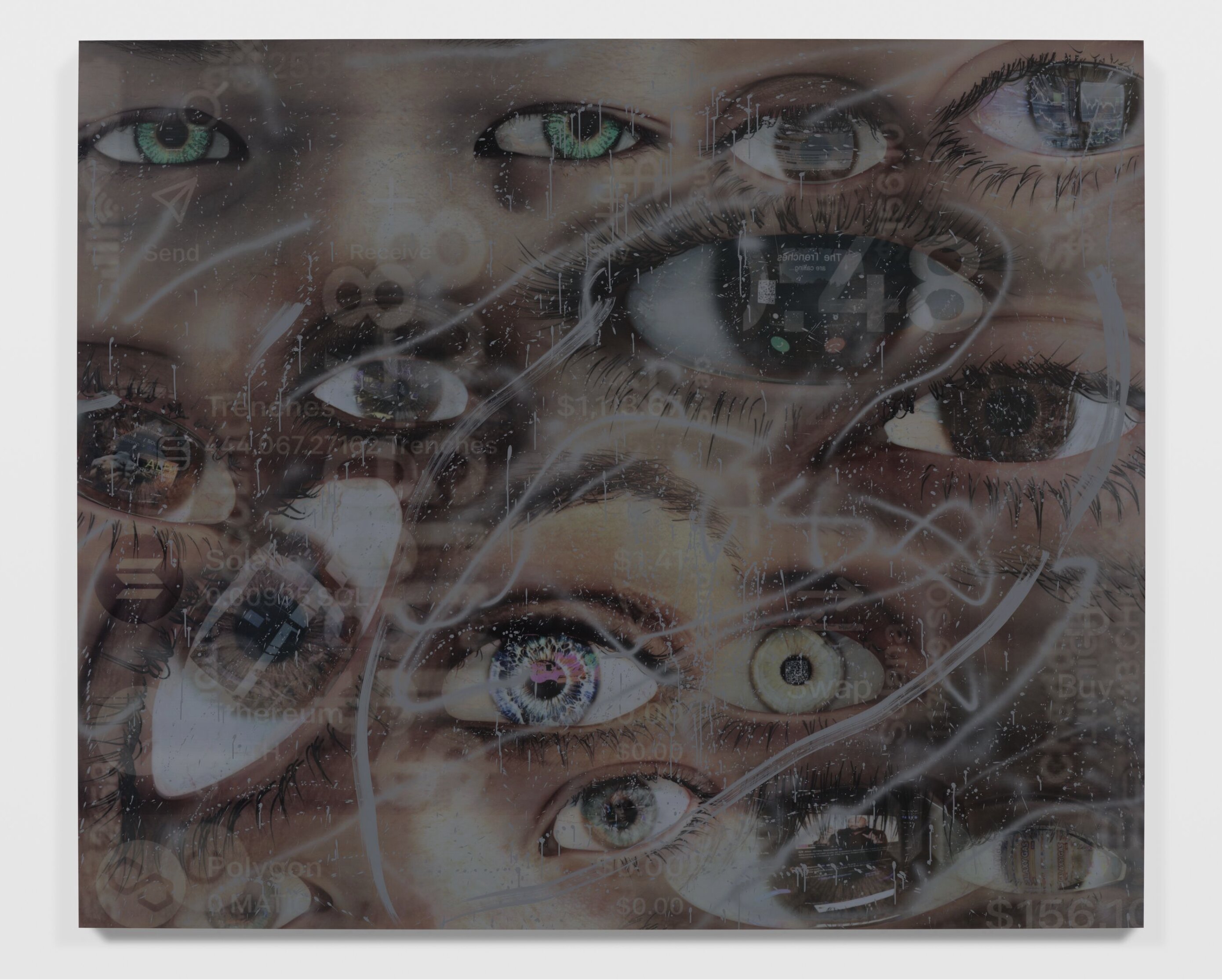
It's doing something neurologically to me. My memory isn't as good as it used to be. I get emotional very easily with stuff on the internet, more so than with movies or books or something.
I just found it to be a really interesting phenomenon. Recently, my brother sent me a podcast about the rise in political violence in the United States, and I was thinking about how this coincides with TikTok becoming popular. We're processing all this information very differently now. I thought using recognizable AI would be a way to nod to that experience.
Peter Bauman: How do you balance being abstract and cerebral with the internet, which seems to prize the meme’s ability to simplify and distill humor-wisdom?
Avery Singer: You can get very wrapped up in constructed narrative on the internet. It's really just a conscious decision to question it. What is my interest in it? Is this something I want to depict in art? Is this something interesting or meaningful to inquire into using the medium of art? Am I capable of doing it? What would the realization of that look like?
Next I start thinking of all the ways I might want to paint it and whether there's another way that I haven't tried yet. If I go forward, it’s because I'm very interested and have an idea of how I think it could be done. I start doing it and assess along the way. It’s really just trusting my gut that this is the right method for what I'm interested in doing. When I’m finished, I then think whether this is actually presenting something new.
That new thing, is it interesting to me? Did I discover something else in the meantime?
Peter Bauman: Where do considerations of hand and automation insert themselves into that internal dialogue? In some ways you go to great lengths to remove traces of your hand, only to reinsert them later.
Avery Singer: I like seeing a little bit of the painter. It just looks different with each type of painting. With the current work, I think of it in terms of a Freudian structure of an id, ego and superego.
I put the id in the haphazard, quick, gestural rubbering, masking solution layer. The ego is like the ground, the very neutral base on which everything sits. Then the superego is all the highly constructed imagery on top of it. So the id is fighting with the superego but it wouldn't even be there if the ego wasn't there as a frame, a box for it to be in.
At the end of the day, I'm working on a flat two-dimensional surface. If it's conveying something as complex as a person or a mind or something, it has to have these contrasting forces in it. I just try to play around with that.
It’s a feeling. It's not something you consciously think about. If you go too heavy into one, it loses meaning because there's no real conversation between the things happening in the painting anymore.
If you become entirely procedural, entirely gestural, entirely minimal, those are things that have already happened, a long time ago. It's just not very interesting. There are no real forces at work.
Peter Bauman: Yeah, it’s this continuation of the postmodern tradition. Why is it important to keep the final object a fixed, static painting when the process is so rooted in digital tools and workflows?
Avery Singer: Even a purely AI-outputted image with no mediation still requires the mediation of display. Whether it's shown on a screen, as a printout, on a social media account or in a gallery, you still need to think about presentation or it can't be experienced.
I mediate in painting, which has this very long, strange legacy. It precedes Homo sapiens sapiens. Painting is the language most native to me.
But I've certainly seen videos where I thought it was an incredible use of AI, where I was like, wow, that's fantastic. I'm not a video artist; I would never make that. But I'm so glad that people who are good at making video art make that.
I'm really excited about how there are artists like Anicka Yi, who's working with biological material that doesn't have a medium-specific name yet. We're going to continually have a lot of new media.
It's just that when I started painting, I was like, “Oh, this is what I'm supposed to be doing. The things I'm thinking about are translating here.” That was very clear for me.
I finally went to see the New Museum extension, where Christopher Kulendran Thomas had this really fantastic video with a lot of AI elements. The whole thing could have been generated by AI; I really don't know. I just started recognizing things that looked AI-generated. There was a hairline that started vibrating and I thought, “That's not a camera mishap; that's a digital mishap.”
Even if we get to a point where AI comes up with a better idea than me as a painter, it still has to execute the painting. But that's cool. Let it get good enough to do that.
Peter Bauman: You've also experimented with that as well with your Michelangelo ArtRobo. How automated is that process? You code an industrial plotter attached to airbrushes?
Avery Singer: Yeah, it goes on the X, Y and Z axes. You give it a 3D file for the Z-axis and then the X and Y and color output are based on an image. And it's all sprayed because I wanted to stick with airbrushing but I wanted to airbrush digitally. Sure, I could have a humanoid robot airbrushing stuff for me. Like, that could be cool. I don't know how far away that is.
Peter Bauman: When you put it like that, it makes what Harold Cohen did even more amazing in the early ‘70s.
In the ‘70s and '80s, artists like Jane Veeder and Copper Giloth at EVL started using video game systems for art. Your earlier character creation was also video game-influenced with 3D animation. Now you increasingly train datasets and use AI technologies. It seems like the full progression of digital imagery with dimensionality.
Avery Singer: Yeah, now I've been training LoRAs on real people. I created LoRAs for specific poker players that I was interested in depicting in my current body of work. Now it's really like I'm not using a DAZ 3D model; I'm using a LoRA.
Peter Bauman: You've talked about learning to "open your mind to be an artist, how to let go of the life script and just think freely." But also the importance of breaking the connection between your thought process and something accessible to the viewer. How does that negotiation work between sharing the mind but also leaving space for the viewer?
Avery Singer: People like to interpret art. That's the experience of it: you look at it, you listen to it, you feel it in the room. It gives you a feeling and then your own framework gives it a place and meaning. I look at it and gain this and that; someone else looks at it and positions it differently. So you don't want to feel like you're giving too much away. You need to allow people to ponder and experience and feel and think.
At the same time, I know there are things that people see that they don't even think about and I can work with those things. I don’t need to give straightforward answers to questions because I could change my mind tomorrow or realize something different in a week.
I think the brain likes to return to things it knows because it feels safe. Recognizing an art movement or a style satisfies the part of the brain that needs familiarity. But I think there's also a part of the human brain that wants novelty, that wants its experience elucidated.

Peter Bauman: Your work at Strange Rules, titled Vanessa, evokes the mediated violence of the last few decades. How does that relate to your ethical concerns with AI tools?
Avery Singer: Recently I've been thinking about Baudrillard a lot because of my interest in engaging with changes in spectacle culture. I revisited his thinking around the television’s reframing of war narratives, which was reconstructing people's self-identification with conflicts. Many of his ideas are still completely relevant today, just within a new technological framework. He wrote about the Gulf War as a televised war meant to bring Americans out of the Vietnam horror. We were reducing US casualties but spectacularizing the event, divorcing people from its realities.
It's something I definitely thought about as a kid. As a 9/11 survivor, I watched the Iraq and Afghanistan invasions on TV, wondering, even at fourteen or fifteen, why this was on at dinnertime. I've been in school all day and I come home and relax by watching a war on TV. And it's so not real to me.
Now we're in an age where the images of war aren't even going to have happened because they'll be produced by AI.
What am I even looking at anymore? I can get emotional and upset and involved in imagery that may never have actually occurred. We have to use AI to fact-check the AI. There are all these levels of trust and understanding, or the lack thereof. It's much easier to destroy things than to build them and I think that's the real worry with AI: it's more effective currently as a destructive tool than a productive one.
I personally am not an AI doomer or skeptic. It's just something I think about. When I see videos of kamikaze drones, I wonder whether they're using AI facial recognition technology.
Peter Bauman: What about ethical concerns like copyright?
Avery Singer: I feel like at the end of the day, I own my copyright. It's not like for sale. I cannot sell it to another person so that they can say their painting is an Avery Singer.
I don't really see how anyone else is ever going to own that so it doesn't really bother me. This happens in real life too. I was like walking down the street in my neighborhood recently and I looked in some random window and there was somebody copying my art, like really badly.
It's like, that's their freedom. They can copy my art. They can copy the techniques that I do or like aesthetics and make it look like it a bit.
But at the end of the day, I didn't make it. I make what I make. What they do is not me.
Peter Bauman: This is one of the oldest recorded debates. Aristotle disagreed with Plato about copying and mimesis. Plato felt copies were degradations of the original. Aristotle defended mimeses and argued it's how people learn.
If your work is memetic enough, it becomes a style and only more influential.
Avery Singer: Yeah, I also think of it a different way. We all see so much bullshit fake Basquiat everywhere, right? Still, when you see a real Basquiat, it's usually a really good painting. And you're like, wow, this guy was really talented. Nothing's really going to beat the original.
------
Avery Singer is a painter whose practice explores the convergence of painting and technology, with work held in the collections of MoMA, the Met, the Guggenheim, Tate, the Whitney, and the Stedelijk, among others. She is represented by Hauser & Wirth.
Peter Bauman (Monk Antony) is Le Random's editor in chief.