Suggested Reading
Article
Essay
Cognitive Technologies
Brian Droitcour
•
February 2, 2026
View



Brian Droitcour argues contemporary art with NFTs operates in the productive tension between two opposing aesthetics: schizocollage (which foregrounds visible seams and difference) and generative AI (which synthesizes difference into coherent wholes). The most compelling work—Mons and Little Swag World by Supermetal Bosch, as well as Ugly Bitches and Little Darlings by Ann Hirsch and Maya Man—uses this tension to surface and critique how desire, identity and collectibility function in culture.
The avant NFT scene that has coalesced on Solana flaunts a schizocollage aesthetic: dissonant styles and references that don’t make sense together. It’s funny how this has become a significant idiom for digital art alongside the rise of generative AI.
Avant NFTs are held together by visible seams. Difference is an essential part of the composition. Generative AI, on the other hand, aspires to synthesis.
Artists who use it may follow some steps of the collaging process: assembling mood boards, reference clusters and other piles of images. But then they feed these to a model that learns patterns from them and generalizes, spitting out images that, strange as they might be, are continuous and coherent rather than visibly stitched.
One mode foregrounds disunity. The other metabolizes it.
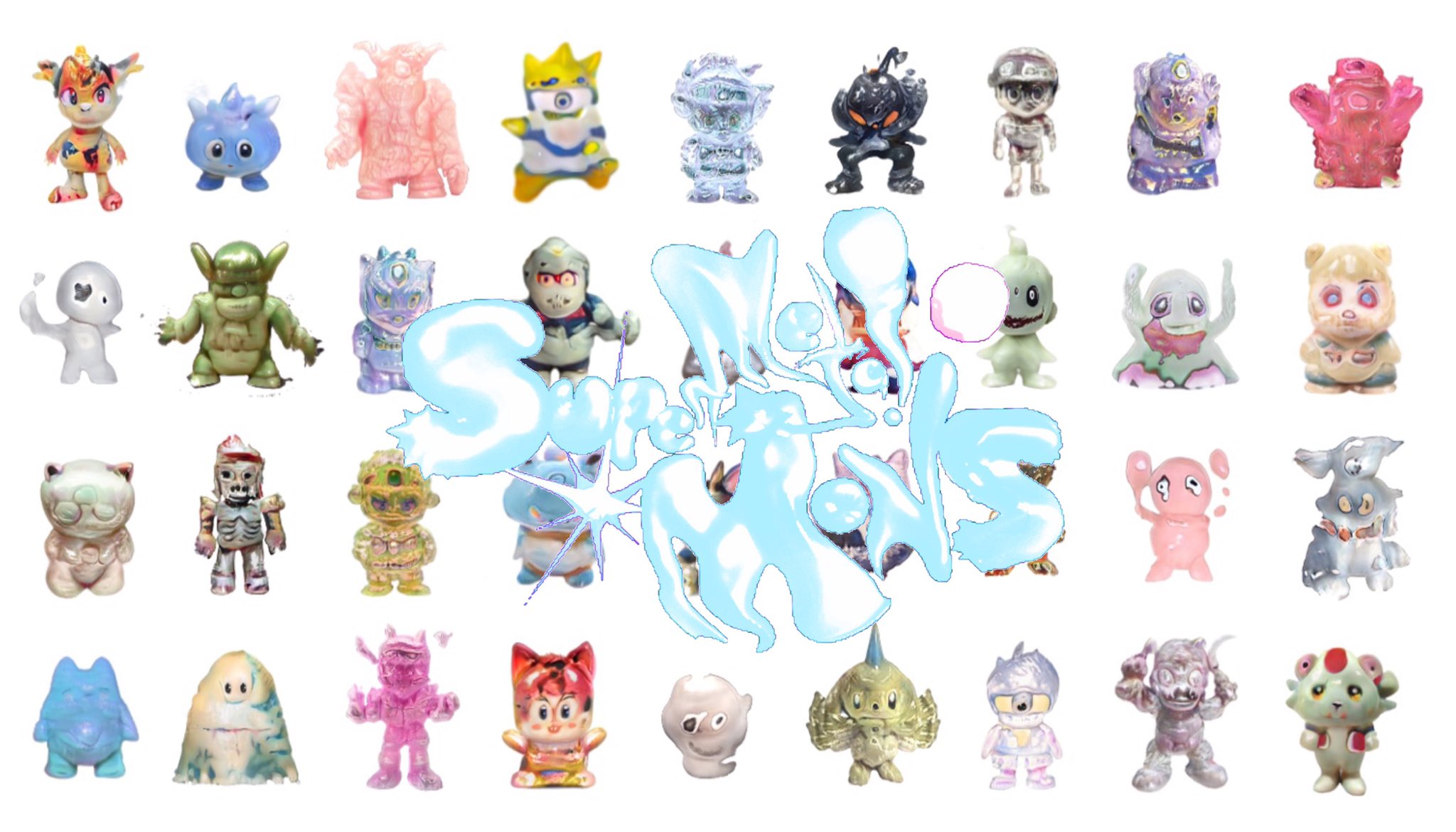
Some projects that sit adjacent to (but not inside) the avant-NFT milieu use generative AI to illuminate this tension between these two contemporary aesthetics. Mons and Little Swag World by Supermetal Bosch, as well as Ugly Bitches and Little Darlings by Ann Hirsch and Maya Man, take the collaging instincts of PFP culture—traitmaxxing, the layered artifacts—and set them against procedural smoothing.
The result is work that considers how difference and sameness are constructed online. The art is cute, collectible, funny and seductive. But it also carries sharp conceptual commentary about identity, systems and the visual grammars that govern both.
This tension between visible seams and synthesized wholes was unusually explicit this summer at Galerie Yeche Lange’s two-man show, One of Us Is Real and It’s Not You, which placed Bosch’s Mons and Little Swag World in dialogue with the maximalist, lore-soaked collages of another artist-persona, Evil Biscuit. Seen together, the works traced two diverging paths for NFTs at a moment when artists are renegotiating the relationship between PFP conventions, generative tools and the logic of collectibles.
Evil Biscuit’s Drifella collages are deliberately sprawling. They revel in the matter of difference: fragments from popular cartoons and games are layered with memes and NFT mythologies in images that insist on their own stitched-together-ness. The original Drifella collection was introduced in 2023 with a legend about the death of Dratini, an aquatic serpent character from Pokemon, who got resurrected with the soul of Mifella, a character from another avant NFT collection. The story insists that the afterlife of millennial fan culture can only unfold through proliferating digital multiples. Biscuit’s method sits squarely in the schizocollage tradition: difference as value, seams as meaning.
Bosch’s Mons series takes an opposite approach. Pokémon appear only as training data rather than as characters. Rather than designing figures, Bosch fed images of cartoon monsters into a GAN to study how character design functions at the level of pattern and rule.
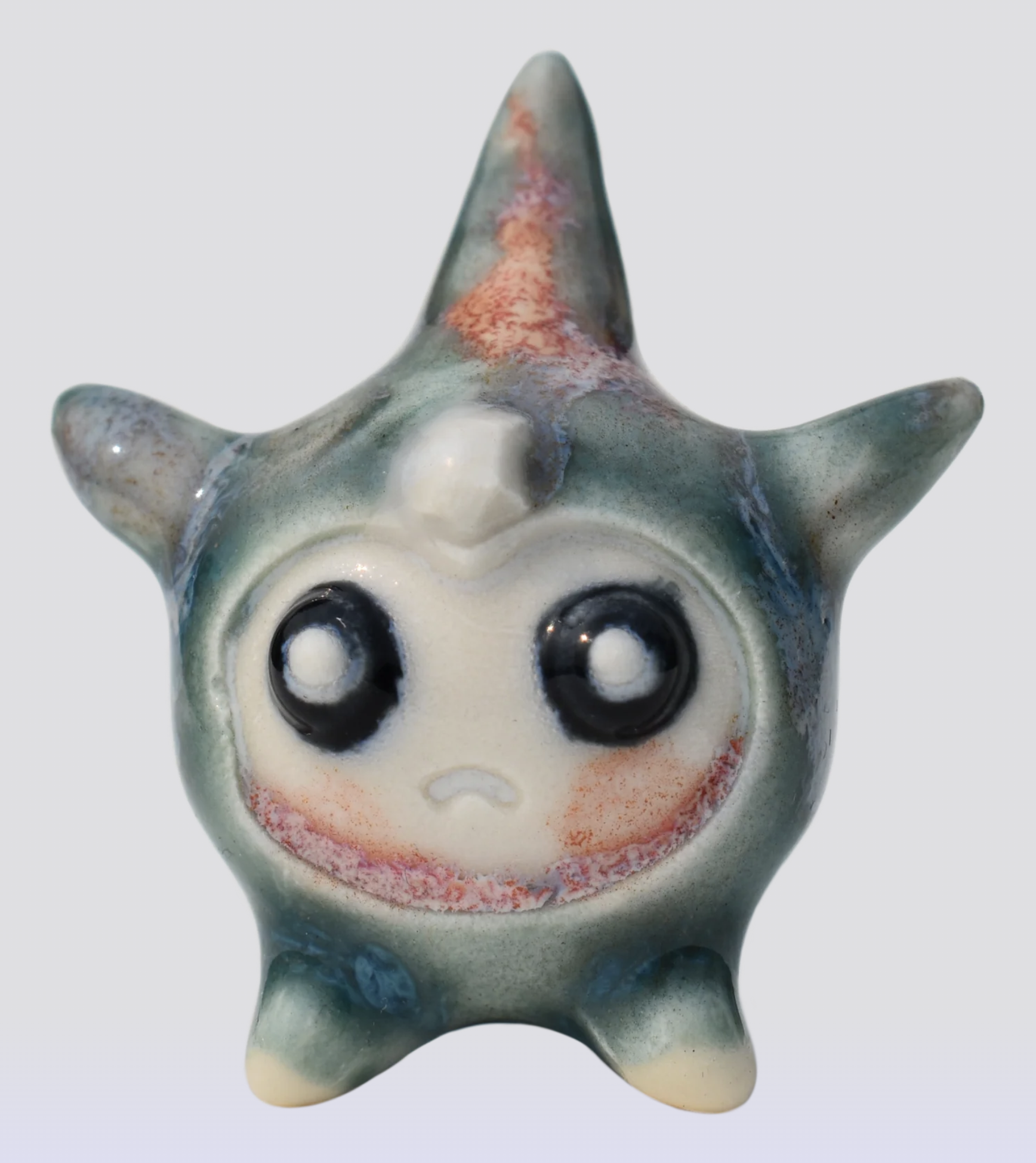
The model produces creatures in formation: blurry, porous, half-realized, often missing an eye or dissolving into their own borders. Their appeal lies in this in-betweenness. They look like they are still becoming.
If Biscuit’s Drifella raises Dratini from the dead, Mons holds Dratini in limbo—a ghost in the dataset, diffused and distantly haunting the outputs.
Little Swag World also uses AI but in the opposite direction. Bosch began with mood-board collages of fashion fragments, then instructed the model to smooth them into holistic figures. On X, Gardenparty85 has mapped out many of the references embedded in the designs: Rick Owens, Margiela and Vivienne Westwood; George Condo’s album art for Kanye West; a plush bear from the studio of Takashi Murakami; pop culture motifs, including a hat in the shape of a coiled Dratini and a horned, helmet-like headpiece that nods to Frank Frazetta’s barbarian art.
The reference field swings back and forth between high fashion and boyish fantasy, mapping a particular terrain of masculinity where grown men perform identity through objects that aestheticize arrested development.
The model smooths the collaged seams into unified figurines: cool little guys rendered as collectible objects, both digitally and, eventually, physically. All of them are pieces in games with both digital and tabletop versions.
Across both Mons and Little Swag World, Bosch treats AI as a way of probing the mechanics of desire in the NFT space: the hunger for characters, for cuteness, for figurines—for self-expression through the acts of trading, ownership and play.
Insert here a version of the bell-curve meme, where the midwit in the middle seethes about the unique complexity of the NFT as a hybridized artistic-financial object, while the moron and the genius flanking him say, “NFTs are just digital Beanie Babies.”
Some of the strongest work in the NFT space embraces this logic, dancing with Pudgy Penguins in the toy aisle at Walmart.
These projects use AI less as a production engine than a key to access the collective unconscious to understand what people want, what they buy, what patterns catch and train attention.
Here, AI is diagnostic as much as it is generative. This mode is especially clear in the collaborations of Ann Hirsch and Maya Man: Ugly Bitches (2023) and Little Darlings (2024). The visual language of Ugly Bitches emerged in part from encountering Mons on the timeline. Hirsch and Man imagined a GAN-made PFP that would hover between meme and character rather than conform to trait-based logic.

They embraced a deliberately wonky aesthetic—“ugly” dolls as a pointed critique of girlboss collections like World of Women, which turned polished femininity into a collectible virtue.
The pair’s GAN-processed composites of Bratz, Barbie and internet girlhood pose against DALL-E-generated influencer backdrops: hotel lobbies, airplanes, gyms, pools. The scenes are slightly off but coherent enough to sharpen the dolls’ jankiness.
That logic intensifies in Little Darlings, which plays a parallel game with masculinity. Stable Diffusion–generated figurines, derived from male-coded collectibles and hypermasculine imagery, pose in settings from video games and action movies. The project both mocks and indulges the NFT collector’s affection for “little guys,” producing objects that satirize the form while still delivering its pleasures. These works rest on a shared premise:
AI trains on what is already visible, just as influencer culture trains people to conform to ready-made templates. Desire, in both systems, becomes procedural.
Text functions as a structural layer across both projects. Overlays generated via automated Photoshop scripts draw from banks of Instagram comments. In Ugly Bitches, saccharine praise is algorithmically bent into sideways insults; in Little Darlings, the rhetoric of adoration in bodybuilder thirst-post comments is already so extreme it didn’t need modification.

The result is a visual form that reads like a meme without quite becoming one and behaves like a PFP without adopting trait logic: a hybrid genre where influencer desire and collectible desire are scrambled into the same image.
The figure/ground play in Ugly Bitches and Little Darlings recalls projects like Mifella and other avant NFTs, where backgrounds function as traits, adding complexity, atmosphere and variation. Visually, the resemblance is real. Conceptually, the logic is not. These newer works borrow the look of trait culture while quietly refusing its mechanics.
Crucially, projects like Mons, Little Swag World, Ugly Bitches and Little Darlings are not trait-based. They hover adjacent to PFP logic without submitting to the transparency that makes traits so powerful. Traditional PFPs thrive on visible rarity markers that are equally legible to humans and machines. Platforms like OpenSea and Magic Eden hard-code this logic into their interfaces. Traits aren’t just aesthetic devices. They are infrastructural.
AI-generated projects rupture this system. Traits dissolve into the black box.
Instead of explicit attributes, artists and audiences must invent traits retroactively, feeling for structure rather than reading it. Some collections have already tried to escape the rigidity of the trait matrix. Milady’s “drip score,” for instance, shifted attention from isolated attributes toward vibe, style and fashion-world reference. And many avant NFT collections emerged in that slipstream.
Bosch’s Little Swag World pushes this further. The collaged “swag” stops functioning as a discrete trait and becomes inseparable from the figure itself, smoothed by AI into a holistic form. Rarity no longer sits in the hat or the jacket. It dissolves into coolness, into desire, into lore.
This shift marks a broader transformation in how NFTs relate to collectible culture. If early crypto aesthetics prized visible difference, these newer projects traffic in synthesized desire. Traits don’t disappear. They melt.

The hybrid field between art and collectibles is the most fertile territory for NFTs. Schizocollage and AI offer different relations to the market’s collective unconscious but both can end up as something you can hold.
Many of these artists move fluently between digital images and physical objects: ceramics, plush dolls, 3D-printed figures. Hirsch and Man produced a soft, quilted version of Ugly Bitches, separating text from image and translating the rigid grid of an OpenSea-style interface into something wrinkled, padded and haptic.
Bosch similarly extends his worlds into matter. Mons exists both as digital collectible and ceramic game piece, where the fuzzy porosity of GAN imagery meets a material process with its own wobble. Similarly, the figurines of Little Swag World mirror the logic of AI upscaling and can be 3D-printed with high precision.
Schizocollage builds lore from the debris of online visual culture. AI analyzes what people already produce, circulate and buy, then distills those desires into alternate forms.
In both cases, generative systems are used to comment on desire while simultaneously courting it. Earnestness threatens to soften the artist’s position; AI provides a buffer that keeps the critique intact.
What emerges is a space where the aesthetics of difference and the aesthetics of synthesis don’t cancel each other out but braid together. Seams and smoothing become parallel tools for addressing the same question: what do people want from their little guys, their monsters, their dolls, their darlings? And how can artists remain inside the tension—between satire and sincerity, collectible and commentary, lore and algorithm—without resolving it?
Traditionally, fine art traded in uniqueness: the singular hand, the singular vision. Industrial fabrication and studio production destabilized this long ago, reframing uniqueness as the property of a concept rather than of an object. The culture of collectibles went in the opposite direction. Teams, companies and franchises displace authorship, while scarcity is engineered through editions and packs. Lore eclipses the maker.
The physical iterations of Mons, Swag, Ugly Bitches and Little Darlings reveal a compressed form of product development, collapsing market research, branding and manufacturing into the artist’s studio practice. The NFT becomes both collectible and prototype.
These projects deliberately inhabit multiple economies at once. They understand that the collectible can function as a little artwork and the artwork as a little toy.
Digital art—whether through the jagged multiplicity of schizocollage or the softened coherence of generative synthesis—becomes the mechanism through which cultural desires surface, to be scrambled and given form.
------
Brian Droitcour is a critic and curator specializing in digital art.